Frederick Burnaby obeyed no boundaries. But Russian edicts were not mere suggestions.
An Unconventional Titan of the Victorian Era
Standing six-foot-four with the presence of a man who could command rooms as easily as he could shape destinies, Frederick Burnaby was everything one might expect of a Victorian adventurer. He hailed from the British Army, a place where his talents were used and at times wasted, given his penchant for wandering beyond conventional borders. Burnaby was not just a polyglot or a dreamer; he was a man who itched for the earth between his fingers and the thrill of something undiscovered. Victorian Britain, swathed in imperial interests, saw its officers bound by duties — but Burnaby danced to a different tune.
At the time, the geopolitical game between the British Empire and Russia, known as "The Great Game," was at a tense crescendo, particularly over Central Asia. The steppes were a contentious no-man's-land, with the Russians imposing a ban on all British officers wandering within its spaces. For most in Burnaby’s boots, the call to halt would be a strict command. However, for Burnaby, it was an invitation. Wariness of Russian ambitions made the steppes an intractable tapestry of intrigue and mystery. Burnaby, with a flare that bordered on conceit, would not be deterred by any obstacles set before him by faraway powers.
A Solo Daring Ride
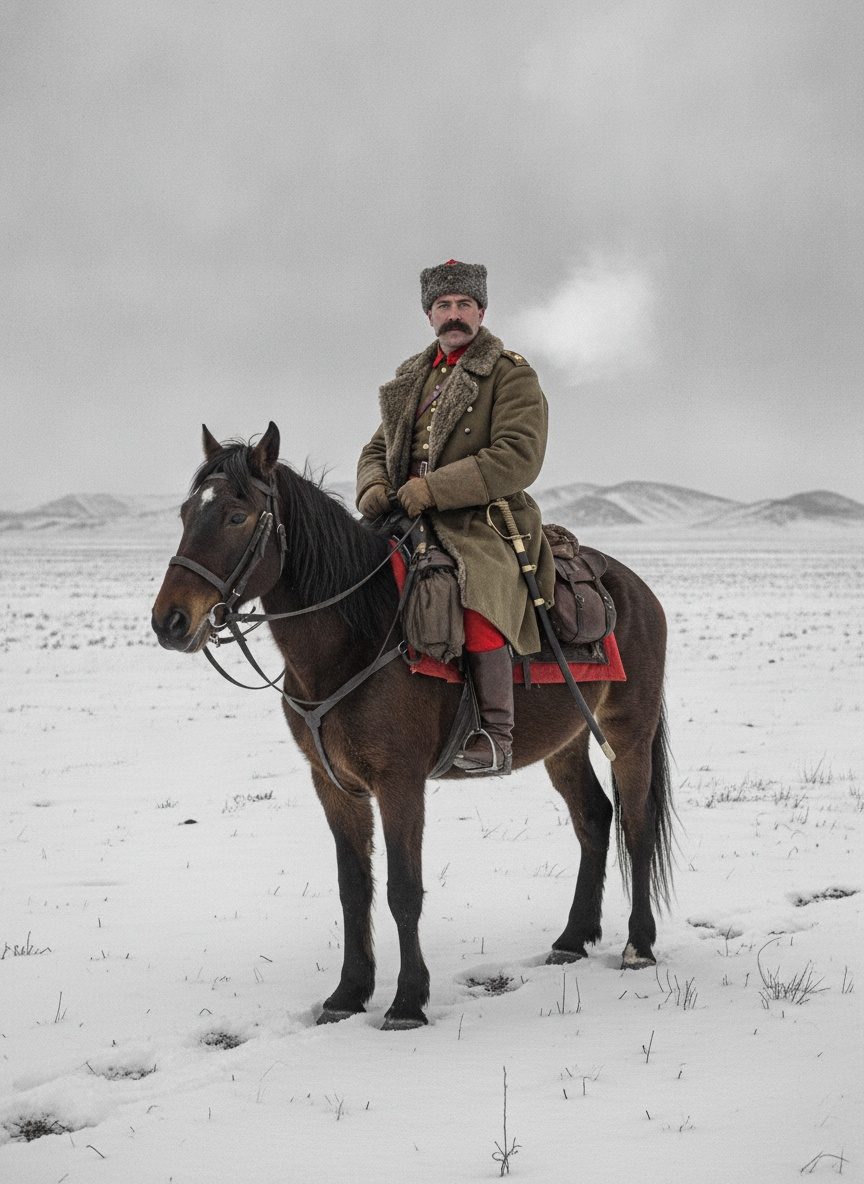
In the winter of 1875, when others wrapped themselves warm against the English chill, Burnaby took to his saddle, prepared for the fierce frost that awaited him in Central Asia. His plan was as bold as it was perilous: a lone ride deep into the Russian-controlled steppes, a thousand-mile ordeal through stark landscapes, icy winds, and a political climate that sanctioned his capture on sight.
Equipped with little more than a trust in his linguistic prowess and an insatiable curiosity, Burnaby ventured into a world defined less by borders and more by expansive skies and indomitable spirit. The scenery changed from the known dimensions of civilization to the surreal expanse of the steppes, where survival could be uncompromisingly elementary. Yet, his journey was not marked solely by its physical demands; it was a passage through a patchwork of cultures, a clashing and meshing not often seen through a Western lens at that time.
The solitude of his journey etched itself deeply into Burnaby’s character. It was a lesson in resilience where human will collided with nature’s immensity. Each town he passed through, each interaction with local tribes and their rich traditions, served as milestones on a trail unseen by most of his contemporaries. To understand this venture was to see the manifest heart of an empire’s tension reflected in the unyielding eyes of one daring soldier.
A Defiance That Resounded
Frederick Burnaby’s journey was more than an act of personal defiance; it became a myriad icon of individualism against empire and geopolitics. The contradictions he embodied — an officer of imperial power, yet an advocate of personal exploration beyond the tight reins of authority — made his endeavor unforgettable. In riding into the teeth of a political tempest, Burnaby demonstrated an early iteration of global awareness, at once beholden to no land and curious about every land's laws, traditions, and conflicts.
Mingling with the denizens of the steppes offered insights that books and maps alone could not convey. This was Burnaby’s unspoken triumph: turning imposed boundaries into dialogues through inquisitiveness, advancing the breadth of understanding by digging into the soul of a place rather than merely trampling over it. His successful return — a testament to both personal grit and unexpected goodwill — would color his famed recounts, an inspiration to aspiring adventurers constrained only by the latest edicts of diplomacy.
What Frederick Burnaby undertook was much more than a reckless traverse of forbidden territory. It was a forceful reminder of an age driven by men and women who challenged the notion that adventure ends at a line on a map. The steppes were mere land, but Burnaby made them a stage for human drama, revolutionizing our sense of what could be faced with courage and humility. His story reminds us to look beyond the fences built by nations and to seek the humanity that binds us in every corner of the world. Burnaby's ride into the Russian steppes wasn't just a defiance of command; it was a celebration of what it means to explore beyond one's horizons, confined only by ambition and the sky.