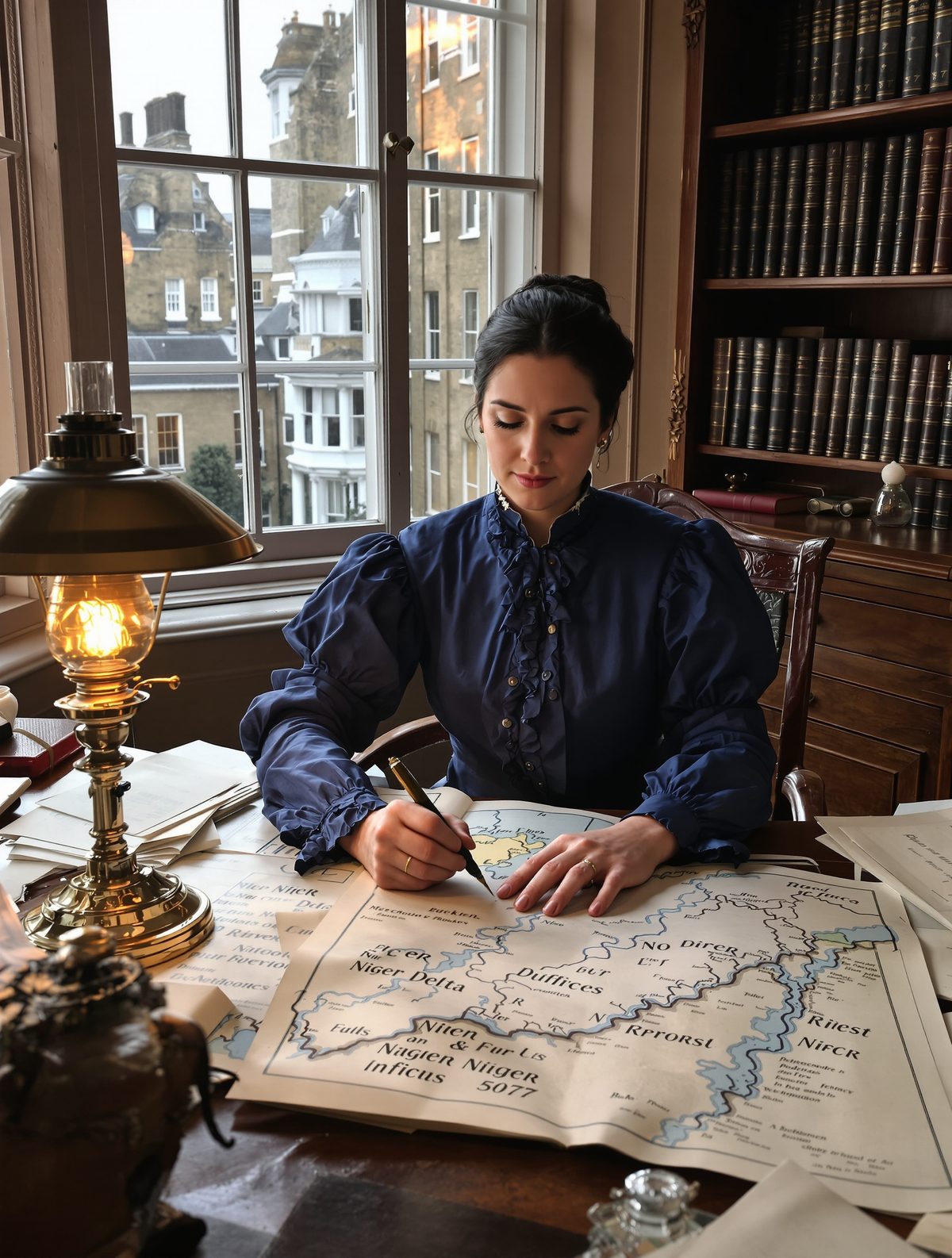
In the waning years of the 19th century, as the British Empire grappled with the complexity of its imperial acquisitions in Africa, a name was needed for a territory sprawling along the Niger River. It was February of 1897 when Flora Shaw, a perceptive and ambitious journalist, dipped her pen into the inkwell to propose a term that would shape the identity of a future nation. In the pages of The Times, she wrote a single, powerful word: Nigeria.
The Power of a Word
Picture London at the turn of the century: bustling streets filled with horse-drawn carriages, the clatter of industrial progress echoing around every corner, and discussions of empires resounding in every gentleman’s club from Berkeley Square to St. James's. The British interest in Africa was at its zenith, following the Berlin Conference of 1884-85, which had set the rules for the so-called Scramble for Africa. Colonial powers were competing frenetically to claim parts of the continent that were depicted as mere swaths of color-coded emptiness on European maps.
Within this context, the territories organized under the Royal Niger Company were vast but nebulously defined. Prominent figures like George Taubman Goldie had worked arduously to assert British control, yet the region lacked a unifying identity. It was Flora Shaw who offered a deceptively simple solution. Drawing inspiration from the river that coursed through the heart of this territory, she coined the term "Nigeria," effortlessly linking the region's natural geography with its emerging political boundaries.
A Woman's Pen in a Man's World
Flora Shaw was no ordinary correspondent. Born in December 1852, she was a woman of intellect and substance, whose path-breaking career was remarkable in a male-dominated Victorian society. By 1897, she had carved out a niche as the colonial editor for The Times—an impressive achievement, reflecting both her journalistic acumen and the shifting societal norms of the day.
Shaw's columns were read widely by policymakers and the influential elite, bolstering her voice in the empire's capital. Her proposed name for the Nigerian territories was not birthed in a vacuum; it was rooted in a deep understanding of both the geographical layout of the region and the political inclinations of her contemporaries. Shaw's suggestion was simple and resonant, evoking a sense of cohesion for an area which was, in essence, a tapestry of disparate tribes and kingdoms.
The Impact on the Internal Landscape
At the time Shaw penned her proposal, the lands that would become Nigeria were home to more than 30 million people—a mosaic of ethnic groups including the Hausa, Igbo, and Yoruba, among others. Prior to the establishment of the colonial framework, these groupings had lived according to their indigenous systems of governance, with rich histories and elaborate cultures. To them, the notion of being confined within a single entity called "Nigeria" was alien.
The creation of Nigeria also meant the re-imagination of existing boundaries, often arbitrarily drawn by colonial mapmakers with scant regard for existing cultural and linguistic divides. What ensued was a clash of civilizations, as British administrators sought to impose their models of governance and economic extraction. Yet, ironically, it was a woman—an unanticipated authority in this masculine epic of conquest—who, with a stroke of her pen, helped crystallize a national identity.
The Irony and the Legacy
Despite Flora Shaw's indispensable contribution to the creation of Nigeria's identity, her role is often overshadowed by her marriage to Frederick Lugard, a notable colonial administrator of the era. Lugard would later serve as the first Governor-General of Nigeria, governing the very territories his wife had helped to conceptualize. The Lugards were emblematic of the entwined destinies of journalism, colonial policy, and personal ambition during this fervent period of empire-building.
Yet, Shaw’s legacy as a name-giver illustrates the enduring influence wielded by this journalist, and her lasting impression on the colonial apparatus. Her ability to succinctly encapsulate the colonial complexities into a cohesive nomenclature was no minor diplomatic achievement. The nomenclature provided both a psychological anchor and a tangible symbol around which colonial administrators could rally as they attempted to negotiate their dominance over the region.
Why It Matters Today
In today's context, the choice of names holds as much influence and weight as it did in the Victorian era. Names confer identity and heritage, and within their syllables resonate the echoes of history, aspirations, and the potential for the future. Flora Shaw’s Nigeria is not solely a testament to colonial impositions but also a starting point for understanding the intricate tapestry of modern African politics and cultural identity.
As Nigeria approaches the challenges of the 21st century—of economic development, social cohesion, and political stability—the story of its naming is a reminder of the enduring complexities embedded within its foundation. In pondering the act of one journalist over a century ago, the world is reminded how power is not only born from the sword or the seal of governmental decree, but sometimes, power emerges quietly, yet permanently, from the ink of a pen.