He was a man who sought warmth in the Arctic's relentless chill. Henry Hudson, perhaps surprisingly, had always been more at home amidst the frozen void than in the comforts of England. In June 1611, this eccentric English explorer, whose ventures into the unknown had pushed boundaries, met an ignoble fate at the hands of his own crew.
Hudson's explorations in the early 1600s were set against the backdrop of the age of discovery, the allure of empire, and the relentless quest for a Northwest Passage to Asia. This passage promised untold riches and new trade routes, a seduction that Hudson seemed unable to resist despite the many previous failures of others. His fourth and final voyage, which began in 1610 aboard the aptly named Discovery, saw him venture further north than any Englishman before him. As we trace his journey, it’s important to recognize the duality of Hudson's nature—a man driven by ambition, yet at odds with the very men who sailed alongside him.
The voyage was fraught with difficulties from the start. The Discovery crew, composed mainly of hardened mariners with little patience for the perils of Arctic exploration, found themselves at odds with Hudson's relentless pursuit. The sea turned treacherous as they neared the frozen labyrinth of what would later be known as Hudson Bay. Hudson himself was, by accounts, a divisive figure; his leadership style was autocratic, creating tensions that simmered dangerously over the course of the harsh winter they were forced to endure when ice trapped their vessel.
As months passed, supplies waned, and grievances among the men festered. The winter of 1610-1611 was particularly brutal, marked by bone-chilling winds and unyielding ice. Days and nights blurred into a monotonous twilight under the oppressive grip of the cold. Hudson’s approach to leadership did little to soothe the crew’s growing discontent. Rations were thin and hunger gnawed at their resolve. For some, this was more than just an expedition; it became a struggle against the indifferent elements of nature and the obstinate will of their captain.
Despite the looming threat of mutiny, Hudson pressed on with a near-irrational determination. It is said that he discovered the vast bay, stretching endlessly with frozen waters shimmering under the thin arctic light. But discoveries and ambitions meant little to men on the brink of starvation, trapped in a relentless winter void of hope or escape. Under these conditions, a spark was all it took to ignite the mutiny that had been brewing for months.
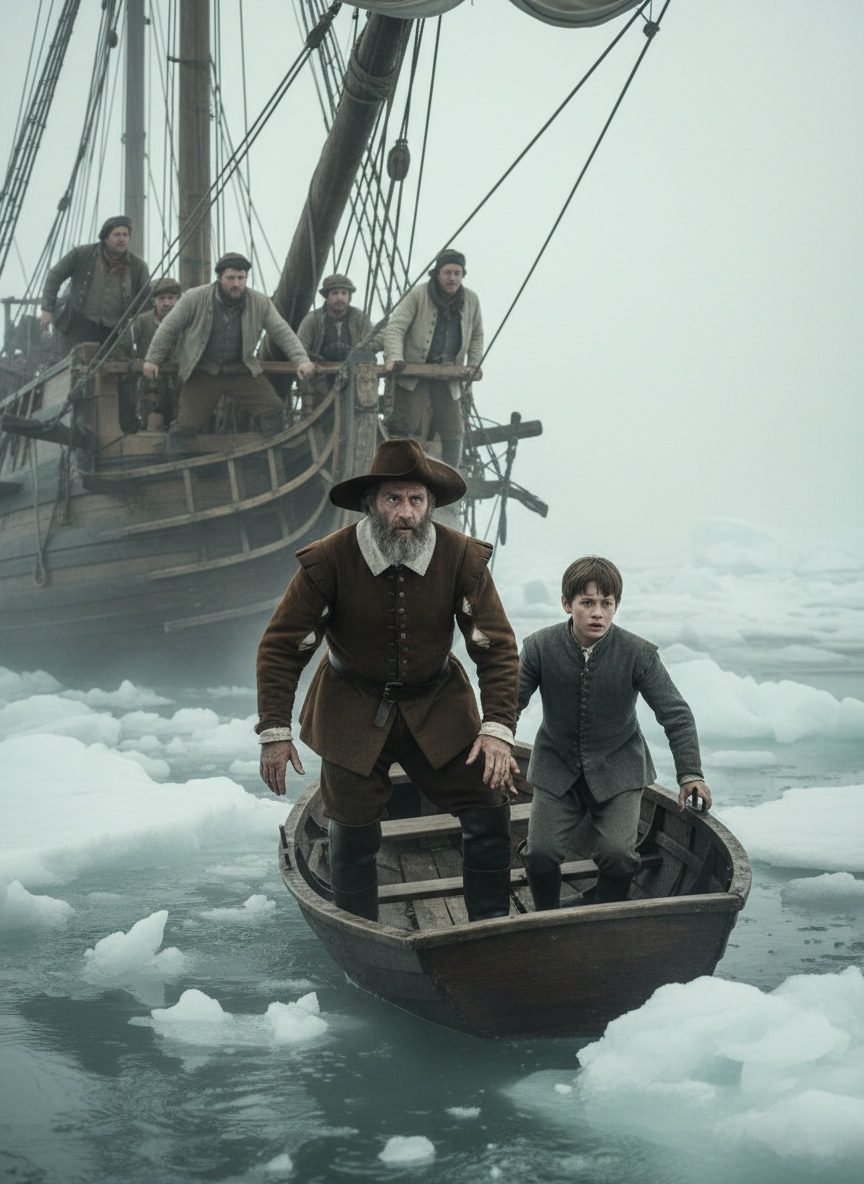
In June 1611, the crew reached a breaking point. A grim decision was made; Hudson, his teenage son, John, and a few loyal crew members were herded onto a small shallop — a death sentence in the merciless waters that bore his name. As the Discovery sailed away, the ice-capped bay swallowed Henry Hudson into its folds. The howling winds of that frozen wasteland became his final requiem, his fate lost to the annals of mystery and myth.
The mutineers returned to England, their stories as cold and fractured as the ice they had left behind. Little did they know, they had etched their place in history, one not of triumphant return but of intrigue and scandal. The disappearance of Hudson sparked rumors and whispers across Britain and Europe. It challenged the concepts of leadership, loyalty, and the human spirit amidst the extremities of exploration.
The legend of Henry Hudson is not just a tale of discovery and betrayal; it questions the human condition when pushed to its limits. His story encapsulates the eternal struggle between a leader’s vision and the stark realities faced by those he led. The frozen expanse of Hudson Bay remains, a testament to the mysteries of ambition and the unforgiving nature of exploration where dreams can be as crushing as the ice that sealed Hudson's fate. As the icy waters claimed him, they also embraced the legacy of a man whose life was defined by his relentless pursuit of the unknown, even unto his last breath.