Many ships have been lost to the sea. Few leave legends behind.
A Cruel Twist of Fate
It was a clear and calm night on February 26, 1852, when fate cruelly drew its hand across the ocean off the South African coast. HMS Birkenhead, a British troopship, was thick with life—the definitive hum of duty-bound soldiers mixed with the gentle lullabies sung by women for their children. Aboard were up to 643 souls, in transit to Queen Victoria’s outposts, when suddenly, disaster struck. Near Danger Point, the vessel collided, brutally, with an unyielding submerged rock. The rock clawed into the iron hull like a predator after its prey, unfolding a sequence of events that would cast the sinking into infamy.
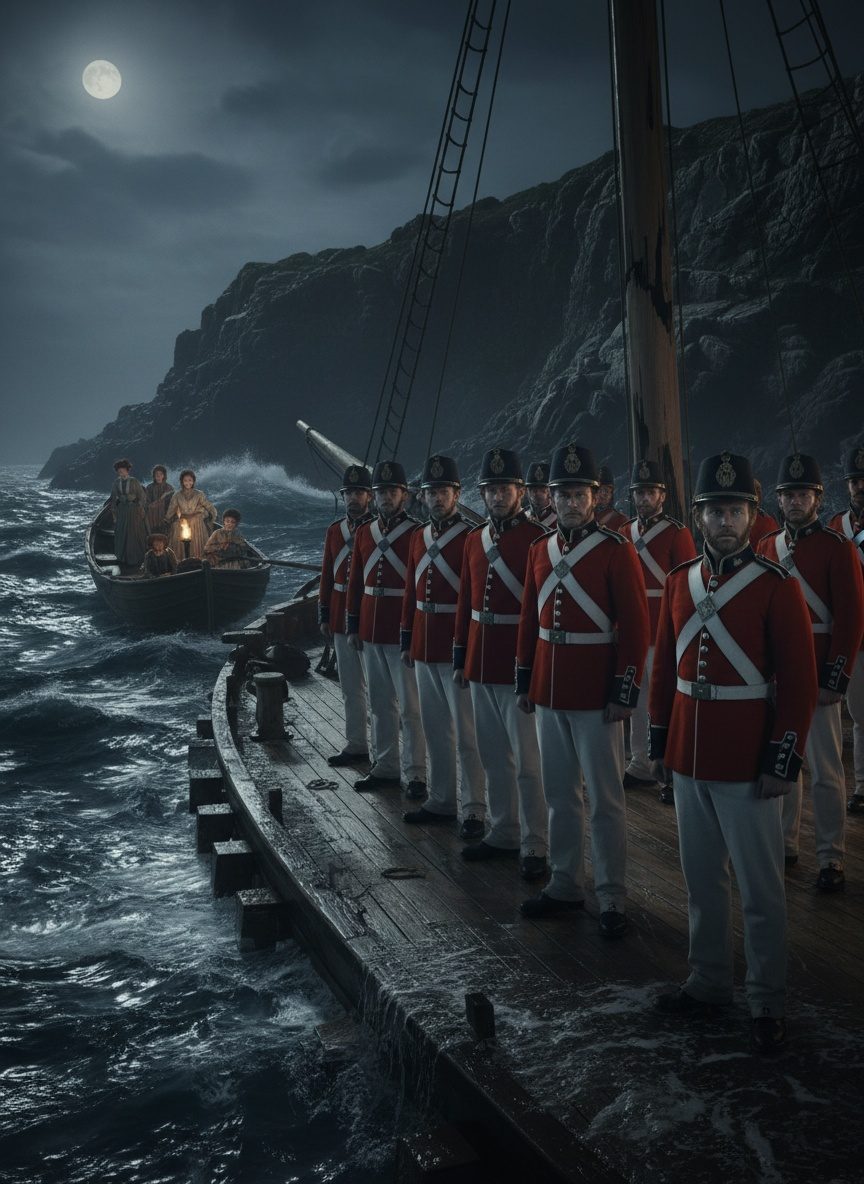
Within minutes, the ship listed treacherously. The cold Atlantic water surged in—a dark tide that consumed everything in its path. Captain Robert Salmond quickly understood the gravity. Yet amid this chaos, an extraordinary and unexpected drama began to unfold. When counted, lifeboats numbered too few, a merciless detail that spelled doom. Not enough to carry all, but vital for whom they might—wives and children. In that moment, unthinkable yet profoundly noble resolve gripped the soldiers packed on deck. Without a command, an almost supernatural discipline took hold. Three British regiments—staunch and unwavering—formed ranks on the sinking deck. Their resolve was clear: women and children first.
The disciplined formation surely invoked the stirring vision of the Empire itself in that fateful hour—a fervent dance between honor and mortality. Around them, sporadic cries of desperation filled the air, yet none broke ranks. It was this fortitude that birthed a most remarkable maritime phenomenon—what came to be known as the "Birkenhead Drill".
The Immovable Human Wall
As the icy water continued to rise, the ship sank deeper into its liquid tomb. But instead of panic and chaos, those left behind were a silent bastion of dignity. Even as the waters claimed the deck, no fear was visible on their faces. These soldiers had become a human barricade against the river of uncertainty. It wasn’t just order they stood for—it was a solemn pledge to protect, even in assured demise. This silent contract was honored in the starkest fashion possible.
Those few lifeboats navigated the churning swells with their precious cargo—women, children, and even a fortunate few men, rowing onwards to the promise of continued life. Yet death lingered ominously for the rest; 193 souls escaped the clutch of the ocean that infamous night, but 480 never surfaced. Their bodies were lost to the depths, granted no grave other than the vast, veiled sea.
As if orchestrated by fate, a shoal of sly sharks was rumored to circle, drawn by whispers of spilled blood. Those ranks—meditative, stoic statues—held as ramparts against not only the clutching darkened waters but also against the beasts that lurked beneath. The surviving narrative of their nobility became more than a chilling maritime tale; it became an ultimate expression of courage. It was not forty minutes—they birthed a legend that would echo down the ages.
Legacy Written in Water
The sinking of HMS Birkenhead quickly rippled across the British Empire, headline fodder tracing the perimeter of its rapidly fanning expanse. In parlors and pubs, chorus upon chorus invoked the tale, swathed with astonishment and pride. Its sharp angle cut into the consciousness of an empire—simplicity polished by the shine of honor and sacrifice, more oft left unwritten.
This uncommanded regimented rigor would inspire the principle now we regularly acknowledge as the universal cry "women and children first," although, ironically, it was unofficial, existing more as folklore than in maritime law. The Birkenhead Drill became indelibly carved into the training of future men promising to uphold the sanctity of ship safety and became part of Royal Navy tradition. The incident assumed a place alongside the proverbial in naval culture and strategy.
The remarkable events encapsulated in HMS Birkenhead’s final minutes resonate with a vivid clarity that belies their distance in history. It prompts reflection upon the civilization, ethos, and valor—a reflective prism to scrutinize the baffling depths of the human spirit. As we too travel life's unpredictable seas, perhaps we take a leaf from their gallant defiance and sense of duty, honoring those specters who stood—not for empire or self—but the simple imperative of life before them. As the waves continue to whisper secrets of the past, HMS Birkenhead’s rank and file stand eternal in memory, steadfast as ever, dressed in the ghostly uniform of the finest pride humanity might conjure in its darkest hour.