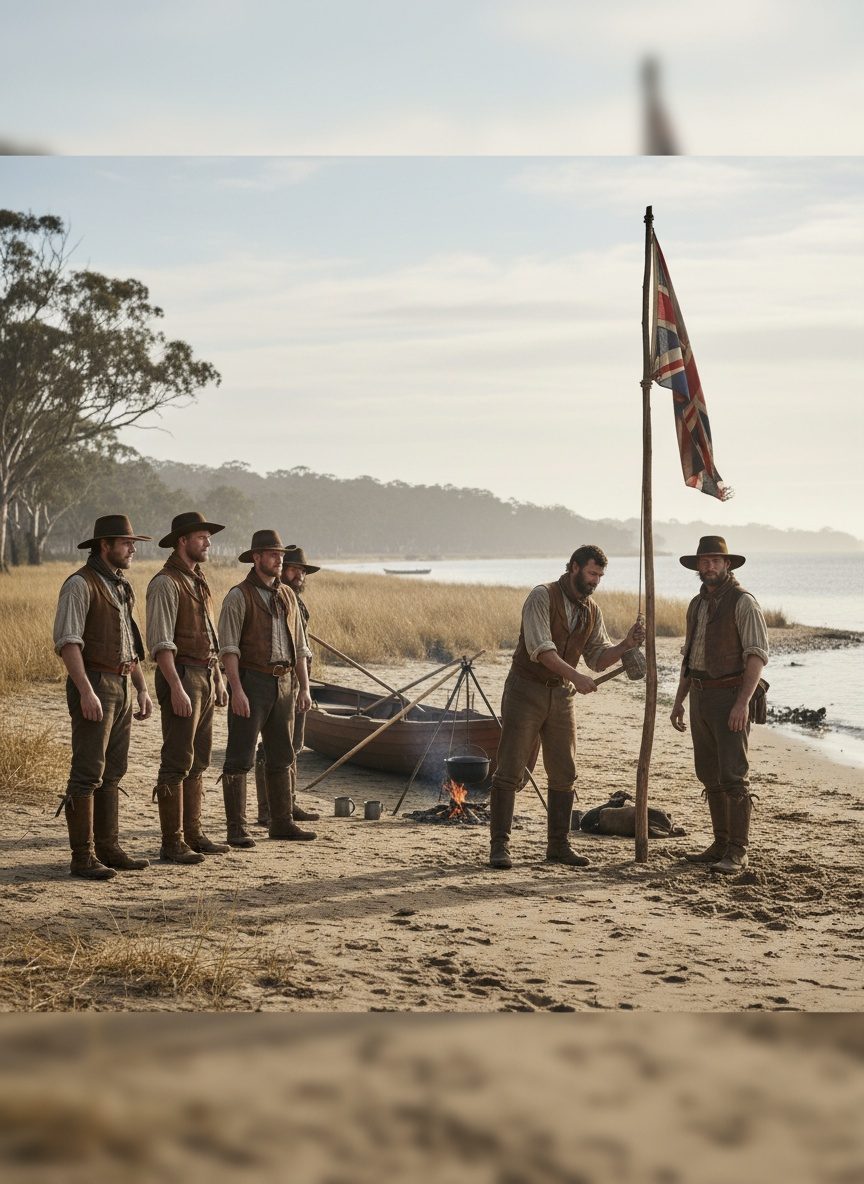
Most people could be forgiven for thinking Melbourne began with an official proclamation. In reality, it was birthed by eight men with a flag and a fire.
The Unchronicled Arrival
In the winter of 1835, a peculiar silence enveloped Port Phillip Bay. The kind broken only by nature’s whispers and the soft lap of water against a small vessel. The Tamar, a modest sloop, and its ragtag crew, led by the vision of John Pascoe Fawkner, carved a quiet path through the cool southern waters from Launceston to these untouched shores. History would have us think of colonization as a meticulously planned affair, with orders from above and armies on standby. Yet, here was a group stepping onto a new shore with none of these—only a dream and a flag to claim an unnamed land.
In their minds, these men—as disparate a group as any—held the firm belief that they were not merely squatters but pioneers. When their feet touched the earth at Port Phillip, it wasn't just land they discovered. They found promise in the wild Australian landscape, a place that echoed with silence and potential, far from the bustling streets of the empire from which they hailed.
The Decision That Changed the Voyage
John Pascoe Fawkner, a Launceston newspaper editor with an unquenchable thirst for opportunity, charmed by tales of fertile lands and the prospect of wealth from grazing, became the unlikely catalyst in this unconventional tale. Swayed by such stories that passed through the docks and newspapers, Fawkner resolved to assemble a crew and make his mark on these distant territories.
History rarely dwells on the perils faced by such early settlers. Fawkner's band, composed largely of convict artisans and laborers seeking redemption, braved uncharted waters. Their journey was as much about surviving the treacherous seas as it was about the promise of land—a gamble against the might of the ocean and, soon, the vastness of the Australian hinterland.
First Camp, First Night
When the men unfurled their makeshift camp on August 29, 1835, beside the rippling Yarra River, it was perhaps as unglamorous a scene of foundation as any. A fire flickered against the encroaching darkness, its smoke curling upward as if in conversation with the untouched stars above. This rudimentary campfire marked the inception of Melbourne, long before the city bore an official name.
The absence of a formal decree or bustling ceremony did little to diminish the significance of those acts. The flag they raised was not a symbol of conquest or imperialism, but rather a hopeful beacon, a mark of new beginnings and dreams cast into the often-empty Australian sky. These men sat by their fire, no doubt warmed by both the flames and the hopeful anticipation of what was yet to be built.
The Name That Took Root
Naming a city is often a grand affair, ensconced in rich deliberations and historical nods. Yet the first whispers of "Melbourne" were passed not in the halls of government, but amongst the salted lips of Fawkner’s crew. Intended as a tribute to the British Prime Minister, William Lamb, 2nd Viscount Melbourne, it was a name that would grow beyond its humble christening by the Yarra’s banks.
This new Melbourne, just a fledgling truth amid the larger colonial landscape, bore witness to the unparalleled audacity of its founders. Their modest efforts and rough-hewn ambitions set the foundation of what would grow to become a bustling metropolis, pivotal in Australia’s economic and cultural journey.
Why These Moments Matter
There is a common thread throughout history: small moments often shape larger narratives. The story of John Pascoe Fawkner's men at Port Phillip is a reminder of how civilizations can spring from the most unassuming of beginnings. These nameless early hours didn’t just herald a new settlement—they forecasted Melbourne’s journey to prominence, an evolution that continues to this day.
This forgotten fireside assembly embodies the spirit of persistence, of creation out of nothingness. It reminds us that sometimes, profound legacies aren’t built on grand proclamations but on the dogged determination of ordinary men who dare to dream. Melbourne stands today not just as a testament to the city it has become, but as a monument to the early dreams and untold legends they left out of the textbooks.