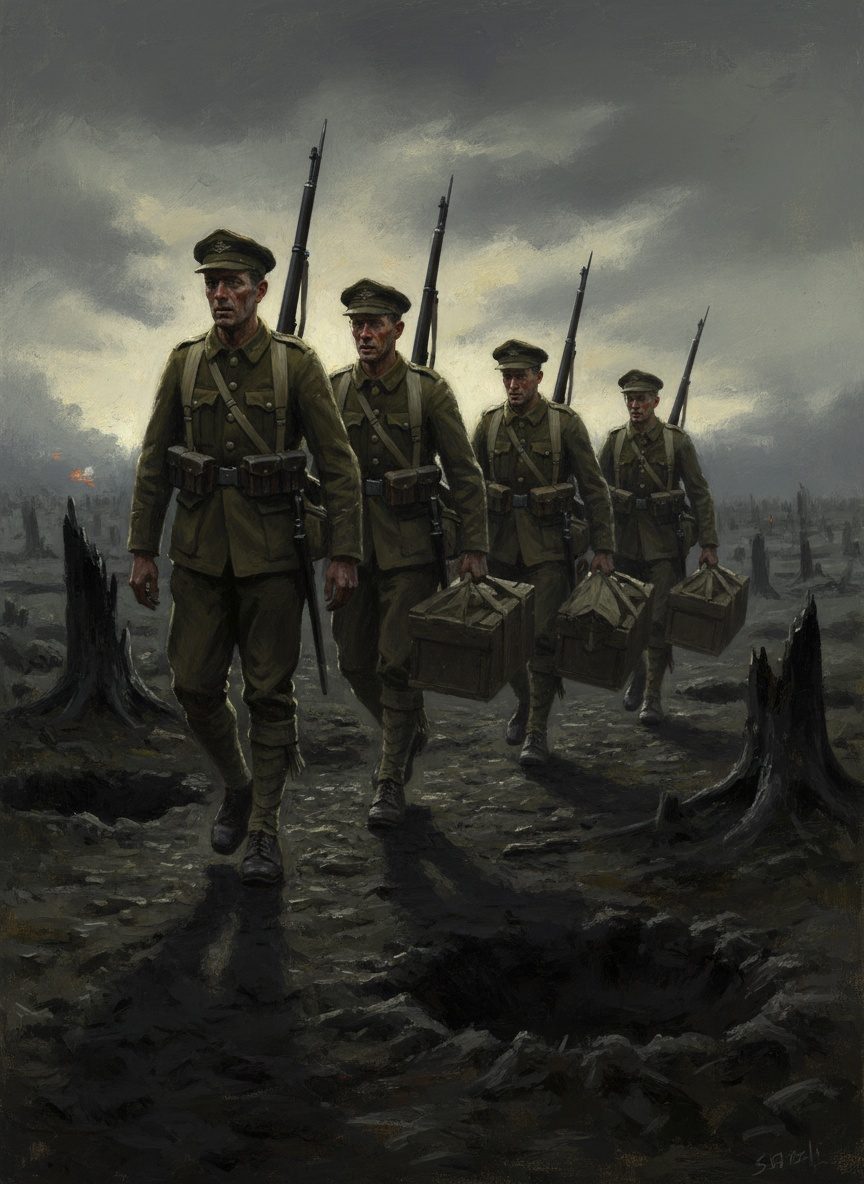
The night is oppressive, thick with the humidity of early spring in northern France. Beneath the muted light of a war-weary moon, Joseph Gray trudges on, his boots sinking silently into the mud of Neuve Chapelle. Around him, the spectral forms of his comrades from the 4th (Dundee) Battalion, Black Watch, slip like shadows through the devastated landscape. They carry more than just food and supplies; they bear the weight of grim uncertainty, each step bringing them closer to the uncertain fates of the friends they seek to nourish or, perhaps, mourn.
The Battle of Neuve Chapelle rages on, a furious assault playing out between March 10 and March 13, 1915, within this scarred earth. Here, amidst the churned fields and remnants of once-bucolic villages, British forces aim to break through the German line. It is an audacious plan, conceived with precision but executed under the cloud of unforeseen chaos and staunch resistance. Joseph Gray and his band of 'Fighter-Writers' of the 4th Black Watch find themselves at the heart of this tempest, weaving tales and painting the grim realities of war that the newspapers back home sanitized for the civilian palate.
As Gray slogs forward, he is acutely aware of the foreboding silence shattered intermittently by the distant thunder of artillery. Men clash here not just at the behest of orders, but mingled with whispers of fear and streaks of courage past the endurance of normal limits. The air is suffused with the acrid scent of gunpowder and the barely perceptible copper tang of blood mingling with the wet earth. Voices, muted and muffled, crackle in staccato bursts of commands and scrambled messages as the men navigate the treacherous maze of trenches.
It was in these confines that Gray's dual talents as both soldier and artist came to the fore. Shortly after arriving at the front lines, his keen eye and steady hand quickly rendered him invaluable. As an observer, he captured the frenzied dance between life and death that played out daily on the canvas of the Western Front. His sketches were raw and unflinching, capturing everything from the banal to the bizarre—a mysterious balance between the enduring spirit of men and the relentless machinery of war.
Unlike the silent brush strokes he would later bring to canvas, Gray's mind is now alive with activity, cataloging each indelible sight and sound. To others, a trampled helmet on soil would appear as debris; to Gray, it represents hours spent in futile valor. He visualizes how he might someday translate this cacophony of despair and resilience into muted oils and watercolors, ensuring the ghosts who populate these devastated spaces are remembered.
As the battle extends, and boundaries are pushed, each soldier persists despite the gnawing specter of mortality lurking in every corner. Estimates at Neuve Chapelle suggest that the British suffered around 7,000 casualties, including dead, wounded, and missing. The numbers were staggering; every man knew another soldier barely clinging to life or already fallen. Yet, in such conditions, camaraderie flourished—sometimes their only solace in this endless night.
The eerie luminescence of the night sculpts horrific figures on the ragged terrain, figures that bear the likeness of the ‘Ghost Men’ Gray would commit to his artwork years later. These ethereal beings are embodiments not merely of the fallen but of the living spectres—men moving mechanically, animated by only rations and an unwavering determination to keep putting one foot in front of the other. It is in this phantasmagorical interplay of light and dark that Joseph Gray would later find the inspiration to depict the true heart of the First World War.
Long after the cacophony of guns has faded into history, Gray's paintings serve as a portal to the past. Those not familiar with the man behind the brush might mistakenly sense only darkness in his work. But to those who know the full measure of Joseph Gray's experiences, each stroke reveals layers of luminescent humanity—trust, hope, fear, and undying remembrance. His artwork is displayed in the Imperial War Museum, a somber yet evocative reminder of the undying spirit of those who bore witness.
Gray's life, like his art, transcended the stark confines of the war. By 1916, he returned to civilian life and continued his work as an illustrator, carrying into peacetime the resilience he acquired on the battlefield. He would go on to travel extensively, his experiences enfolding nearly every corner of Europe. Yet, no matter where life took him, the landscapes of Neuve Chapelle, the once-vibrant spirit of its ghost men, remained indelibly etched into his memory.
In exploring Joseph Gray's legacy through both his service and artistry, we glean wisdom about the human condition. We learn that history is not solely inscribed in the grandiose statues of leadership or triumphs of victories. It speaks louder in the whispered tales of those who lived, loved, battled, and ultimately, remembered. Gray's paintings invite us to peer not just at the shadowy visage of war, but at the light that flickers, ever so delicately, within each soul caught in its fray. Joseph Gray painted not just to capture a moment in time but to ensure that history, often distilled to points on a timeline, would instead breathe with the vibrancy of those who lived it.