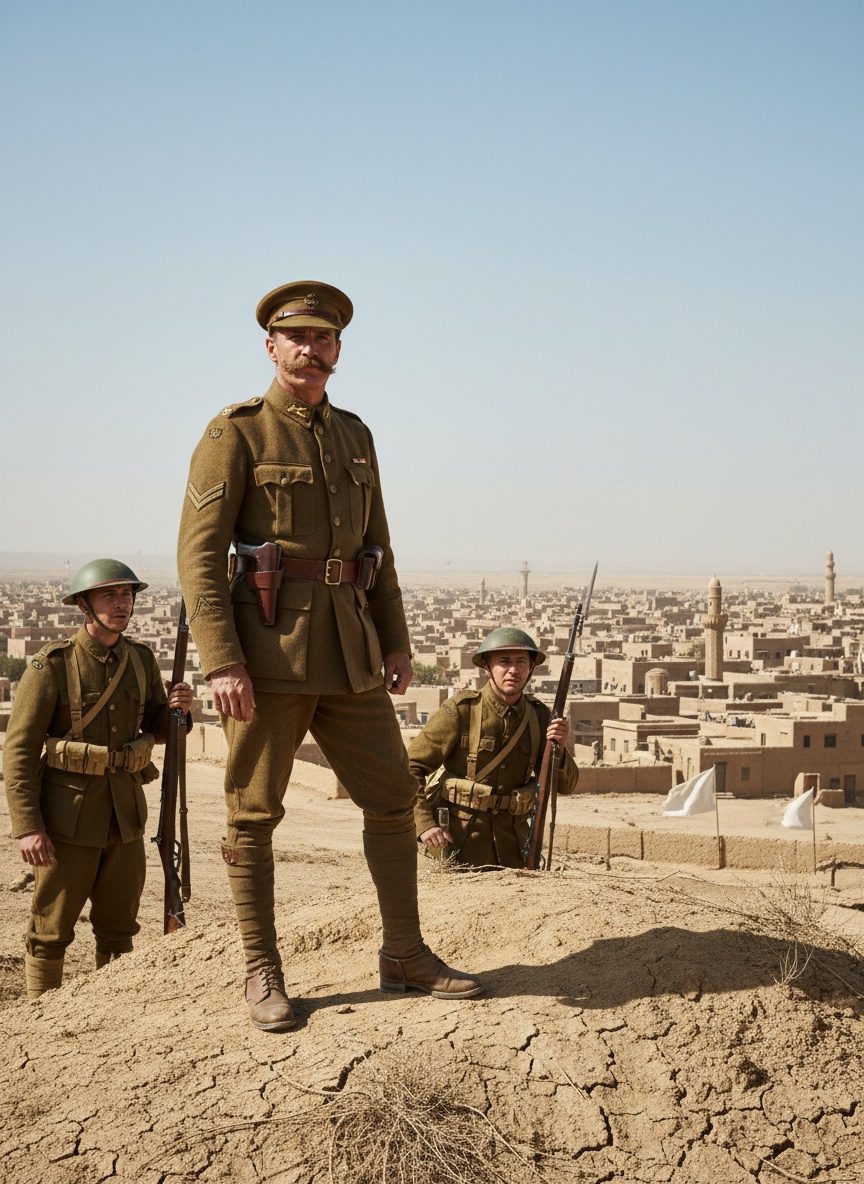
The morning air of March 11, 1917, hung thick over Baghdad, with a sun that promised to blaze mercilessly as the day grew. The sound of boots crunching over the dry, dusty earth, mingled with distant chants from mosques, filled the air. This ancient city, with its labyrinth of narrow alleys and grand domes, was at the brink of history once more, a stage set for the clamor of war and the echoes of fallen empires. Yet on this day, something remarkable unfolded — a silent chorus of white flags rising across the cityscape. Within those fluttering symbols lay a promise of relief. For the British, however, this was triumph stitched from the tatters of defeat.
The Shadow of Defeat
The Mesopotamian Campaign had hardly begun auspiciously for the British Empire. The tarnish of defeat was fresh, a raw memory etched at Kut al-Amara where, in April 1916, nearly 13,000 British and Indian troops capitulated to the Ottoman forces. It was a humiliation graver than any suffered in living memory. The once unshakeable confidence of British military superiority seemed quixotic, a distant eagle clipped mid-flight. The surrender at Kut was more than a tactical setback; it was a gut-punch to morale and prestige in a region overburdened with the weight of imperial ambitions.
Enter General Frederick Stanley Maude, named commander with a mandate as daunting as it was clear: restore the army, prepare for Baghdad, and erase Kut's ignominy. Arriving in August 1916, Maude was determined to rebuild not just a weary force, but also the shattered confidence that came with it. His approach was methodical and deliberate, focusing on the minutiae often overlooked in haste. Supply lines were reinforced, equipment renewed, and spirits reignited with a patient yet relentless drive.
The Anatomy of a Rebirth
General Maude set to work like a meticulous craftsman reassembling a clockwork beast. By the time his campaign was ready to unfurl, the conditions were vastly transformed. Training was thorough, and the strategy honed. The Tigris Corps, under his command, was a mobile and prepared force, a phoenix risen from Kut’s ashes. With each forward thrust towards Baghdad, Maude employed deception as an ally, keeping Ottoman forces guessing and on edge.
Logistics — the lifeblood of any campaign — became an instrument of assurance. Supplies flowed more freely along the rivers, troop movements synchronised with intricacy. The men who had felt the bite of hunger and thirst at Kut were shielded from the creeping uncertainties that had plagued them before. As they advanced on Baghdad, the army displayed a cohesion and discipline that underscored Maude’s leadership, turning what had been a demoralised contingent into a capable and formidable force.
Baghdad on the Horizon
As the British pushed towards the historic city, the significance of Baghdad loomed large — an ancient seat of caliphates, a city whose very name evoked splendor and lore. Yet, it was more than a symbol; it was a strategic linchpin in the Middle Eastern theatre of the Great War. Control over Baghdad meant leverage — politically, militarily, and psychologically. It was the prize jewel in a campaign aimed at securing not only ground but also footholds in the broader geopolitics of the region.
The fall of Baghdad, however, was not a raging melee of violence and siege. It instead befell through quiet resignation. Ottoman troops, beleaguered and overextended, could no longer hold back the tide. Exhaustion did what cannonade and cavalry could not, compelling the city’s defenders to raise those poignant white flags. On that pivotal day, British troops entered a city that offered no resistance, its streets subdued under the weight of inevitability. For the men who marched in, it was a welcome reversal of fortune that began years earlier in the dismay at Kut.
A Moment Fulfilled
When the Brits walked into Baghdad, their arrival signposted more than the capture of a city. It marked a turning point, a resurrection of British morale from the bowels of past defeat. Maude, ever modest, declared to his troops, "Our armies do not come into your cities and lands as conquerors or enemies, but as liberators." His words, though crafted from necessity, speak to the complex narrative of imperial enterprise—one that is both liberator and occupier in the eyes of history.
Baghdad's fall did not spell the end of conflict but offered a chapter where despair was met by determination. The story of Maude's campaign is an emblematic tale of resilience, illustrating how redemption can take root even in the soil of defeat. As those white flags fluttered overhead, they signaled a restored confidence that would ripple through the annals of the British Empire, leaving an indelible mark on the tumultuous landscape of World War One.