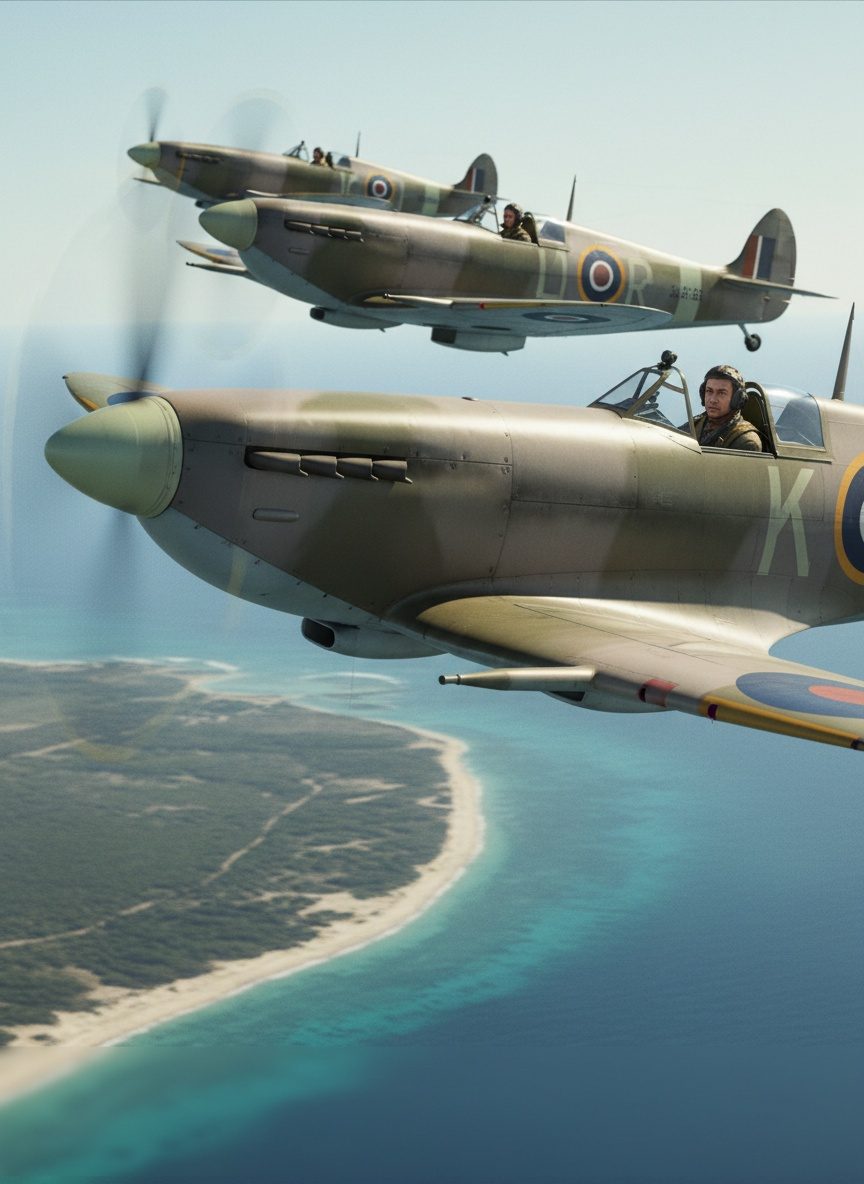
The roar of engines filled the cockpit, drowning out every other sound as the Spitfires sliced through the air. The morning sky over Tunisia, in March 1943, was a canvas streaked with the contrails of war machines. Below, the ridges of Mareth rose like ancient sentinels, standing witness to the clash between Allied forces and the Afrika Korps entrenched in their formidable defensive line. Squadron Leader Lawrence peered through the canopy, eyes narrowing against the glaring sun. The three Spitfires of No. 244 Wing, nimble and deadly, glided like hawks above their domain, always vigilant and ever waiting to spring into the hunt.
No. 244 Wing, Royal Air Force, was the tip of the spear for the Allies in the North African Theatre. In the crucible of Tunisia's skies, these heralds of the air would shepherd light bombers, guarding them through the hostile reaches toward their objective: the Mareth Line. This line was a testament to German engineering prowess, a sprawling web of defenses that made any breach a daunting reality. But today, the Spitfires' mission extended beyond escort duties; they were the last layer of protection, their presence a ghostly force that Axis interceptors learned to dread.
The Spitfires in question were the LF Mark VBs, specific variants crafted for engagements below fifteen thousand feet, tuned for maximum ferocity at their operating altitude. Built for low-level dogfights, they traded armor for agility, elegance for effectiveness. With these machines, pilots experienced an almost supernatural connection, a symbiosis between man and machine that allowed for split-second decisions in the dance of death that was air combat. Each simple throttle adjustment or deft aileron maneuver could decide life or death, victory or defeat.
On this March day, the scene below was tense but beautiful: ribbons of green became quickly obscured by the swirling desert dust. As the formations of British and American bombers they escorted tightened their courses toward home, No. 244 Wing's Spitfires turned with assured grace, vigilant against enemies potentially lying in wait. The skies were a chessboard of tactical decisions, played out at supersonic speeds, with invisible pawns and unyielding queens.
The Afrika Korps had underestimated the resolve and resourcefulness of the Allies, and particularly of the RAF's tenacity in the air. The harsh reality of conflict had taught them a valuable lesson in air superiority. These skies belonged to No. 244 Wing as much as to the eagles flitting across the sun-draped heavens. For each Spitfire pilot, the task was simple yet paramount—to protect, defend, and enforce air dominance, even if it meant dancing with death. The men inside these horses of war possessed nerves as steely as their machines, knowing well that the protection of their squadron depended on their skill and bravery.
Each sortie was an exercise in precision; from the coordination of formation flying to the calculated assaults on enemy lines, every move was choreographed with the skill of a seasoned dancer. Months of training had honed them into a finely-tuned unit, their every climb and roll a spectacle of aviation prowess. The historical tapestry of these aerial engagements is woven through with tales of camaraderie, ingenuity, and unyielding courage—qualities not often highlighted in conventional tales of battlefields and frontlines.
As they swept back towards the coast, the pilots knew that any slip in concentration might mean the difference between reaching the safety of their home bases or scattering in fiery descent. The agility of the Mark VBs enabled them to react instantly to any potential threat on the horizon. Watching from above, the topography of the land beneath—now a mingling of sand and stone—seemed almost peaceful. Yet, they knew conflict simmered below, a landscape marked by struggle's indelible scars.
Amid the daring sorties and dogfights were moments of unexpected tranquility—instants caught between warfare where time seemed to stretch endlessly, suspended in the thin desert air. Such was the duality of man versus machine, where the monotony of aerial vigil was broken by the adrenaline-fueled chaos of surprise attacks. No. 244 Wing became not just a collection of aircraft and men but a living, breathing entity, integral to the success of forces operating along this harsh and unrelenting front.
The seamless unity of No. 244 Wing with their aircraft exemplifies the era's evolving dogfighting doctrines. As World War II drew on, battles were fought not just in the air but at the design tables and in the cockpits—pitting innovation against desperation. The emergence of the Spitfire as a symbol of resistance and might was underscored by the tactics developed by units like No. 244 Wing. Their influence stretched beyond the war, shaping air combat strategies and technological designs that would echo through subsequent decades.
The echoes of those March skies above Tunisia are reflections of determination, a portrait framed by grit and valor. The story of No. 244 Wing's Spitfires is not merely one of warfare but of human endurance—a story that resonates with every new generation that takes to the skies. They remind us of the unseen battles waged in defense of freedom, fought over sunlit coasts and dusty deserts, led by those who dared to take wing and meet fate head-on. As the Spitfires lifted and soared, each patrol reinforced a single truth within the maw of conflict: mastery of the skies can determine the shape of futures untold.