Amidst the swirling chaos of World War II, a select group of men stood silently poised at the precipice of destiny. It was March 1944, and as the sun peeked uncertainly over the horizon of the Anzio beachhead, the warriors of No. 9 Commando prepared for another day of battle. The siege had become a brutal stalemate, a test of endurance in which men fought not only against bullets but against the very will to relent. Armed with little more than determination and sheer grit, these soldiers embodied a moment when the empire held its breath. Within this crucible of conflict, army photographer Ronald Lambert ventured among them, recording fleeting glimpses of courage that history nearly forgot.
Into the Inferno: The Landing at Anzio
On January 22, 1944, Allied forces landed on the beaches of Anzio, Italy, under the cover of early morning darkness. What was intended as a swift, decisive flanking maneuver to seize Rome and force the formidable German defences into retreat quickly devolved into a grinding siege. Operation Shingle, as it was known, instead transformed the coastline into a harsh battleground and a test of resolve that would stretch on for months.
Number 9 Commando, a unit consisting of meticulously trained volunteers, served alongside traditional infantry divisions. Their roles included reconnaissance, raids, and direct combat engagements meant to disrupt enemy operations. These men were an elite cadre of warriors, tempered by previous engagements across Europe and North Africa. Yet even for them, Anzio was unlike any theater they had known. Commanded by Lieutenant-Colonel George French, No. 9 Commando came to epitomize the very essence of courage.
The Perilous Stand: Holding the Line
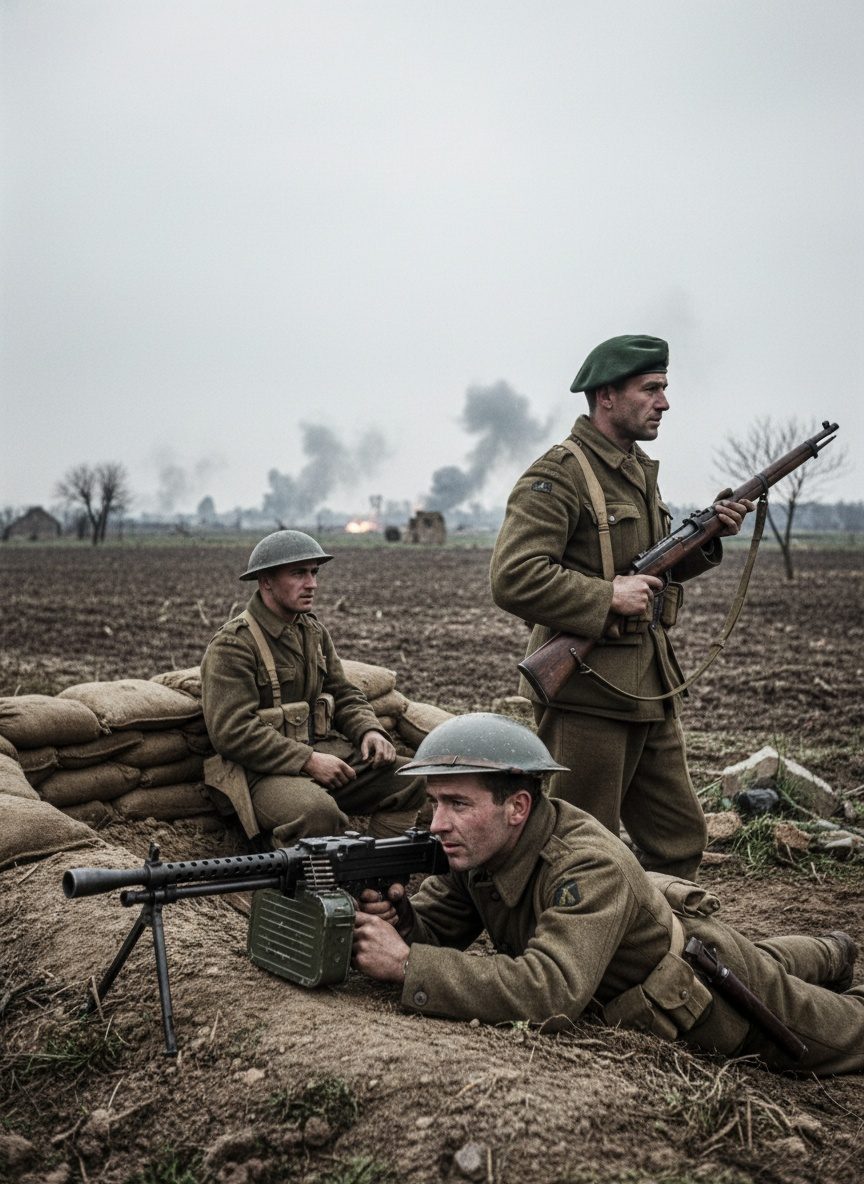
By March, the Anzio beachhead had become synonymous with peril. German forces, commanded by Field Marshal Albert Kesselring, transformed the region into a fortress, determined to expel the invaders or see them crushed. Artillery shells rained down day and night, and snipers lurked, ever-keen for prey. As the siege tightened, both sides dug in, preparing for the inevitable crucible of combat. Amidst this turmoil, Lambert captured an indelible image of three soldiers from No. 9 Commando. With just a few clicks of his shutter, a timeless snapshot of weary, resolute faces emerged, stark against the peril of their environment.
John ‘Jack’ O’Leary, a Corporal from Manchester, James ‘Jim’ Hargreaves, a Lance Sergeant hailing from London, and David ‘Davey’ Clarke, a young sapper from Glasgow, found themselves under scrutiny – not only from the enemy but through Lambert’s penetrating lens. Each bore marks left by endless conflict. Mud-caked uniforms and hollow eyes belied an indomitable will. Yet, even in such adversity, these men remained steadfast, a testament to the empire’s indomitable spirit and the human capacity to endure.
War Time Wonders: Men and Machines
Beyond the human tenacity lay an array of equipment and tactics that can spark marvel even through the passage of time. No. 9 Commando was uncommonly equipped for its era, often utilizing captured weaponry and innovative tactics. Their signature battle cries were often those of surprise and ferocity, elements that terrorized opponents unwilling to face such determination head-on.
Equipped with unique weapons such as the ‘Welrod’ silenced pistol and the versatile Sten gun, the commandos adapted to whatever the situation demanded. In the thick of Anzio’s chaos, every available piece counted. Notably, their penchant for creative sabotage and tactical deception led the German forces to grossly overestimate their numbers - a psychological victory that became as integral as battlefield success in holding the lines.
The Witness: Behind the Lens of Ronald Lambert
In Lambert’s own words, he was never just capturing images; he was capturing stories that needed to be told. For both those in the heat of battle and those far removed from its realities, his photographs provided a connection across the abyss of war. Lambert’s work was human-centric, portraying not only the suffering but the defiance echoing through each of his subjects’ eyes.
While much of history devotes itself to the leaders and strategies, the contributions of wartime photographers like Lambert remind us of the pervasive humanity that underscores every engagement. His clicks immortalized a singular vision of valor often neglected in textbook recountings. In his frames, ordinary men became extraordinary figures, speaking volumes through silence.
The Legacy Preserved
As the Anzio campaign drew on and men like those of No. 9 Commando persevered, this beachhead proved vital in draining resources from other German operations, indirectly supporting the broader Allied war effort. Finally, after months of hardship, Allied forces broke the deadlock, advancing inland to liberate Rome by June 1944.
The photographs Lambert took, including the portraits of O’Leary, Hargreaves, and Clarke, capture more than just faces amidst war's background. They capture the essence of an empire at war and the fundamental acts of heroism often overshadowed by the sweeping narratives of history. Today, those images serve as powerful reminders that history is written not only in textbooks but in the lived bravado of those who stood firm when the world threatened to unravel.
Why It Matters Today
Reflecting on the history preserved by moments like these offers insights into the character and resilience that define human endeavor. In a modern world that continually faces its own conflicts and challenges, understanding the threads of shared pasts reminds us of the collective strength that carries societies through adversity. The story of No. 9 Commando at Anzio, immortalized through Lambert’s lens, speaks to the timeless nature of courage—a legacy carved not in monuments but in the hearts of those who dare to remember. Such stories, though absent from many academic texts, offer the whispers of epochs where people dared greatly and stood resolute against overwhelming odds.