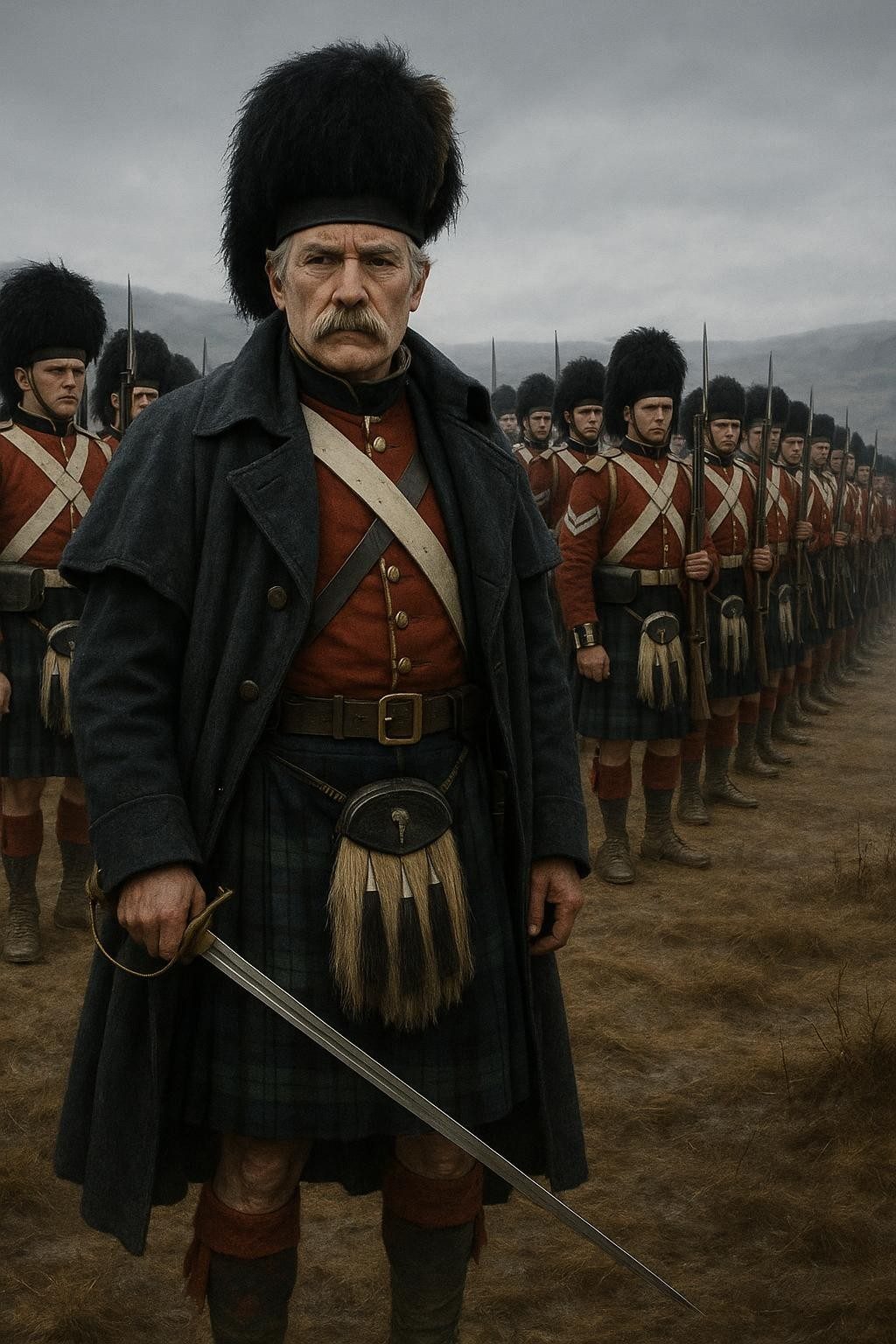
High upon a windswept, barren ridge in the Crimea, against a backdrop of ominous grey skies, stood the 93rd Highlanders. It was October 25, 1854, and these 550 kilted warriors were the last thin line of defense against the advancing Russian cavalry. Outnumbered and seemingly outmatched, they faced a choice that was no choice at all: to hold or to be obliterated. Yet, amid the chaos and impending doom, a solitary bugler’s call would etch their stand into the annals of history as the legendary "Thin Red Line."
The Clatter of Hooves: Prelude to Battle
The Crimean War, a byproduct of European power struggles, had led to this critical juncture. The morning fog had lifted to reveal the Charging Hordes: 40,000 Russian soldiers sweeping across the plains. The din of hooves and the clamor of war pierced the chilled air at the Battle of Balaclava, each second a ticking bomb towards inevitable confrontation. Sir Colin Campbell, a weather-worn commander known for his uncompromising grit, faced his hastily assembled regiment. His words were scarce but potent—“There is no retreat from here. You must die where you stand.” They were words not just of instruction, but of validation, steeling their resolve against overwhelming odds.
A Formation Unseen: The Double Line Defense
Traditional military doctrine of the time demanded infantry squares against cavalry charges, formations that offered a semblance of security against hoof and saber. Yet, here, in this crucial moment, such formations were impossible. Campbell made an audacious choice: his men would form a mere two deep lines, their Redcoats a stark scarlet slash across the ridge—a visual defiance against the tides of war. Popularized later by William McGonagall's poem, their stance became a symbolic line in the sand that dared not falter.
The soldiers fixed bayonets to their rifles with steely determination, creating a bristling hedge of danger. Despite being vastly outnumbered, amidst the four-deep Russian cavalry squadrons riding in full battle array, they remained steadfast. The sound of their heartbeats was nearly as loud as the enemy's charge.
Echoes of Courage: The Bugler's Note
What set this stand apart was not merely the valor of the men, but the critical role of a single bugler, John Scott. In the chaos of battle where commanders’ voices were often swallowed by the din, Scott's bugle became the Highlanders' lifeline. As the Russian cavalry neared striking range, Campbell ordered Scott to sound the advance. It was an unexpected strategy—a counterintuitive boldness that rippled like electricity through the ranks.
"Advance!" The bugle's high notes sliced through the clamor, a call to embrace the unfurling chaos with steadied hands and unwavering hearts. The note struck an invisible chord of solidarity and courage, its significance undeniable. In that instant, Scott's call became a sonic anchor that fortifies men made of flesh and bone against waves of iron and fury.
Standing Against the Storm: The Clash
Like a crimson razor, the thin red line cut through the battlefield landscape, its slenderness misleading in its might. The Russians charged at full gallop, seeking to break the line, expecting it to fold like parchment. To the astonishment of onlookers, the 93rd held fast. Bolstered by Scott’s echo, the men fired at will, unleashing torrents of lead, and each bullet fired was a punctuation of their human frailty turned inexorable strength.
The Russian advance faltered, then stilled. The cavalry fell back under the relentless gunfire, their charge shattered against the living barrier. The improbable had been achieved; the Russian cavalry withdrew, unable to overcome the seemingly fragile yet indomitable resolve of these men in red. Their bravery was chronicled not by their numbers but by their unyielding spirit.
Legacy of the Thin Red Line: Why It Matters Today
The extraordinary stand of the 93rd Highlanders at Balaclava reverberates well beyond the Crimean fields. It remains a testament to the power of resolve and the foresight of leadership that dares to defy convention. The courage of a few, steadfast in their tracks, can deter what seems insurmountable. The bugler’s call, preserved in time, reminds us that the sound of hope often comes from the unlikeliest sources.
In an age where boundaries are both defined and blurred by conflicting interests, the story of the Thin Red Line has enduring relevance. It underscores the significance of unity and steadfastness amidst adversity, capturing the essence of human resilience. As we grapple with the challenges of our own time, the tale of these valiant Highlanders imparts lessons that are as necessary today as they were on that cold Crimean ridge—with a single note turning the tide of history.