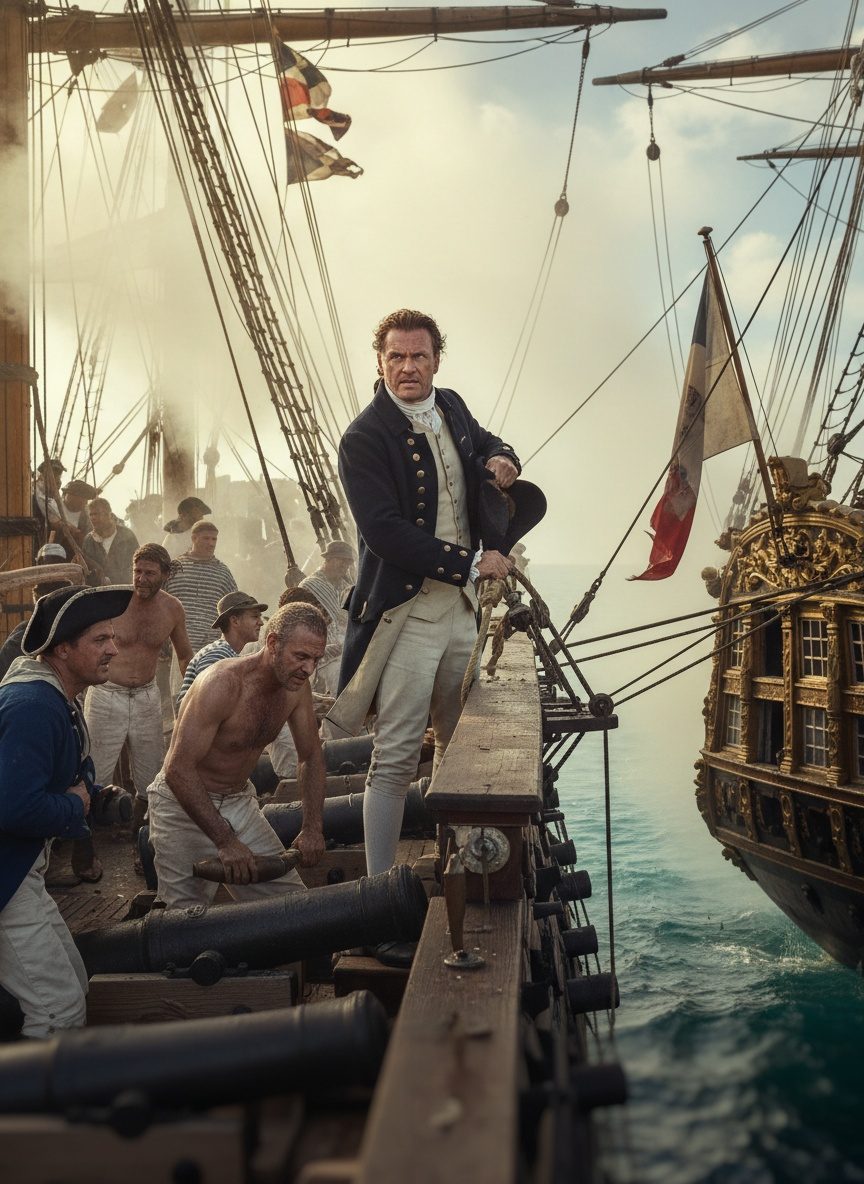
The crash reverberated through the hull of the HMS Duke as if Neptune himself slammed his trident upon her deck. Captain Alan Gardner clung to the sudden upheaval, every fiber of his being focused on the audacious maneuver underway. Sails fluttered violently against the Caribbean breeze as the battered warship drove headlong into the mighty French line, sending splinters of wood and cries of surprise through the dawn-lit chaos.
The Audacity of the Waves
The April sun had yet to crest the horizon on the morning of April 12, 1782, when the ships of the British Royal Navy, under Admiral Sir George Rodney, began their fateful engagement with the French fleet led by Admiral de Grasse. Anchored within the azure confines of the Caribbean, these leviathans of timber and iron had gathered with the weight of two nations’ expectations resting upon their masts.
The air was tense with anticipation and the tang of salt as the two fleets squared off near the Isles of Saintes. The French, with the confidence of numbers and advantageous positioning, seemed poised to solidify their grip over the West Indies. Yet, conviction took human form in Captain Alan Gardner of HMS Duke, a man unbowed by the magnitude of his opponent. Gardner, sharing the commander's resolve, read the shifting winds and tides with the expertise of a seasoned mariner. There, amidst the thunderous cacophony of cannonades and the ominous swell of possibilities, Gardner seized upon a singular moment of vulnerability.
The British fleet had attempted to engage the French in a pitched battle, but it was the Duke's daring maneuver that became the fulcrum upon which the day's fortunes would hinge. As the enemy guns roared their defiance, Gardner, his eyes trained on the enemy's strategic integrity, made a decision that sailed against the prevailing currents of naval combat. Charging toward the perceived gap in the French line, he turned his wooden leviathan into the path of destiny.
Into the Breach
The Duke, creaking and groaning under the strain, punched through the stalwart formation of French ships like a fox in a henhouse. Aboard the deck, the clash of steel and cries of courage echoed with the ferocity of men who understood the cost of failure. As the Duke drew its scar through the enemy line, the British fleet took the cue, falling upon the disarrayed French with calculated precision. Cannonballs whistled through the air as cheers erupted from British throats, galvanizing the morale of men who now pressed their advantage.
Historians often ponder on the curious convergence of audacity and opportunity. Though widely depicted through the lens of Admiral Rodney's strategic brilliance, it was the daring of men like Gardner that rewrote the battle’s narrative. Even as the French fought bravely to re-form their lines, the momentum had decisively shifted. In the chaos, French commanders found their orders blurred and their resolve tested. The scent of gunpowder and the fiery brilliance of exploding barrages framed this tableau of war, crafted by Mother Fortune herself.
Gardner's actions that day were more than a tactical gambit; they were a clarion call to the inherent unpredictability of warfare. As the day's battle wore on, the gaping rift cleaved into the French discipline grew unbridgeable. HMS Duke’s bravery had handed the British fleet the prize of advantage, threading opportunity through the needle of uncertainty.
Beneath Caribbean Skies
As the sun dipped below the horizon, painting the sky with fiery hues, the Battle of the Saintes came to a close. The French fleet, their proudest charge blunted by the startling intervention, began its retreat. De Grasse himself was captured, his plans of robust dominion over the Caribbean dissipating like so much sea spray in the night.
Captain Gardner, meanwhile, surveyed the aftermath from his fatigued vessel with a grim satisfaction. Aboard the Duke, the revelry of triumph mingled with the sorrow for those lost and the understanding of what war rarely spared. His actions that day had not only altered the course of a battle but had also sewn threads into the wider fabric of naval history. The Caribbean, now retained under British influence, bore Gardner’s mark as surely as the distant stars bore the navigator’s guide.
The tale of the Duke ramming the French line is more than a footnote in the grand historical saga of empire and sea. It reveals the intricate dance of unpredictability and humanity in warfare. In the audacity of Captain Gardner, we see the reflection of many unknown tales that lie beneath textbook simplifications—stories of risks taken and destinies altered by men and women who dared to act beyond the ordinary confines of their roles.
Indeed, as night surrendered to the embrace of dawn, and the echoes of that day softened toward forgetfulness, it was the breach created by Gardner that sang through the wind—a resounding reminder that history is often shaped by the unsung courage found in the gap between caution and valor.