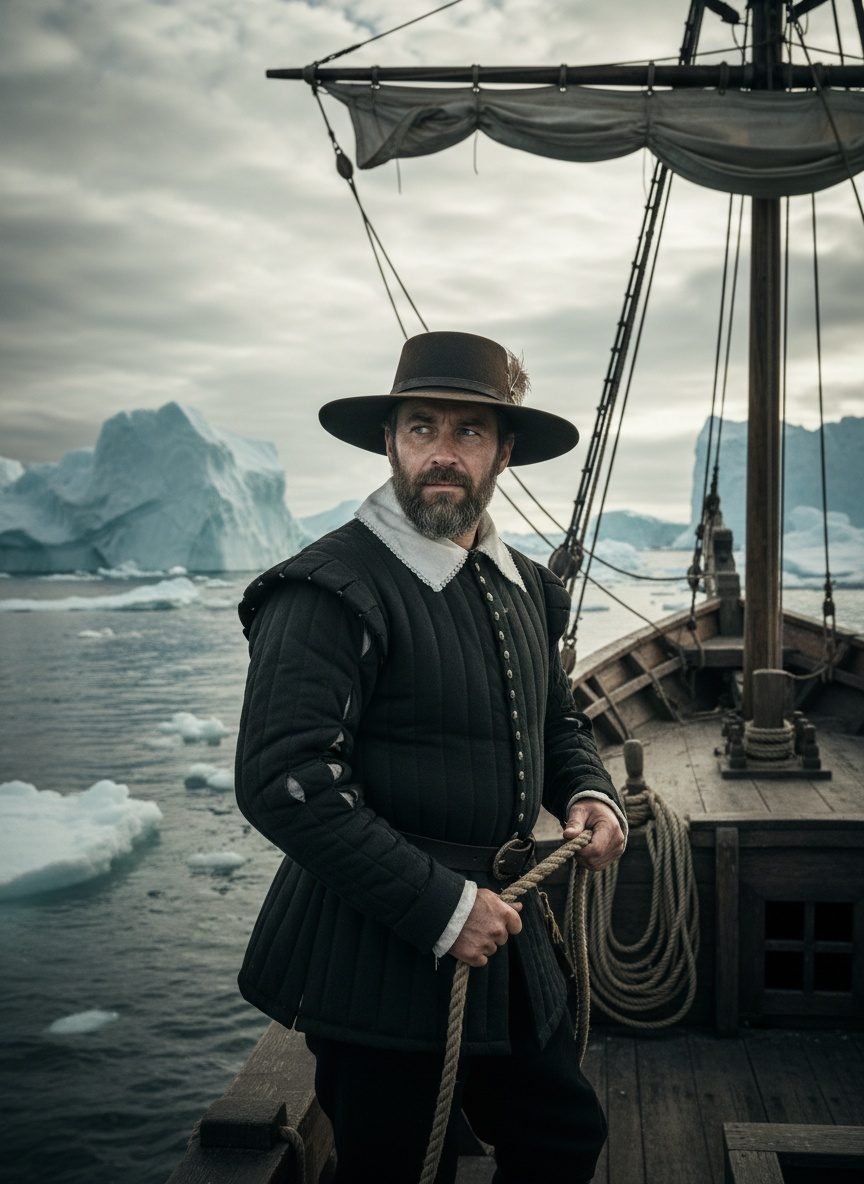
July 25, 1576. The cold wind howled unabated across the desolate expanse of the icy Arctic waters. Above, the pale sun hung diffidently in the sky, reflecting off jagged icebergs that pierced the sea like ghostly sentinels. This was a realm untouched by English eyes — until now.
In the heart of this frozen wilderness was Martin Frobisher, a resolute sea captain whose determination and gall carried him into the unknown. As his ship, the Gabriel, inched forward into the frigid territory, the dangers of his ambitious undertaking became starkly apparent. He was leading a small fleet of three ships in search of the elusive Northwest Passage, a mythical route believed to connect the Atlantic and Pacific oceans and offer untold riches to those who could conquer it.
Martin Frobisher, born in Yorkshire, had set out from England with high hopes and royal support, his expedition part of Elizabethan England's broader quest to expand its maritime empire. This was a time when the seas were as much a frontier as space would be centuries later. Frobisher's objective was not only to explore but to chart a course that could elevate England's standing among the great seafaring nations of Europe.
The journey had begun with three ships: the Gabriel, the Michael, and the diminutive Pinnace. However, fortune frowned early on their enterprise. The harsh Arctic greeted them with a stunning, alien beauty but quickly descended into a host of threats: towering walls of ice, treacherous currents, and unrelenting storms. The sea itself seemed a belligerent adversary.
The Pinnace was the first to succumb, its flimsy frame no match for the crushing ice that snapped satisfyingly around it, a grim reminder of nature's superior hand. Soon after, the Michael turned back — its crew gripped by the primal fear that encroached upon even the bravest of hearts in these inhospitable waters. They had seen enough and fled towards the welcoming embrace of more temperate climes.
Yet, for Frobisher, retreat was never an option. Steeled by a mix of fervor and obstinacy, he pressed on alone aboard the Gabriel, a vessel not much larger than a modern yacht, yet as potent a symbol of ambition and human resilience as any grander ship. As once Alfred the Great had rallied against the Vikings or as Richard the Lionheart had marched to the Holy Land, Frobisher forged ahead into the Arctic unknown.
The unyielding landscape was as indifferent to his presence as it was to any human plight. Icebergs towered menacingly, some as high as a cathedral, shifting unpredictably in the icy waters, always threatening to entomb him in a frozen grave. The sky, devoid of warmth, seemed closer, a blanket of gray that smothered hope. In those icy reaches, where compasses faltered and maps were but blank spaces of imagination, Frobisher found himself confronting not just the limits of his endurance, but also those of human knowledge.
His battered ship found refuge in an almost mystical land of rugged cliffs and beaches streaked with gold flecks. Frobisher believed — or perhaps hoped — that these golden threads could be the key to changing England’s fortunes forever. Here was potential evidence of a New World wealth that could rival the stories of Spanish treasures in the Americas.
Still, this was not just a quest for material riches. It was an encounter with the very boundaries of the known world, a clash between entrenched perceptions and raw reality. The climate was harsh; provisions ran low. But Frobisher's indomitable spirit, something that separated leaders of his era from ordinary men, pushed him onward. This was a voyage of exploration not only in the geographical sense but a probing of the psyche, an expedition into the heart of courage itself.
Upon return from the Arctic, Frobisher's tales must have sounded both fantastical and unnerving back in England. He returned with a shipload of "black ore," believed to contain gold. The discovery set off a frenzy of excitement, though it later proved largely fruitless when the ore yielded no appreciable wealth upon analysis. Frobisher’s voyages did not unlock the fabled passage nor deliver rivers of gold, yet their significance lay elsewhere.
What Frobisher did achieve was a breakthrough of another kind. His singular journey opened the Arctic to England, sowing the seeds for future exploration and mapping efforts. It was a harbinger of imperial ambitions that would blossom in the centuries to come, driven not only by economic gain but also by the unquenchable thirst for knowledge that defined the Age of Exploration.
In the story of Martin Frobisher, we are reminded of the complexity and duality of human nature — the bravery and folly, intelligence and ignorance, faith and despair — all embodied in the voyage that pushed the limits of what was possible. Frobisher's lonely path became a beacon that lit the way for others who would follow, charting the unknown corners of our world and unlocking secrets hidden beyond the ice. In this respect, his journey was more than just a physical exploration; it was an exploration of potential and limitation, a testament to human tenacity in the face of insurmountable odds.