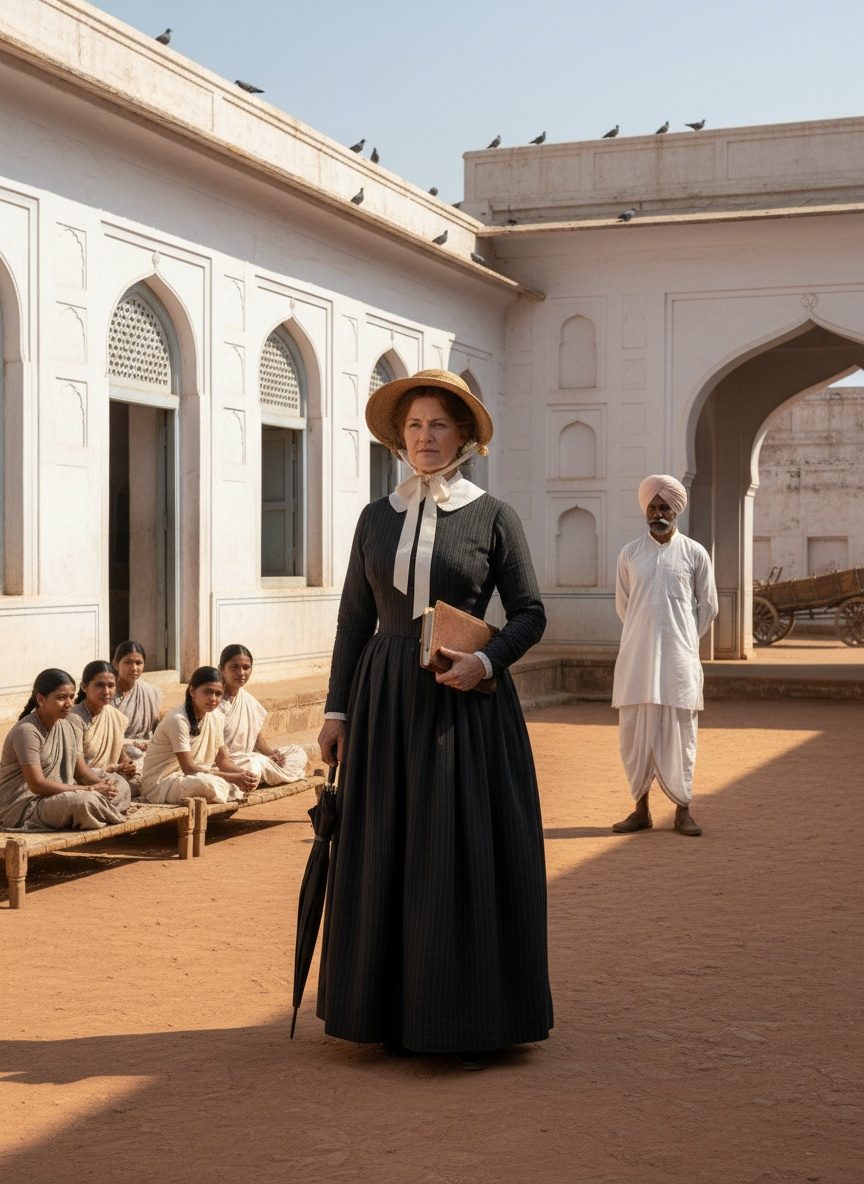
The humid Calcutta air clung to Mary Carpenter's skin as she stood before the grand doors of the Government House. She could feel the eyes of the colonial officials boring into her—a solitary woman in a sea of men, her notebook tucked under her arm like a sword. The scent of jasmine from the gardens mingled with the oppressive odor of coal fires and sweat. It was a world away from the familiar cloisters of Bristol, yet her mission couldn't be clearer: to open the Raj's eyes to the plight of India's hidden daughters.
Mary had embarked on this voyage in 1866 not with imperial backing, but driven by a fierce and singular determination. Her work in British slums had taught her well—poverty did not discriminate, but society often did. Years spent reforming juvenile criminals in England had given her insight into the transformative power of education, particularly for those whom society deemed unworthy. However, it was amidst the chaos and clamor of India's streets that she witnessed a profound neglect: girls barred from the classrooms, locked within the shadows of zenanas, or trapped in the grim reality of the slums.
The sight of young girls peering through barred windows in Calcutta was a stark reminder of the obstacles that education could overcome, yet in India, it seemed insurmountable. These girls were born into a social poverty as dense as the smog that enveloped the city. Mary witnessed the stark disparity between potential and reality, each face a testament to what could be achieved if only afforded an opportunity. The schools, inaccessible and seemingly uncaring, became the battleground for her impassioned crusade.
Armed with her detailed observations and relentless drive, Mary Carpenter sought an audience with the Viceroy himself. It was an audacious move; one not typically undertaken by a woman, especially one without a formal invitation. Yet her reputation preceded her—unbeknownst to many of her contemporaries, Mary's influence back in Britain was substantial enough to bend even the most rigid ears. The sharp intellect she wielded was matched only by her unyielded compassion, qualities that made her presence impossible to dismiss.
Within the cavernous halls of the Government House, Mary presented a landscape of India's future that was radically different from its present—a future in which girls were educated and empowered. She spoke not with the gentility expected of her gender or station, but with an assertiveness that captured the room. Her arguments were peppered with anecdotes and statistics carefully gathered from her tours throughout India, from the darkest prison cells to the cloistered zenanas.
What Mary understood deeply was that education could not only liberate individuals but transform entire societies. She detailed her experiences with an eloquence that belied the harshness of the conditions she described—girls being refused the right to learn, not due to lack of will, but lack of opportunity. With each sentence, she painted the education of girls not simply as a moral imperative but as an economic and social necessity for the Empire.
Mary Carpenter's boldness did not end on the subcontinent. Following her return to Britain, she authored four influential books that argued passionately for educational reform, crafting narratives and citing first-hand accounts that few could ignore. These texts, alongside three additional voyages to India, solidified her commitment to the cause and expanded her influence. They stirred conversation not only in England but reverberated throughout the corridors of the Indian government, each publication a ripple toward reform.
Through persistent lobbying, Mary began to chip away at the entrenched preconceptions of the time. Her advocacy called into question the latent hypocrisies of an Empire that prided itself on enlightenment, yet kept half its population in the dark. When she finally shamed the Raj into action, it was not through force but through exposure—exposing the persistent injustices girls faced and challenging the system to do better.
Amidst her challenges, Mary was met with resistance, as change is seldom without its opponents. Some government officials balked at her audacity, others quietly feared the upheaval her proposals might incite. Yet there were also those captivated by her vision, inspired to venture beyond the constraints of traditional thought to endorse a more inclusive educational framework. She realized that converting skeptics would require patience and evidence, so she gathered both with the deftness of a collector seeking priceless treasures.
The transformative impact Mary Carpenter had on India's educational landscape is often left out of textbooks, perhaps because it defies traditional narratives about who can be a catalyst for such monumental change. Without title or commission, Mary carved her legacy into the very foundations of British India’s education system, creating ripples that would be felt far beyond her time. Her work stands as a vivid reminder of how one determined individual can challenge, redefine, and reimagine the future.
Today, the story of Mary Carpenter is a lens into a broader conversation about the power of education and the critical importance of inclusive opportunities. Her life’s work serves as a potent reminder of the enduring truth that the fight for equality and education is never fully won; it is a continual struggle that demands courage and action across generations. While the specifics of her battles may have evolved into the past, the essence of her mission—to bring light to shadowed corners and ensure that all children have the opportunity to learn—remains sharply relevant today. Mary Carpenter's spirit echoes as a silent reminder that though the gates of change may be barred, they must never remain so for long.