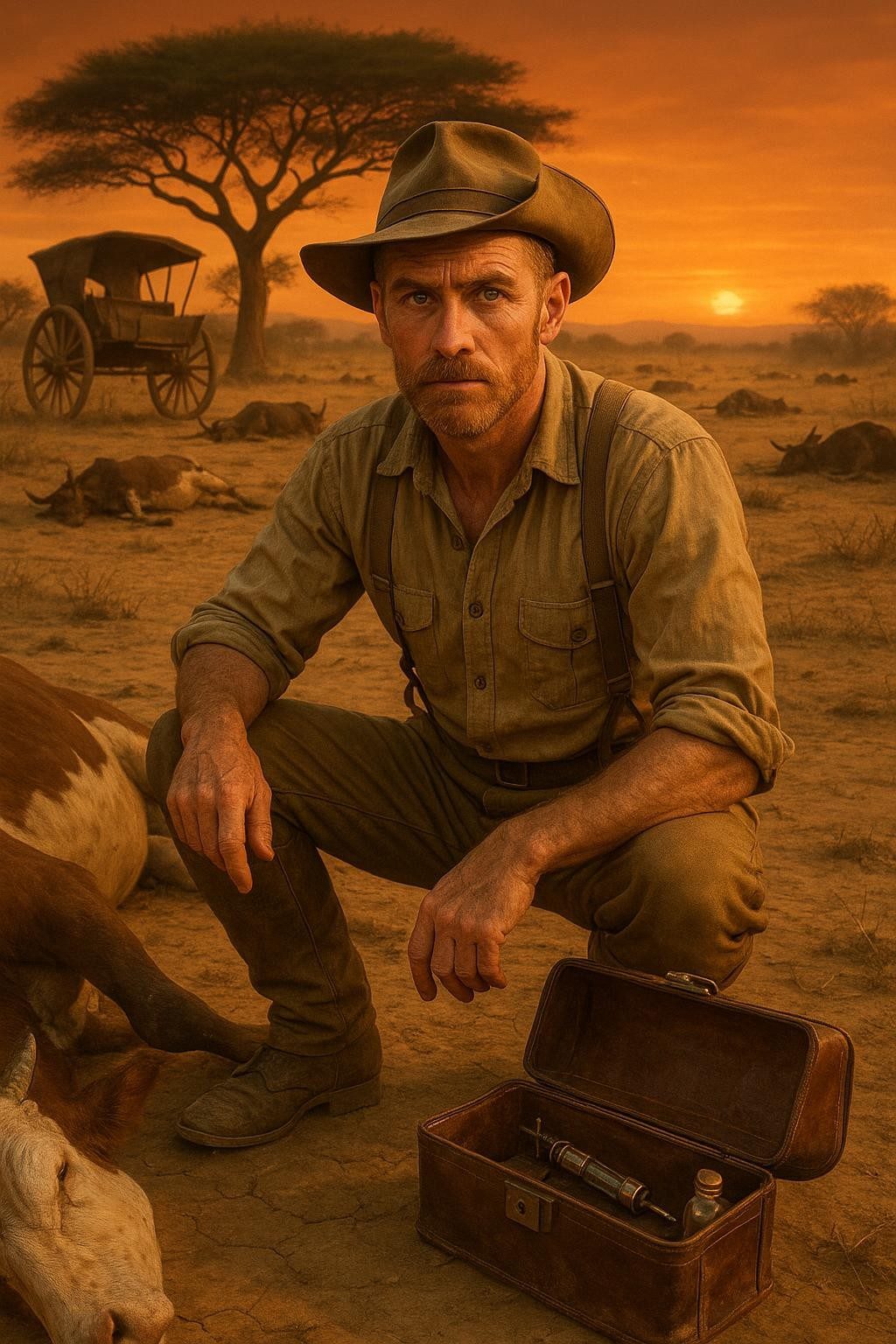
Few have heard of Arnold Theiler. Yet, without him, a corner of Africa might have faced a fate too grim to contemplate.
The Plague Descends
The Victorian era was a time of great discovery and advancement; however, it was also a period that saw humanity challenged by its own ambitions in the scramble for Africa. As the waves of European colonizers swept through the continent, they brought with them both prosperity and peril. One such peril arose in 1896, manifesting in the form of a relentless cattle plague known as rinderpest.
The deadly virus, originating from Asia, had made its way into the African heartland, spreading at an alarming pace. Rinderpest was not just a threat to livestock. In a continent heavily reliant on cattle for milk, meat, and as an integral part of the social fabric, the epidemic threatened to annihilate entire communities. As cattle fell by the thousands, starvation loomed large over the horizon, and the specter of famine grew ever closer.
Alone Against the Storm
Enter Arnold Theiler, a Scottish-born veterinarian. Nobody would have bet on the young veterinarian's odds as he rode solo into the swelling crisis. Yet, it was precisely his indomitable spirit and scientific curiosity that spurred him to confront the calamity head-on. Journeying through the devastated lands of southern Africa proved more than just physically demanding; it was an emotional trial, witnessing emaciated herds and desperate communities hanging by a thread.
Theiler’s approach was rooted in a meticulous observation and an unflagging determination to find a solution. While others saw inevitable doom, Theiler saw a puzzle to unravel. His tools were not those of a conventional hero—no swords or shields, but rather syringes and slides as he painstakingly collected samples, studied patterns, and hoped to unlock the virus's deadly secret.
A Eureka Moment
What followed was nothing short of remarkable. Theiler identified that the root of the epidemic was the newly introduced virus—a discovery that could steer the course of the outbreak. Yet, understanding the problem was merely the beginning. The true challenge lay in developing a cure or at least a defense against the disease.
Theiler's breakthrough came with the development of a vaccine, an audacious solution for its time. And to those watching, it seemed almost miraculous when this vaccine began to show results. While many saw devastation, Theiler saw a blueprint for salvation, and with every successful inoculation, the tide turned ever so slightly in favor of recovery rather than collapse.
The Ripple Effect
The impact of Theiler’s work extended far beyond the immediate recovery of cattle populations. His discovery provided a lifeline, preventing widespread famine. As herds slowly rebuilt, so too did the communities that relied on them, sparing countless lives from the clutches of starvation.
Moreover, Theiler's efforts laid the foundation for veterinary science in Africa, setting standards for future generations. He effectively demonstrated the importance of scientific inquiry and intervention in combating epidemics, a precedent with reverberations echoing into modern times. His actions spoke to the potential of individual resolve in evoking monumental change.
The Forgotten Savior
Arnold Theiler’s tale is a reminder of the unsung heroes quietly shaping the course of history. In a world more fascinated by grand battles and political intrigue, the story of a lone veterinarian hardly seemed headline-worthy. However, his resolute action in the face of adversity stands as an indelible reminder of the difference one determined individual can make.
In the shadows of the Victorian Empire's grand narratives, Theiler’s saga is tucked away, yet it remains profoundly relevant. His journey is a testament to human resilience and innovation, showing that even in the midst of devastation, hope can be found. It’s a history seldom taught, but one that should not be forgotten.