
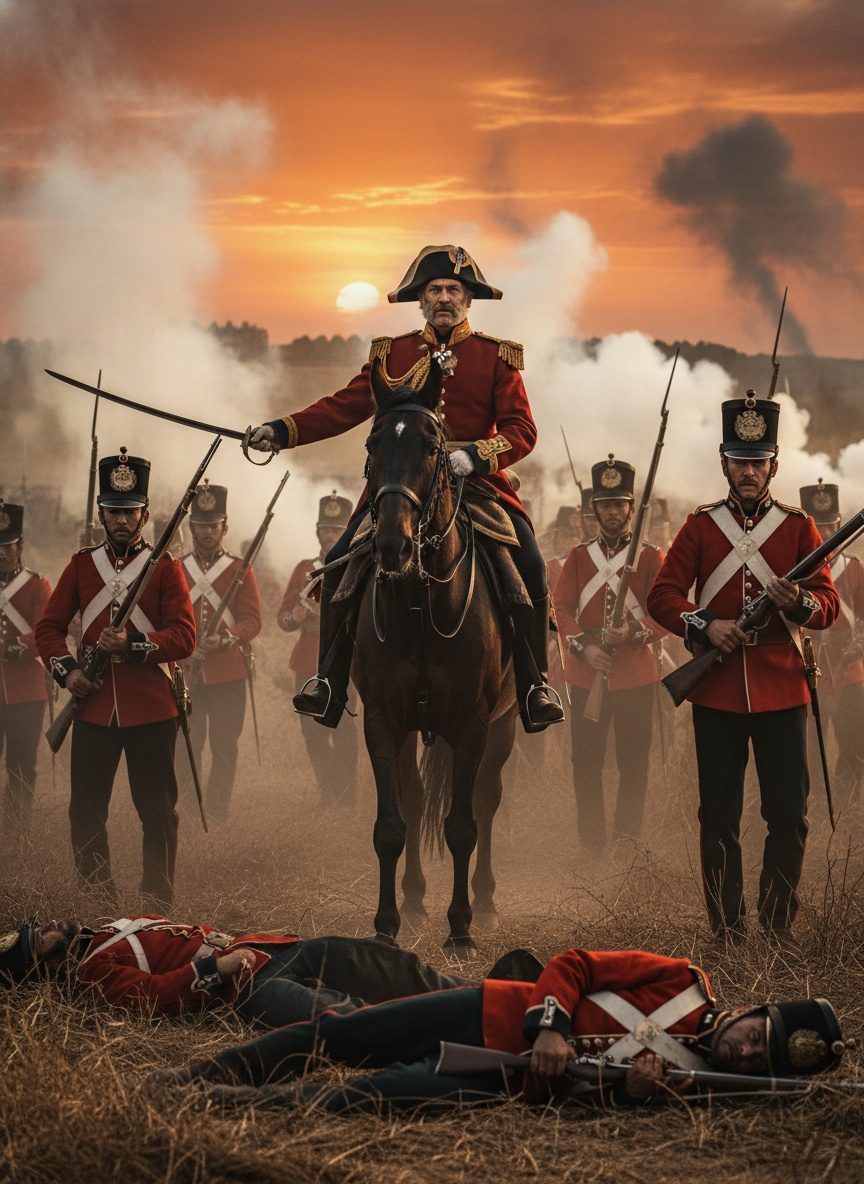
The mists of dawn clung mute and heavy over the plains of Ferozeshah on that fateful December morning in 1845. The cold air seemed to conspire with the smoke from dying fires, shrouding the field in a veil of steel-grey foreboding. Silence pervaded, broken only by the faint murmur of restless men and the distant echo of hoofbeats upon hard earth. Under this indifferent sky, the fate of empires would soon balance on the edge of a whispered command and the flash of bayonets. For two days, General Hugh Gough and his British forces had withstood the punishing might of the Sikh Empire’s battalions, formidable in their numbers and refined artillery skills. The crunch of shattered earth beneath the relentless bombardment was a persistent reminder of the dire stakes at play, as retreat became a tempting suggestion. Yet retreat was not in Gough's vocabulary, and as night gave up its shrouds to reveal the colors of war, he resolved on a course of action that would etch his name irreversibly into the annals of military audacity.
A Determined Defense Against Daunting Odds
As the sun crawled to reclaim the sky over Ferozeshah, it revealed a battlefield that had borne witness to the relentless ferocity of one of the most formidable armies the British Empire had faced in the Indian subcontinent. The Sikh forces, sixty thousand strong, were not only a numerical threat but also masters of artillery. Their cannons, trained under French guidance, spoke with thunderous authority, dominating the field from afar. Their prowess was underscored by their strategic use of the terrain and the sheer determination that characterized the Khalsa Army of the Punjab.
For two days, the British lines had borne the brunt of an artillery barrage that seemed unending. Gough's own artillery, handicapped by its comparatively limited reach, faltered against the disciplined precise fire from the Sikh opposition. The British infantry, seasoned veterans of countless campaigns, found themselves under a relentless deluge that tested even their famed stoicism. Officers and enlisted men alike murmured the unspoken fear—that maybe, just this once, the Empire had met its match.
Yet, among those who commanded, a different silence pervaded. Gough, known for his valor and aggressive command style, saw something others did not. To yield would be to admit defeat, to crumble under the unique discipline that the Sikh infantry displayed. Memories of fierce encounters during this First Anglo-Sikh War echoed in their minds. Memories of scars etched upon skin and psyche, endured long before the coming to Ferozeshah. Deeply aware of the withering morale and dwindling options, Gough's resolve hardened. Under the mantle of twilight, when prudence whispered exit, his mind turned instead to attack.
The Charge Through Smoke and Fire
At the first light of dawn, Gough’s army stood, a huddled force wrapped in determination, braced against the frigid bite of the northern plains. Facing them—the shrouded ghostly ramparts of Sikh defenses, fortified by artillery trained to mow down any advance that came forth. In the silence before the command, each man held his breath in anticipation of battle’s inevitable and chaotic din, a contemplative calm that bespoke the rising storm.
Gough’s order broke the stillness. Bayonets were fixed, and with an echoing war cry, the men surged forward. What followed was a spectacle of shared human resolve against an entrenched and superior force—a rarity in the warfare of such magnitude. Through thick smoke and a cacophony of exchanging volleys, the British lines advanced relentlessly, steel tipped spears of courage piercing the uncertainty of war’s chaos.
The Sikh guns, relentless still, cut swathes through the advancing red coats, yet the momentum built by Gough's gambit refused to relent. Hardened by grim resolve, each step was taken amid a hailstorm of metal. Amidst the smoke and mud, driven by valor and spurred by obligation to their brethren and beyond, past wounds were avenged, and inched towards the enemy's heart they went.
In these moments, the true meaning of the soldier's fortitude was laid bare—an allegory of an iron will against immovable odds. The tide of the battle turned on the precipice between valor and vulnerability, and in this space, Gough’s army found its strength. Their bravery demoralized the defenders, fracturing the very fortifications thought impenetrable, turning the tide in favor of the invaders.
The Legacy of a Reckless Resolve
As the dust settled over Ferozeshah, the ramifications of Gough’s bold thrust were undeniable. The fortress, its walls breached by nothing short of dogged determination, marked a pivotal point in the First Anglo-Sikh War. Viscount Gough had achieved not merely a battlefield victory but had also emblazoned a lesson in the chronicles of war strategy—a lesson as much about defiance and the psychology of confrontation as it was about military precision.
Though celebrated as a tactical triumph, the battle of Ferozeshah also illuminated the hardships of war, and the terrifying cost of command decisions that tread the line between genius and folly. British forces had faced one of the toughest opponents yet, their numbers significantly diminished, and by proxy, a lesson in the measure of empires was set forth. For the Sikh Empire, the battle became a testament to unwavering valor, a reminder that even the most advanced strategies can be humbled by the sheer tenacity and resolve of an unexpected force.
Thus, the legend of Ferozeshah is more than just a tale of strategy and success; it is an exploration of the complex tapestry of human resolve and leadership. Gough’s decision stands as a cautionary tale. Yet, it is also an enduring narrative of resilience, a story underscored by the relentless pursuit of belief—a story of how at the cusp of withdrawal, men chose instead to heed the call of charge, defining destiny with dust-laden boots and glinting bayonets, leaving an indelible trace, forever etched in history. Mere remnants of names and dates capture only a fraction of the human spirit's undying symphony—a legend they left out of the textbooks, speaking the universal language of war and willpower.