
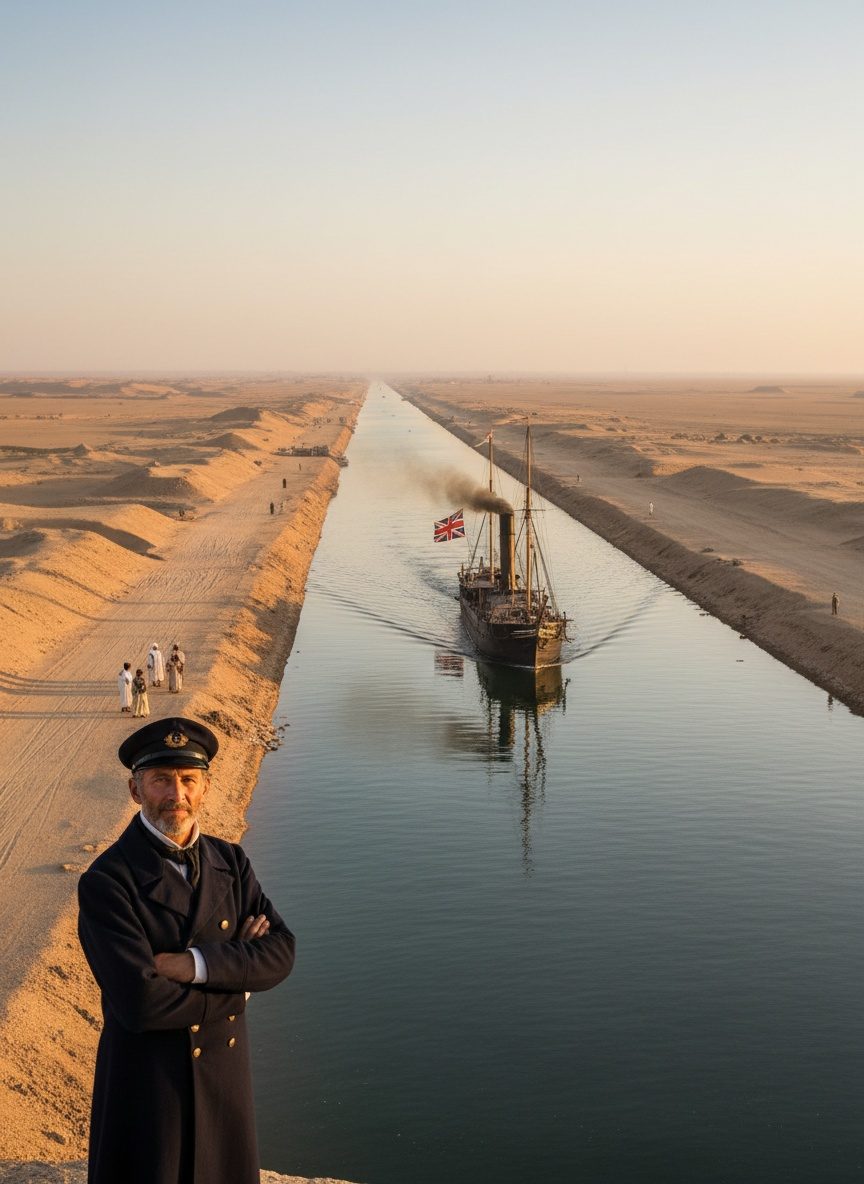
Picture a desolate stretch of desert—a barren land where the harsh sun glares down, and the air shimmers with heat. Now imagine a singular, almost mad aspiration: to carve a channel through this arid terrain to connect two mighty seas. This was not just a fantasy spun by fevered dreams but a tangible, collosal vision that would turn the concept of trade and naval prowess on its head. Welcome to November 1869, when a waterway revolutionized the course of history and reshaped the map of global power. This is the story of the Suez Canal, a Victorian dream turned into the world's commercial artery.
The Audacious Dream: From Impossibility to Reality
Enter the bustling cafés of mid-19th century Paris, where one can almost hear the excited murmurs over steaming cups of coffee. Among the grand ideas floated in these esteemed circles was the audacious plan to dig a canal through the Isthmus of Suez. Ferdinand de Lesseps, a charismatic French diplomat, became the face of this monumental project, drawing inspiration from ancient Pharaonic attempts to connect the Mediterranean and Red Seas.
Yet, opposition loomed large. None other than British engineer Robert Stephenson, a pioneer of the railway age, dismissed the notion as absurd, pronouncing it an engineering impossibility. And why not? The canal would need to be 100 miles long, cut through desert, swamps, and hills. But de Lesseps was nothing if not tenacious. Fueled by the imperial competition between France and Britain and financed by a daring consortium of European investors, construction began in 1859, under the harsh Egyptian sun.
The Herculean Task: Labor, Sweat, and Sand
To stand at the construction site was to witness an industrial marvel in motion. Tens of thousands of workers, recruited from Egypt and across Europe, toiled relentlessly. The early phases of the project relied heavily on manual labor—picks, shovels, and sheer grit moved mountains. Eventually, innovative technology, including dredgers and steam-powered machinery, hastened the canal's progress.
The Suez Canal was completed on November 16, 1869, a triumph of engineering against all odds. When the first ships sailed through, the forgotten laborers were left with only memories of their sweat-soaked toil. Often overlooked is the human cost: thousands of these workers died due to harsh conditions, disease, and malnutrition. Yet, the canal stood as their monumental legacy.
The Corridor of Empire: Britain's Strategic Masterstroke
Though French vision laid the canal's foundations, it did not take long for Britain's strategic interest to crystalize. The canal's completion coincided with the height of the British Empire, an era when the sun famously never set on its vast dominions. Realizing the canal's value for rapid troop movements and an expedited route to the jewel in its crown—India—Britain acted swiftly.
In 1875, in a deft political maneuver, British Prime Minister Benjamin Disraeli purchased the Egyptian ruler's shares in the Suez Canal Company. By 1882, following the British occupation of Egypt, the canal was firmly under British control. An artery that facilitated the flow of silks, spices, and countless other commodities now fell under imperial supervision. The Suez Canal, carrying 12% of global trade by the dawn of the 20th century, became a crux not only of commerce but of military might.
The Lesser Known Struggles: Politics of Passage
The canal's backstory is punctuated with intriguing, lesser-explored nuances. Its geopolitical significance is underscored by numerous skirmishes and diplomatic brouhahas. One often overlooked incident is the Fashoda Crisis of 1898—a standoff between British and French forces in Sudan which nearly flared into war, with the Suez Canal as the tacit prize both nations eyed jealously.
Moreover, during World War II, the canal's strategic importance as a military supply line was undeniable. Recognizing this, the British organized the "Little Theater of War," fortifying it against Axis aspirations. Alongside the very real military skirmishes, the Suez Canal's gates bore witness to the realms of clandestine espionage and subterfuge—a true stage for Victorian intrigue.
A Modern Legacy: Why It Matters Today
Fast forward to present day, and the impact of the Suez Canal is as profound as ever. As an artery navigating the ebb and flow of international trade, it cuts shipping times and distances dramatically, with more than 18,000 vessels passing through its waters annually. A disruption, such as the famous 2021 backlog when a container ship blocked the canal, sends ripples through the entire global economy, starkly demonstrating its essential nature.
Politically, it remains as strategically sensitive as it was at its inception, a chess piece in the Mediterranean and Middle Eastern theaters. As new geopolitical alliances form and climate concerns pressure global trade to reduce maritime carbon footprints, the Suez Canal's significance endures.
The legacy of the canal transcends its Victorian origins—an enduring monument to human ambition and ingenuity. As history flows through its waters, the Suez Canal reminds us of the powerful confluence of dream and reality, of how one man's impossible vision can indeed become a world-changing conduit.