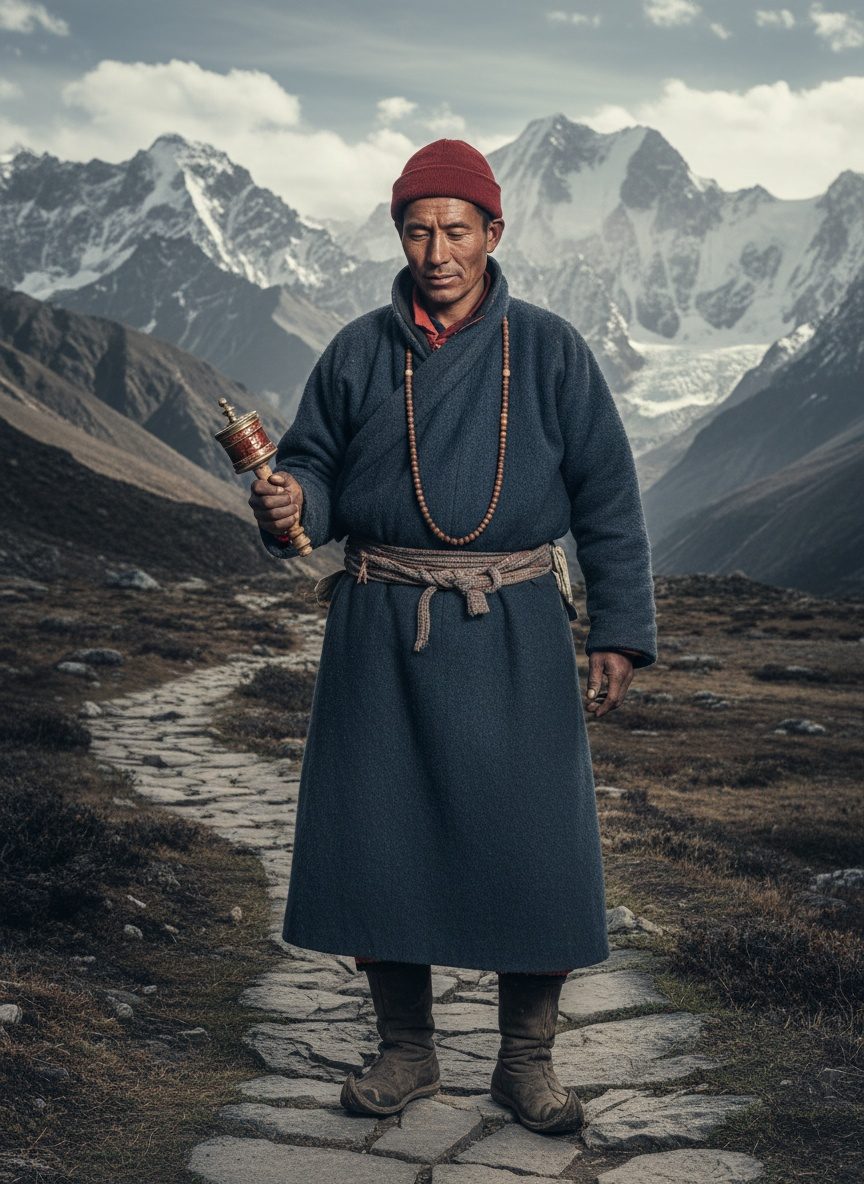
The sun had barely stretched its tendrils over the snow-peaked horizon as he took his first step into history. Clad in the modest garb of a Tibetan trader and armed with nothing but his wits, a prayer wheel, and an uncanny sense of estimation, Nain Singh set out on a mission that would change the contours of the world—or at least, how it was drawn on a map.
The Crowning Jewel of The Victorian Era
The mid-19th century was an era when the British Empire thirsted for knowledge as much as it did land. To govern and expand its sprawling territories, maps were as crucial as muskets. But the roof of the world—Tibet, shrouded in mystery and zealously closed to foreigners—remained a tantalizing blank on those maps.
The British needed eyes on the ground—someone who could blend in, someone audacious but discreet. Enter Nain Singh, a modest schoolteacher from the Himalayan village of Milam. The year was 1857, and the region was simmering with rebellion and upheaval. Amid this chaotic backdrop, Nain Singh received a secret mission from the Survey of India. His task? To slip into Tibet unnoticed and map the uncharted lands that no European could tread.
A Journey Measured in Steps
Clad not in the polished shoes of an officer but the simple sandals of a commoner, Nain Singh embarked barefoot on a journey spanning over 3,000 miles. With the movements of traders and pilgrims as his cover, he crossed through the stunning but perilous passes of the Himalayas, exuding a calm resilience in the face of the ferocious natural elements that had deterred many before him.
His mapping tools weren't the expected theodolite or compass visibly clutched in the hands of a gentleman explorer. Instead, Singh carried them ingeniously hidden: a prayer wheel that held strips of paper and a watch; a rosary with every tenth bead different to keep count of his steps; and a pair of mercury thermometers cloaked as part of his clothing. Even the act of counting his steps was disguised as a devotional activity, something ordinary for a devout Buddhist.
The ground he walked—often with the unforgiving earth biting into his soles—was secretive, forbidden, and alluring. Each measured step, each prayer he chanted aloud, was a covert code of distance that revealed the secrets of the land underfoot.
Into the Forbidden City
Lhasa, the spiritual heart of Tibet and the forbidden city to outsiders, loomed in Singh’s path. No European had stepped foot in Lhasa since the Portuguese Jesuit missionaries in 1661, and they had narrowly escaped with their lives. Singh's entry into the city in 1866 was a remarkable gamble, a high-wire act of human curiosity and courage.
Surviving on the sparse trade of local goods and whatever hospitality he could muster, Singh chronicled the pivotal details of Lhasa's streets—a clandestine catalogue of elevations, latitudes, and cultural observations. His reports, often scribbled in cryptic codes, made their way back over the precarious paths he'd navigated, returning to the Survey of India with the shape of the world cradled within them.
The Return of the Prodigal Cartographer
After years undercover, Singh’s return was not greeted with pomp and fanfare, but his findings quietly reverberated through the corridors of power. By 1875, the British maps of Asia were mirroring new realities, and Singh had etched his place in the annals of history. He’d traversed rivers, scaled heights, and illuminated regions cloaked in obscurity, and all without speaking more than a whisper in public declarations.
Nain Singh’s legacy was formally recognized in 1877 with the Royal Geographical Society's most prestigious honour, the Patron's Medal. His citation praised his "great journeys and surveys," but the quiet schoolteacher remained a man of few words. It was his footsteps—numbering countless millions across treacherous terrains—that spoke volumes.
The Ghostly Footsteps That Shaped Nations
Singh's story is one that resonates with the timeless spirit of discovery and the relentless quest for knowledge. It wasn’t only the maps that changed, but the very essence of exploration was redefined. His courage in embracing the unknown, with the world’s tallest peaks as the backdrop, stands as inspiration today.
In a world now edged by satellites and digital maps, it is essential to remember the bare feet that once trod unfamiliar paths to reshape human understanding. Singh's journey tells us that adventure is not always about the uncharted land but sometimes about ghostly footsteps that indelibly influence how the map of our shared world is drawn. In an age of hashtags and social media, Singh's story humbly beckons us to walk miles in search of knowledge, even when the journey appears impossible.