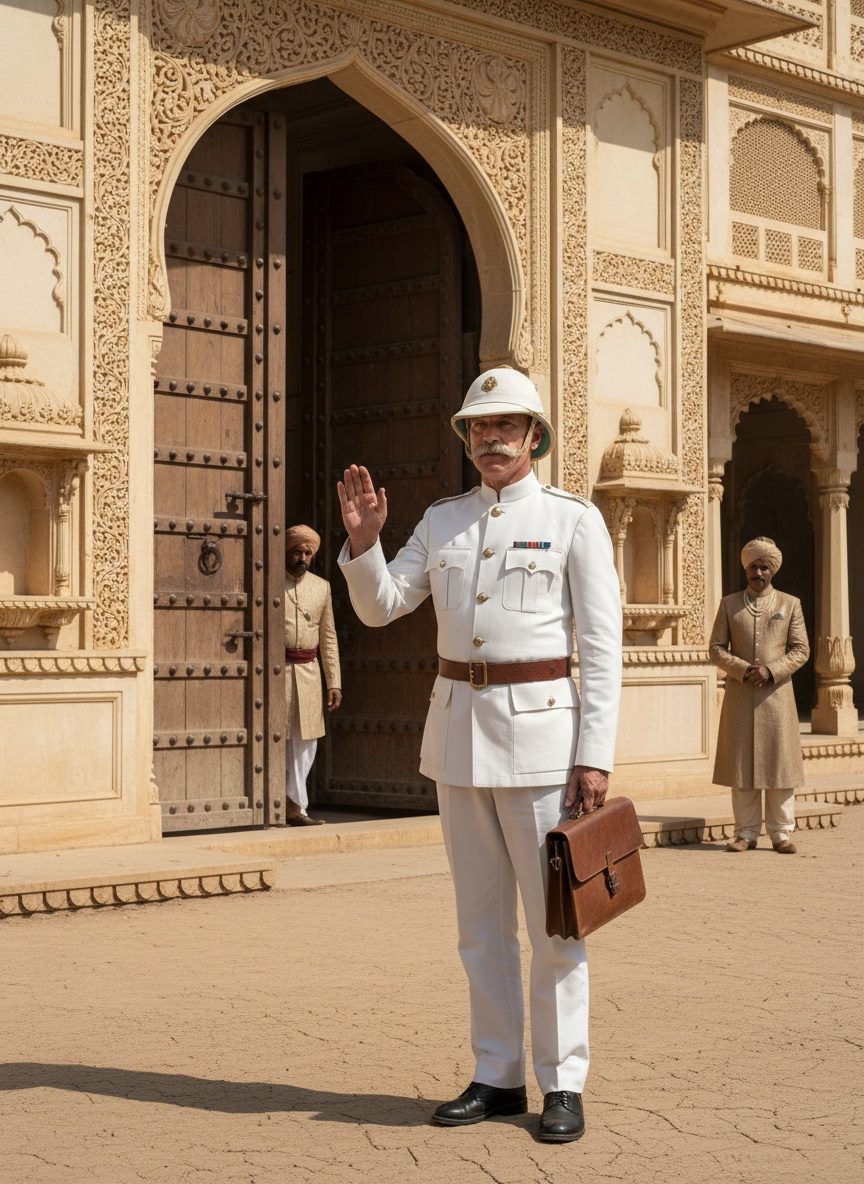
He had never fired a shot in his life. Yet, on one pivotal day in 1881, Colonel James Fergusson faced the fortified gates of the Morvi Palace armed only with a meticulously written letter and an unyielding sense of purpose.
The Unexpected Envoy
Colonel James Fergusson, a political agent then stationed in Kathiawar, was not your typical envoy of the British Raj. Unlike many of his contemporaries who resorted swiftly to military might, Fergusson wielded a different kind of influence. Known for his strategic acumen and diplomatic finesse, he approached conflicts not with an iron fist, but with a mindset aimed at negotiation and mutual respect. Such was his reputation that even the most recalcitrant of rulers reportedly found themselves listening intently to his words.
In Rajkot, 1881, Fergusson faced a daunting challenge. The Maharaja of Morvi had isolated himself within the walls of his impregnable palace, locking the gates and refusing to submit to British oversight. This wasn't just a matter of disobedience; it was a brazen challenge to British authority in a region where control seemed absolute. Without a single soldier at his side, Fergusson relied solely on his authority to sway the Maharaja's resolve.
A Fortress Under Lockdown
To understand the formidable position of the Maharaja, one must visualize the scene at the Morvi Palace. The walls, towering and imposing, stretched out like a giant stone arm around the estate. Behind those walls was a ruler determined to protect his sovereignty against the ever-reaching grip of British imperialism. Guards manned their posts, watchful eyes scanning the horizon for any hint of approaching adversaries.
The Maharaja's defiance was not without cause. The era was rife with tensions, as the British pushed to consolidate their control over India's princely states. Many rulers, like the Maharaja of Morvi, perceived the British officials as overstepping their boundaries, encroaching upon traditional powers that had existed for centuries. Security was tight, gates impenetrable, yet Fergusson approached, undeterred and alone.
The Power Within a Letter
Colonel Fergusson's approach to the stalemate at Morvi was nothing short of extraordinary. Locked out of a fortress and with no army to back his demands, he turned to the power of written words. Handing a letter to a palace guard, he requested that it be delivered directly to the Maharaja. The contents of this letter remained within the palace walls, a private communication between two men of power.
Historians speculate on what the letter contained. Some believe Fergusson had a deep understanding of the Maharaja's personal and political struggles, offering concessions that appealed directly to those concerns. Others suggest that he used a deft combination of promise and threat, implying the inevitability of British victory should conflict ensue but advocating for a peaceful resolution that preserved the Maharaja's dignity and governance.
What is certain is the letter's effectiveness. Within hours, the palace gates that had been resolutely sealed swung open. Fergusson walked out with a signed submission, leaving behind a ruler who had chosen diplomacy over defiance—a remarkable testament to the officer's tactical approach to colonization.
A Quiet Victory with Loud Implications
Fergusson's diplomatic victory in Rajkot might appear as a mere footnote in the grand tapestry of the British Empire's rule over India, yet it holds profound implications. In an era marked by territories often seized through bloodshed and coercion, one officer's triumph through word and compromise demonstrates the potential for nonviolent resolution in political strife.
His methods, eloquently demonstrating that the pen can indeed be mightier than the sword, stand out precisely because they run counter to the aggressive tactics frequently employed by the Empire. The incident at Morvi is a powerful reminder of the complexities of colonial rule, where the art of negotiation could achieve what might and force might not.
As the British Empire's influence stretched across continents, Fergusson's story embodies a subtle, albeit rare, reflection on the potential for dialogue amidst domination. It asks the reader to ponder not just the outcomes of history, but the methods by which such outcomes are accomplished. The true legacy of that day in 1881 is not merely a treaty signed, but an example of diplomacy's intrinsic strength—an enduring lesson for humanity well beyond the borders of Victorian India.