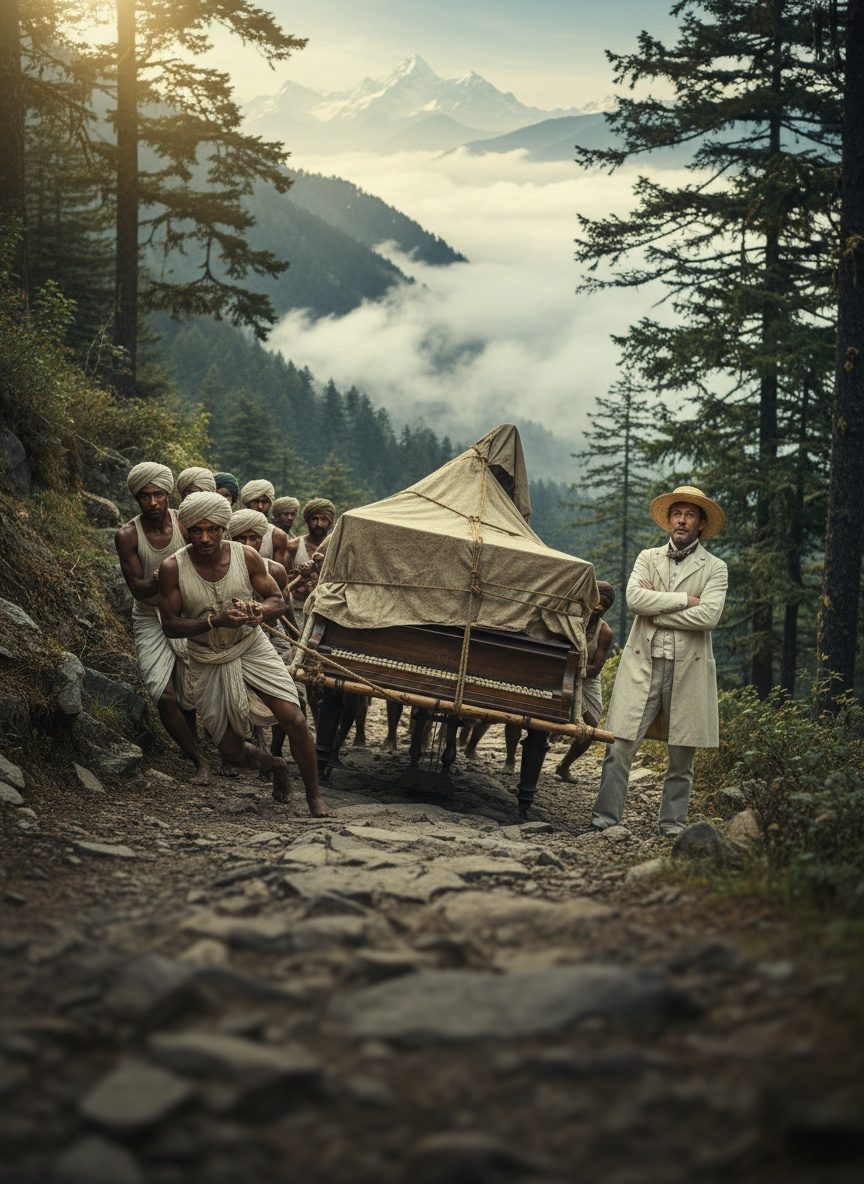
The piano had traveled oceans and plains, yet it was only at the foot of the Himalayas that its journey truly tested human strength. Sixty hill coolies bonded in a singular, extraordinary task that only relentless human will could achieve. What made it more astonishing was not just the weight they bore but the extraordinary elevation they overcame—seven thousand feet against gravity itself.
In the year 1836, as the British consolidated their grip on India, the concept of a summer capital in an obscure hill station called Simla began to take shape. The British, longing for the cooler climes reminiscent of home, had started escaping the sweltering heat of the Indian plains for this quiet Himalayan town. Nestled high in the mountains, Simla was at the threshold of a transformation, morphing from an unassuming hamlet into a microcosm of British society. But in those early days, there were no roads worthy of the name, and certainly none that could accommodate a grand piano's passage by conventional means.
When the piano arrived from Calcutta, its presence wasn’t merely a symbol of colonial luxury; it represented the concerted effort of replicating the homeland’s comforts in an alien land. Transported by ship and then by bullock carts, it finally reached the daunting base of the Himalayas. The last leg of the journey was to be the most arduous and was to be completed not by mechanical means but through sheer human determination and skill. This was a time when muscle and endurance were engines, and a task such as this was a reminder of both human frailty and capability.
The hill coolies themselves were a fascinating element of this tale. Broad-shouldered and wiry, they were acquainted with the hills in ways few outsiders could comprehend. Their livelihoods depended not on what they could extract from the land directly, but on what they could transport across it—loads heavier than their own bodies, for wages measured out in mere coins. Despite the meagerness of reward, the hill coolies demonstrated a resilience that spoke of generations living in harmony with a harsh terrain.
The journey itself was fraught with inherent dangers. Loose rocks, steep inclines, and narrow paths posed threats at every turn. The piano, and sometimes the men themselves, dangled life-threateningly above precipices. Yet, step by methodical step, rope by tightly-held rope, the procession inched ever upwards. The hill coolies relied on an orchestrated sequence of movements, every action in concert, their expertise turning the impossible into the probable. These workers were masters of collaborative balance, using harmonized heaves and shifts to maintain equilibrium.
As the cooler air of higher elevations began to greet them, exhaustion gnawed at their muscles, but the piano itself—the harshly polished ivory keys, the resonant echo of untouched strings—was to be Britain’s majestic offering to the Simla hills. For the gentry who awaited its arrival, it would be the centrepiece of many evenings, a vehicle of cultural superiority; for the coolies, however, it was merely an object, another burden to be carried on their journey of survival.
Recollecting this episode is as much about the piano as it is about the human spirit that overcame what seemed, at first glance, insurmountable. It highlights a forgotten aspect of everyday life in early Victorian India, marked by the excesses and eccentricities of empire but shouldered by unsung laborers. The piano, having reached Simla, would go on to grace drawing rooms and salons, a relic of England’s cultural dominance showcased in the heart of the Himalayas. For the hill coolies, there was no personal legacy to savor, neither fame nor fortune, only the continuation of toil with each day.
Yet, this story also serves to remind us of human endurance and the lengths to which society will go to replicate familiarity in foreign lands. It captures the earliest introduction of Western culture through objects rather than people, threading an intricate tapestry of what was deemed valuable. The trek of the grand piano symbolizes so much more—a struggle against natural obstacles, a man's insistence on supremacy, and a negligible acknowledgment of the toiling many.
In the annals of British colonial endeavors, it is these snapshots of everyday strife and determination that are often overshadowed by grand military exploits and imperial proclamations. While the piano’s music might have eventually filled the halls of the burgeoning British community, it's essential to hear the silent, steady rhythm of the men who brought it there. They may not have played the keys, but they were the ones who made its song possible. This episode stands as a testament to an empire of contrasts, built on the backs of those who, step by rugged step, moved mountains—or in this case, carried a piano high into the skies.