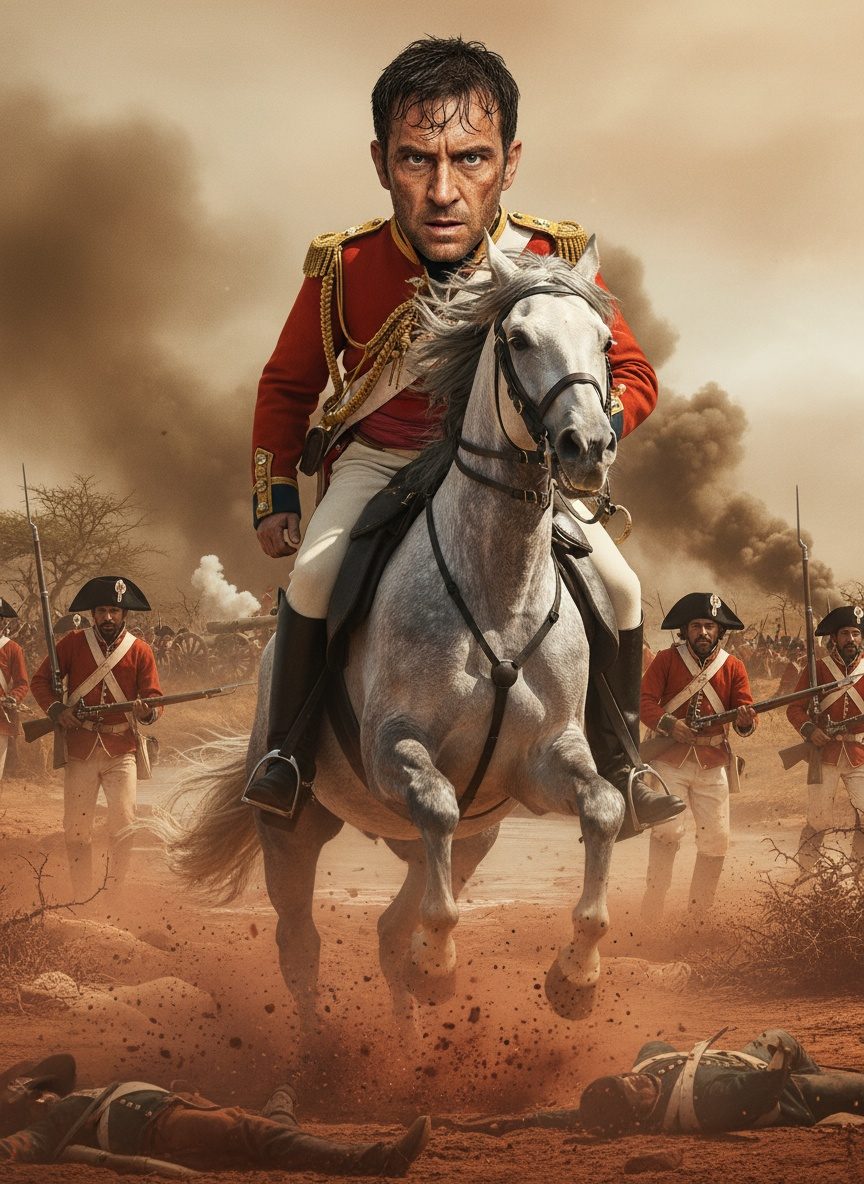
The soil erupted beneath Arthur Wellesley's feet as the cannonball crashed into the earth, spewing dust and chaos around him. The air was thick with smoke and the grim cacophony of battle — a symphony of clashing steel, desperate cries, and the sharp reports of gunfire. Wellesley, his uniform streaked with the blood and grime of battle, pressed forward, undaunted. He was the calm in the storm, a pillar around which his men rallied. Across the field, the enemy was a roiling sea of Maratha warriors, their shouts echoing through the valley as they bore down upon the British line.
It was September 1803 in the heart of India, and Wellesley faced a formidable foe. The Maratha Confederacy, 50,000 strong, represented one of the last great threats to the British East India Company's ambitions on the subcontinent. Wellesley could muster only 7,000 men, making his task seem perilously close to madness. Yet, within this dizzying inferno, Wellesley remained resolute. Only a man with extraordinary courage—or extraordinary folly—would dare lead such a charge. And charge he did, across the unfordable river, into the teeth of an enemy who expected a retreat. His decision was bold, driven by the audacity that would one day make him a legend.
The Battle of Assaye was more than just a strategic confrontation; it was a test of will and endurance. The sun baked the warriors on the field, the heat only matched by the intensity of combat. Wellesley himself was already twice unhorsed, each time snarling to his feet in defiance as if daring the fates to end him. His leadership was more than barking orders; it was the embodiment of resolve, inspiring those around him to defy the overwhelming odds. As the two sides clashed, the battle transformed into a brutal melee, where every inch of ground was won with blood and valor.
Wellesley had chosen Assaye for its strategic position, a pivotal point that controlled the heartland of the Maratha's power. When others might have considered a more cautious approach, he recognized the opportunity to cripple the Maratha army by striking with surprise and force. His military mind, sharp and analytical, saw a path to victory where others saw only potential disaster. Even with his outnumbered forces, he understood that the momentum of the assault itself could become an ally. It was a gamble born out of necessity that relied on the element of surprise and the indomitable spirit of his troops.
Eyewitnesses later recounted the vivid scenes of that day — the ground littered with the fallen, the cries of the wounded rising like an eerie chorus. The river, choked with debris, ran red. For a moment, the courage of the Maratha cavalry threatened to breach Wellesley's line, their charge a tide crashing against the stubborn cliffs of disciplined resistance. Yet despite—or because of—the carnage enveloping them, Wellesley’s men fought like lions. The advantage of experience was on their side, forged in the forge of previous encounters, guided by a leader who demanded nothing less than everything they had to give.
As the battle wore on, each new attack seemed destined to break the fragile line held by the British and their Indian allies. And yet, each time, the line held firm. Strength of arms and strategic cunning were tested, stretched to their very limits. It was in this crucible of war that Wellesley’s leadership crystallized into legend. Here was no young officer seeking glory for glory’s sake—for all accounts, Assaye was his proving ground, a stage upon which he carved out a distinctive military philosophy that favored grit and tactical innovation over sheer numbers.
As dusk descended, casting long shadows over the dismal tableau, the Maratha army’s will finally broke. Exhausted and demoralized, their formidable ranks began to falter. The battle was won, but at a great cost. With victory in hand, Wellesley surveyed the aftermath. Overwhelmed by the sights and sounds of his most arduous battle, the true scale of what he had achieved began to dawn on him. Against all odds, his calculated risk had not merely succeeded; it had resonated with a bold new note that would echo through history.
Wellesley’s victory at Assaye secured British control of central India and demonstrated his ability to handle large armies, earning him the command and confidence to face future challenges. The success at Assaye wasn't just a tactical triumph; it was prophetic of the potential yet to be unraveled in Wellesley’s career. It was here, on this ruddy plain, that the kernels of a once and future greatness took root, destined one day to flourish on the soggy fields of Waterloo. For not only did Assaye portend the rise of Arthur Wellesley, later the Duke of Wellington, it symbolized the burgeoning might of the nascent British Empire, a force that would shape the destinies of numerous nations.
The Battle of Assaye mattered because it was a moment where raw human determination and tactical brilliance collided, producing a narrative that deeply resonates with the human spirit. Wellesley’s conduct was a testament to what leadership under duress could achieve — it transcended simple military victory, rippling into the realms of destiny and history. In the shadows of Assaye’s ruined field lay an understanding that battles define more than lands and borders; they define people, embodying aspirations, fears, and possibilities. Assaye was a story of odds defied, of a singular will holding firm against relentless adversity, and ultimately, of triumph that reshaped histories to come.