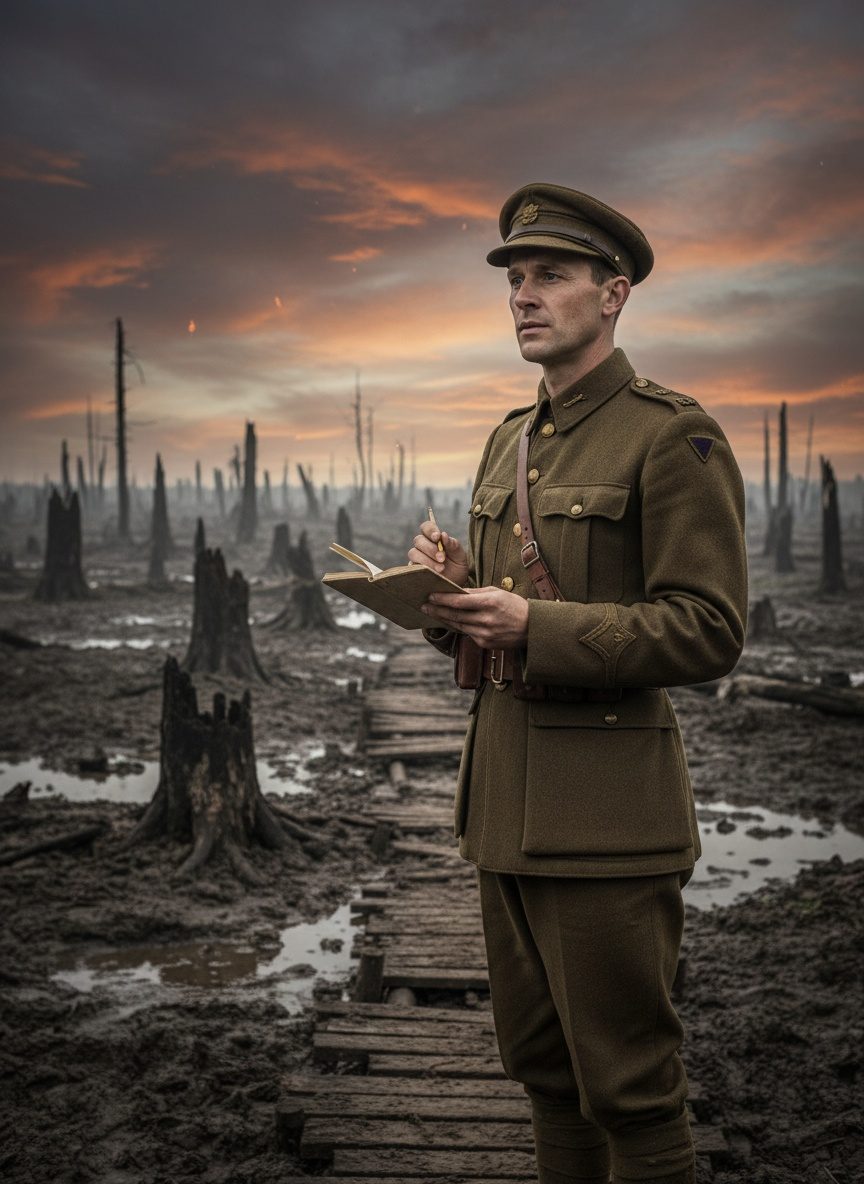
He was trained as an artist before he ever set foot in a battlefield. The thought of painting war had never crossed his mind. Yet, Paul Nash would forever reshape how the world saw the Western Front, not with brushstrokes of glory, but with harrowing admissions of the devastation he witnessed. When Nash was assigned as a British official war artist in 1917, his task was ostensibly to pay tribute to the might and heroism of the Empire’s soldiers. However, the reality he encountered was one few could have imagined, and even fewer dared to depict with such candid, unforgiving honesty.
The extent of the shocking transformation in Nash's perception of war is captured poignantly in a letter to his wife, penned in November 1917 from the Western Front. Here, he described the war-torn landscape as nothing short of a nightmare. The earth itself appeared tortured—mutilated by artillery and scarred with trenches that marred the horizon in grotesque disarray. Nash did not see a battlefield of heroic conquest; he saw the remnants of a world laid to waste, devastated as much by human ambition as by human failings.
Nash, who initially trained at the Slade School of Fine Art in London, had never envisioned himself as a chronicler of war. His early works explored nature and landscapes with an almost reverent appreciation for their beauty. Yet, the Western Front presented a landscape devoid of gentle beauty, replaced by a desolate void where natural and human destruction fused into a nightmarish vista. Instead of verdant fields and serene skies, Nash found himself confronting a horizon lined with shattered trees and crater-pocked earth, a metaphor for the ruined lives and futures lost amidst the conflict.
In less than a year, Nash's artistic vision evolved radically. His series of paintings and drawings from 1917 to 1918 offered the British public a startlingly unvarnished portrayal of the war's grim realities. Unlike the conventional war art of the time, which often spotlighted the valor and triumph of soldiers, Nash's work sparingly highlighted the human figure. He chose instead to focus on the broader destruction—vast, scorched landscapes under oppressive, broken skies. The paintings were stark, raw, and unsettlingly candid, showing no glorified clashes but rather the eerie silence that follows such devastation.
One of Nash's most iconic pieces, "We Are Making a New World," exemplifies this approach. The title itself is laced with irony, as the painting displays a scene bereft of any semblance of life or renewal. The sun, usually a symbol of hope and dawn, hangs over a landscape ravaged beyond recognition. In Nash’s sky, clouds churn malevolently, as though nature itself is complicit in humanity's cataclysm. Bushes and trees lie splintered, set against the distorted ridges left by heavy artillery impacts. Nash’s fractured world was not a harbinger of new beginnings but a grim testament to destruction and loss.
Nash’s critical view did not come without consequences. His works inspired controversy and discomfort among the public and authorities alike. In a period where maintaining morale was paramount, some criticized his paintings as seditious. They offered no comforting illusions, nor did they align with the propaganda ideals of unwavering fortitude. Instead, they forced viewers to confront the stark realities of industrial warfare and its capacity for obliterating not just armies, but entire worlds. It was a jarring shift from the sanitised bravery depicted in recruitment posters and censored newsreels.
Nevertheless, his work found a significant place in the evolving discourse about the war. For many returning soldiers and those on the home front, Nash’s paintings resonated deeply, capturing experiences words could scarcely convey. The art ignited heated debates over the role of war artists and whether their role was to inspire with patriotic fervor or to document and critique. Was it the duty of an artist to sanitize war for the sake of morale, or to lay bare its brutal, tragic essence?
Through his eyes, the Western Front was an indictment of the war’s inhumanity and the futile destruction it wrought. His works stem from a broader movement among artists and writers who rejected traditional depictions of war. This movement sought to convey authentic emotional responses to the conflict, one that often confronted the viewer with horror rather than honor. It marked a shift in cultural narratives and would go on to influence how conflicts were depicted in art and literature for generations.
Paul Nash returned to England permanently altered, both in his view of war and in his role as an artist. The transformations he experienced during the conflict infused his later work, which continued to explore themes of mortality and disillusion interwoven with natural imagery. His time at the Western Front not only impacted his trajectory but also left an indelible mark on the artistic community, challenging future generations of artists to capture the truth of their times, however unsightly it may be.
Today, Nash’s contributions serve as a haunting reminder of the moral complexities and devastating impacts of war—truths as relevant now as they were a century ago. His paintings still resonate, not just as artifacts of the Great War, but as timeless commentaries on humanity’s propensity for destruction and the enduring hope for something better. By daring to depict war's grim reality, Paul Nash opened a window into history's darker moments, compelling us to reflect on the cost of peace and the toll of conflict, witnessed under a perpetually fractured sky.