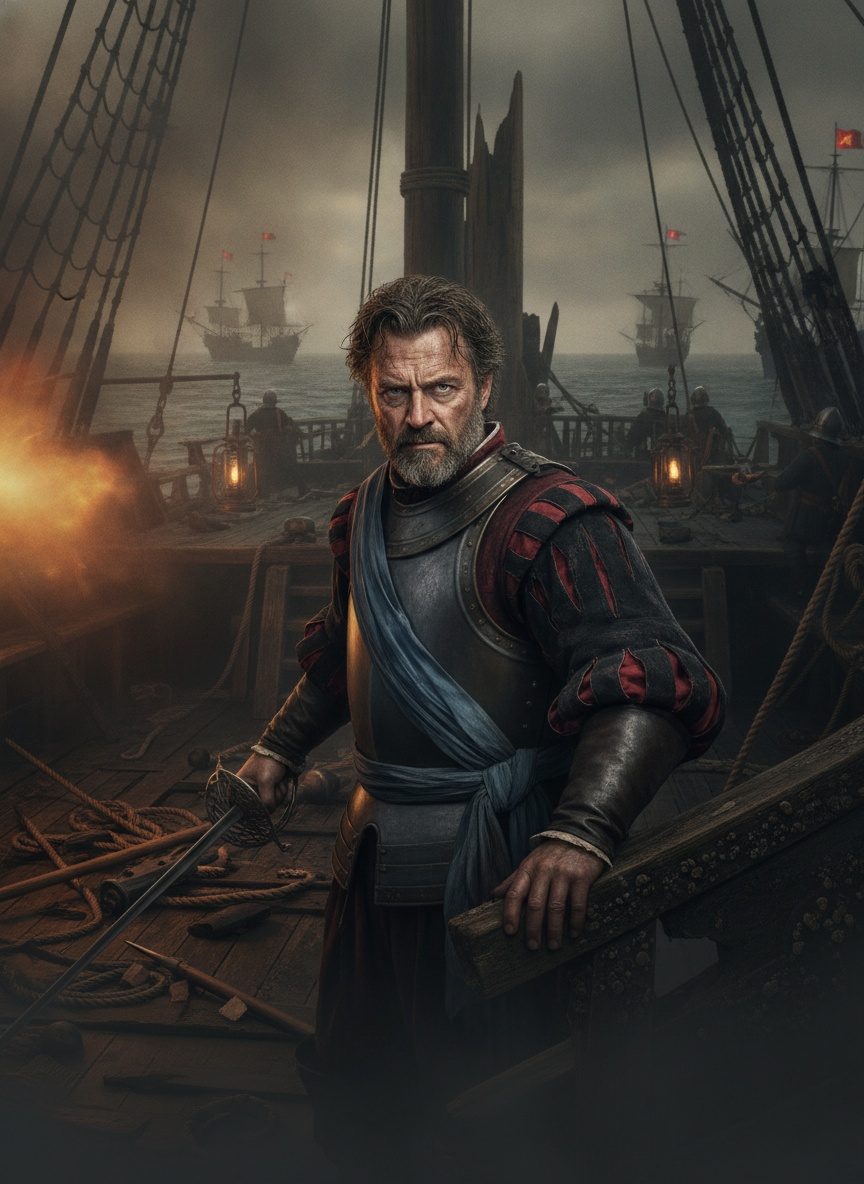
He was a gentleman adventurer in an age of explorers and privateers. Sir Richard Grenville’s resolve was unyielding, even in the jaws of apparent defeat. On one fateful August day in 1591, his unwavering spirit turned the isolated decks of the HMS Revenge into a stage for his legendary final stand.
Charting the Course to Catastrophe
In the summer of 1591, Elizabethan England found itself embroiled in the long, attritional conflict with Spain that would become known as the Anglo-Spanish War. Amid these tensions, Sir Richard Grenville was entrusted with commanding the HMS Revenge, a formidable 46-gun galleon and a symbol of English maritime strength. The mission was clear: capture or disrupt the Spanish treasure fleet’s return from the Americas, a strategic move to cripple Spain’s war effort by cutting off the flow of gold that fueled its empire.
In the vast, endless dance of the Atlantic, the Azores served as a critical waypoint for seafarers. The islands were both a sanctuary and a perilous arena due to their strategic location. And it was near these very islands, on the coast of Flores, that Grenville's fate would be tested against an overwhelming Spanish armada. What began as a daring strike quickly spiraled into desperation as Grenville's solitary battleship found itself encircled by 53 Spanish vessels.
The Infernal Engagement
The evening air held a tension that would soon explode into violence. As the Spanish fleet closed in around Revenge, Grenville faced a choice that would immortalize him in maritime lore: stand and fight or attempt to escape. To retreat would mean certain capture or destruction; to fight would be a dance of death against insurmountable odds. His decision reflected not only his courage but also a defiance against the very concept of surrender.
For fifteen harrowing hours, under the cloak of night, Grenville and his crew met the ferocity of a fully mobilized Spanish fleet with grit and defiance. As wave after wave of Spanish boarders surged onto the decks of Revenge, Grenville countered, leading his men with an indomitable will. The Spanish galleons, their rigging silhouetted like giant specters in the moonlight, closed in relentlessly, each cannon blast rocking the beleaguered English ship.
The Heart of an Unyielding Captain
Sir Richard Grenville was a figure forged in the crucible of the Elizabethan age—a mix of knightly chivalry and pirate pragmatism, embodying the audacity of a man who embraced risk and glory in equal measure. As the night wore on, his personal injuries mounted; shot thrice and grappling with mortal wounds, his defiance did not dim. Grenville commanded his ship with a singular aim: to take as many of the enemy with him as possible.
The human spirit and tenacity of Grenville’s crew were remarkable against such overwhelming odds. Even as comrades fell around him, as decks became slippery with blood and the acrid smoke of cannon fire filled the air, they fought on. Their struggle was not merely physical, but deeply rooted in their refusal to let the Spanish fleet gain the wealth of the Revenge without a cost measured in blood.
The Legacy of Flores
By dawn's light, every man aboard the Revenge lay dead or in the throes of death. Grenville himself, a testament to human endurance and spirit, succumbed to his injuries. Yet, his actions reverberate through the annals of naval warfare, etched forever in the minds of those who value courage and sacrifice. His last request, to be put aboard a Spanish ship and die honorably, speaks volumes of the stoic warrior ethos he embodied, even in his final moments.
But why does Grenville’s doomed defense against the Spanish fleet still capture our imagination? It is not merely the grim romance of noble resistance but the echo of an era where individual valor could contest against empires. In an age of formidable distances and uncertain outcomes, Grenville’s final stand against 53 ships illustrates the boundless capacities of human courage in the face of overwhelming adversity. This story invites reflection: in the heart of every insurmountable challenge, there lies an opportunity for valor.