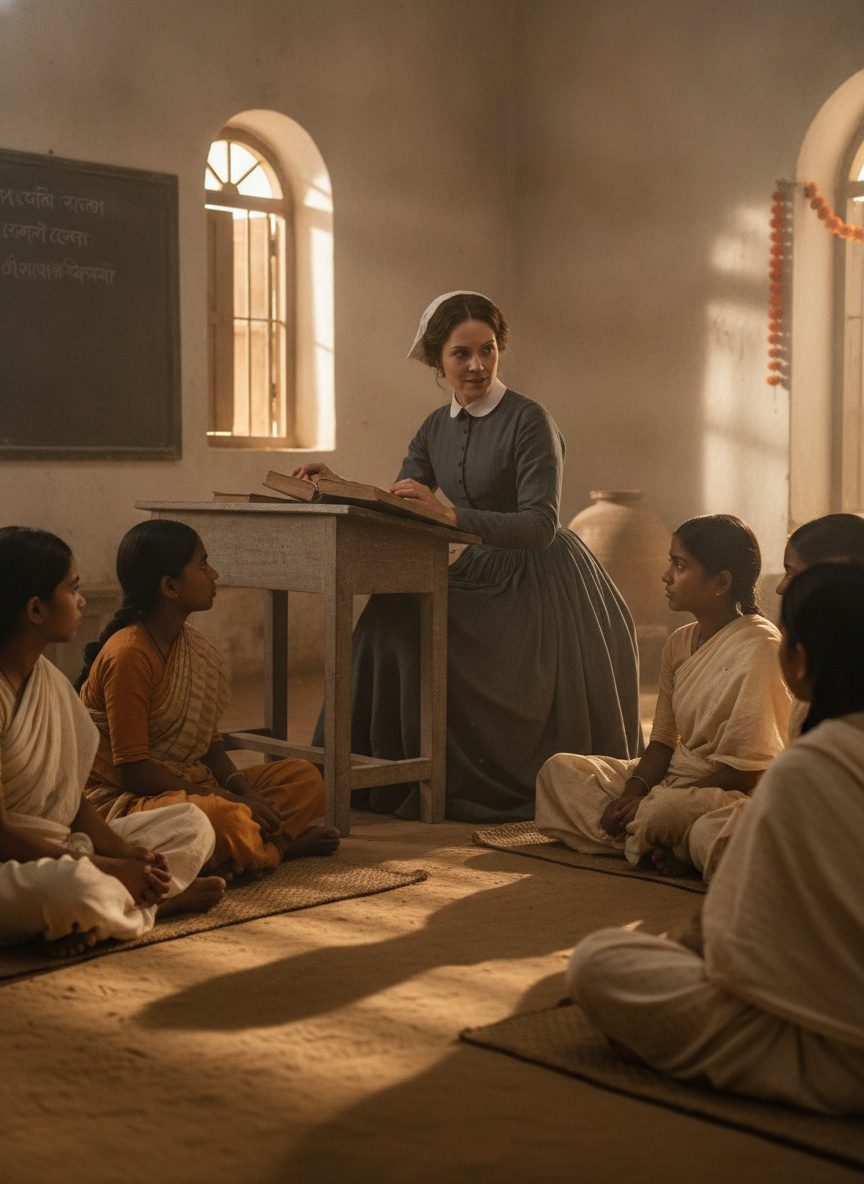
The air was thick with sounds and scents that clung to the bustling streets of Calcutta. Somewhere a hawker called his daily fare, children scampered over cobblestones, and the aroma of korma wafted from a nearby chaiwala. Mary Carpenter stepped into this vivid tableau, her shoes dusted from the worn road and her eyes firmly set on the modest building ahead. Inside, forty pairs of eyes awaited something new, something unheard of—a beacon of learning where none had existed before.
Into the Heart of Calcutta
Mary Carpenter, a resolute schoolmistress from Bristol, had chosen an uncharted path. Unlike the more privileged members of the British Empire who dwelt in Calcutta’s colonial quarters, her feet carried her to where the heartbeats of India’s poorest mingled with the rhythm of daily life. The slums were the arteries of the city, alive with a thrumming that echoed the untold stories, dreams, and deprivations of its inhabitants.
The warren-like lanes where Carpenter found herself were a world apart and yet quietly humming with the potential for change. She did not come with soldiers to enforce her mission or financiers to fund her cause. Instead, she carried only books, slate boards, and a resolve born from a conviction that education was not a privilege but a right. Her attire, modest yet practical, bore the marks of her journey halfway across the world, but her gaze remained steadfast.
In 1849, to establish a school for girls in such a setting was an audacious undertaking. The colonial authorities dismissed her vision as futile—surely the impoverished families here would not see the value in education for their daughters. Yet Mary Carpenter understood something they did not. She knew of the indomitable spirit she had seen in the eyes of her students back in England. She believed Indian girls had the same potential, suppressed not by their abilities but by the circumstances of their birth.
As she opened the door to that cramped schoolroom, sounds of curiosity mingled with waves of shy giggles. Carpenter’s lessons began not with the Queen’s English but in Hindi and Bengali, familiar cadences to bridge worlds. Here, beneath the simple thatch roof, girls squatted on the earthen floor, chalky fingers poised for the first strokes of literacy.
The Language of Change
Each day was a conversation unwritten in the annals of British colonial policy. These young students learned to trace the familiar shapes of their alphabets, their tongues tasting the words their mothers spoke at home. Carpenter’s revolutionary approach lay in the language of the people, as she eschewed English in favor of vernacular instruction. Such methods were radical in their validation of native tongues, contested by colonial purists who deemed English a superior mode of instruction.
Yet for Carpenter, the mission was clear—education in a language these girls could understand, connect with, and transform their worlds through. The school flourished as an island of learning amidst societal currents indifferent to female education. Within a year, hundreds joined this embrace of knowledge, enrolled with eager hearts and deft fingers acquiring the skills that had once seemed the domain of others.
A tapestry of lessons unraveled every day. Mathematics, geography, and stories imbued with morals and courage tested young brains. Between her teachings, Carpenter spilled tales of women like themselves, crusaders who altered fortunes with pens and determination rather than dowries and subservience. Little by little, resistance softened. Fathers and brothers, who once scoffed at a girl’s education, came to admire the reading wonders that these siestas produced after hard day’s work.
Beyond her improvised classrooms, debate grew more pointed in the drawing rooms of the Empire. Whispers of discontent were drowned by compelling evidence. Carpenter's girls read from scrolls; they solved sums as deftly as any son of an East India Company officer. In the quiet revolutions of their homes, they sparked a realization—an educated daughter was not just an anomaly but an asset.
A Legacy Beyond Boundaries
As smog lifted each dawn over the city, Carpenter’s laborious efforts pieced together a mosaic unfamiliar but undeniably potent. She stitched together hope for girls who would otherwise have become part of an indistinct blur in the city’s vastness. Her school, this fragile cradle of learning, defied expectations, transforming from an anomaly to exemplar. The stories it spun into young hearts changed not just individuals but families, neighborhoods, and perhaps the very fabric of society.
No formal dispatch from the Governor arrived to bow to her efforts; no vivid ribbon cutting recorded her year in India’s shadows. And yet, the imprint of Mary Carpenter's solitary venture seeped into wider horizons. Those first forty girls, bright-eyed and fervent, took seeds of esteem from reading and writing into futures once unimaginable. This was the magic of education, without pomp, funding, or colonial prestige.
In the velvety folds of time, Mary Carpenter’s name may fade, yet her impact endures in girls unfurling their potential across generations. Her story is an unsung chord woven into the unscripted songs of the subcontinent—a ballad not just of her own tenacity, but of an unbridled belief in opportunity devoid of cultural or social blinders. As dawn breaks each day, more such tales await the ones ready to carve change, alone if they must, with just courage and a book in hand.