September 1942. Dust was caking into the skin of planes as they sat poised for takeoff on a remote English airstrip.
The Secret Forge Under Churchill's Eye
Hidden away in the shadows of England's towering industrial prowess during World War II was a modest workshop, Churchill's private haven for the unconventional. Here, the air buzzed not with the clattering of heavy machinery but with the whispers of innovation that were destined to change warfare. This was the birthplace of the Welbike—a small, defiant marvel designed for one singular purpose: to grant Allied soldiers a swift, albeit modest, mobility advantage behind enemy lines.
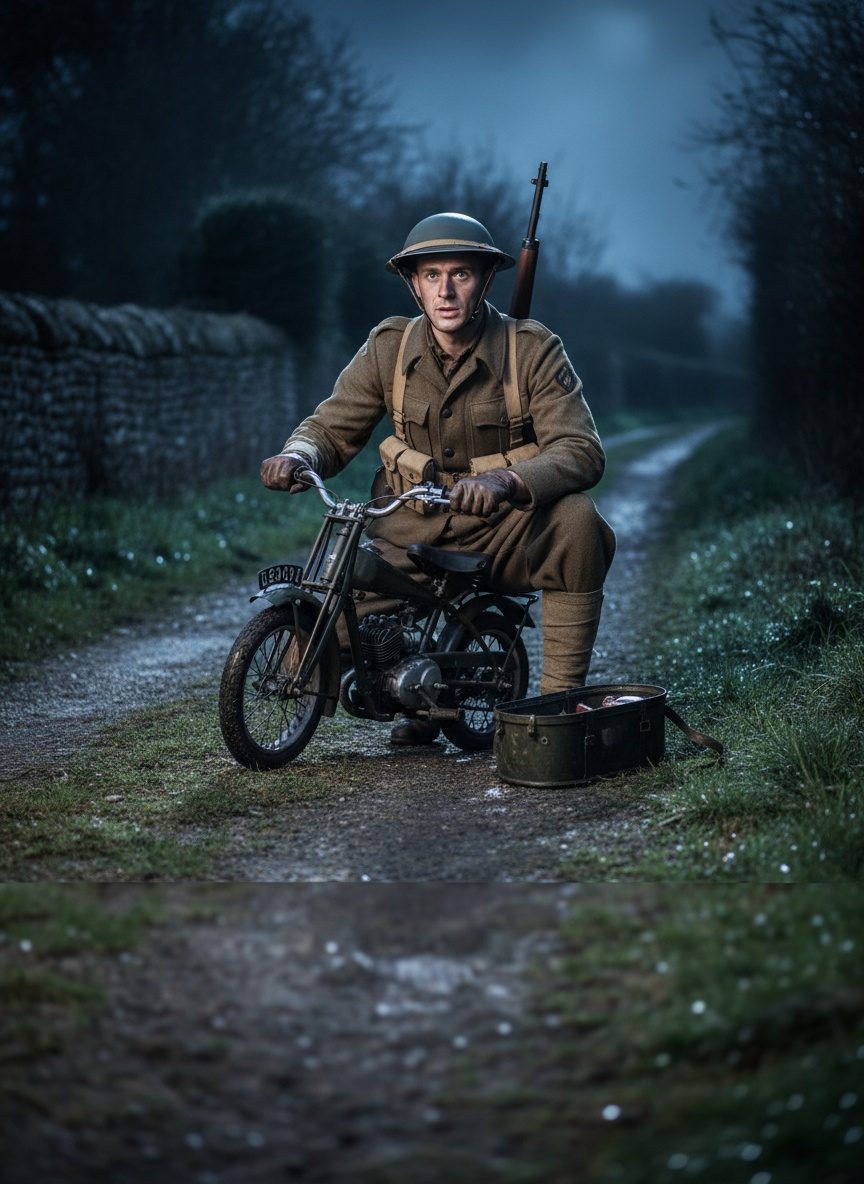
The Welbike was a bizarre blend of necessity and imagination. Inspired by the idea that speed and surprise could turn the tide of battle, this two-wheeled machine could transform a paratrooper’s landing into a fast-paced escape. Weighing just 70 pounds and packed into a standard parachute canister, the bike could be unfolded and ready to carry its lone rider across hostile terrain. An elaborate escape plan secured not through overwhelming firepower but through the nimble utility a solitary motorcycle afforded.
Dropping in the Dead of Night
As nighttime drills honed the skills of the Special Air Service (SAS), they grew accustomed to the unexpected, trained to trust the unknown contraptions handed to them by war tacticians and engineers alike. Let loose into the cover of darkness, SAS operatives would leap from aircraft with little more than a Welbike drop by their side.
Upon landing, no small degree of agility was required to quickly unpack the compact motorcycle from its metal cocoon. The blackened silence of enemy-occupied territories held no sympathy for hesitation. Once assembled, the Welbike promised an edge, a fleeting glimpse of power to evade capture or strike swiftly, depending on the demands of the mission.
Yet, in the quiet corridors of intelligence and strategy, there was always an awareness that what the Welbike offered wasn't raw speed or long-lasting endurance, but rather the chance for survival where there was once only peril. The rush, the roar of its tiny engine, was as eerie as it was encouraging—an embodiment of resilience, carrying its operator a short, crucial distance to opportunity or safety.
An Uncommon Piece of Design
Enveloped by the war's grand, unwieldy machinery, the Welbike was a stark contrast—a testament to the Army’s embrace of ingenuity over sheer brute force. Its design was straightforward: a tiny, single-cylinder engine; no gear change; a pull-start akin to lawn mowers of the era. Built with simplicity in mind, it could reach a top speed of around 30 miles per hour, enough for quick dashes rather than prolonged travel.
Its minimalist frame, lacking even a headlamp, wasn't a limitation but a deliberate measure to minimize what could be destroyed upon landing or discovered in hostile environments. Sturdiness and camouflage were synchronized into a design that required few resources yet demanded adept handling. These spartan builds made them easier to deploy in numbers and allowed for quick dispersion, serving strategic offensives like surprise raids more effectively than standard, bulkier vehicles of the time.
And it wasn't just its mechanical simplicity that played a role; its understated presence influenced the SAS’s role in asymmetric warfare during the conflict. The Welbike wasn’t a tool for brute confrontation but an embodiment of silent defiance—allowing small teams to strike, move, and evade in ways larger, more cumbersome machinery could never facilitate.
The Quiet Legacy of Bold Ideas
As innovative minds churned under wartime pressures, the invention of the Welbike reflected a broader wartime ethos that prized lateral thinking and tactical surprises. While its operational life was short, and the motorcycle isn't remembered as a foreground hero of the global conflict, it underscored a pivotal military truth: that sometimes, the most effective tools aren’t those that overwhelm but those that cleverly circumvent.
In many ways, the Welbike embodies the audacity of wartime innovation—a symbol of speed captured in a whisper and not a roar. It challenged the traditional warfare ideals by equating ingenuity with impactful strategy, and it served to remind that sometimes in battle, it is not the size of the machine that counts, but the surprise it delivers. This small, inconspicuous motorbike, dropping from the sky with the SAS, remains a testament to the era’s clandestine creativity and its unyielding quest to gain advantages in places—and with tools—where none were expected.