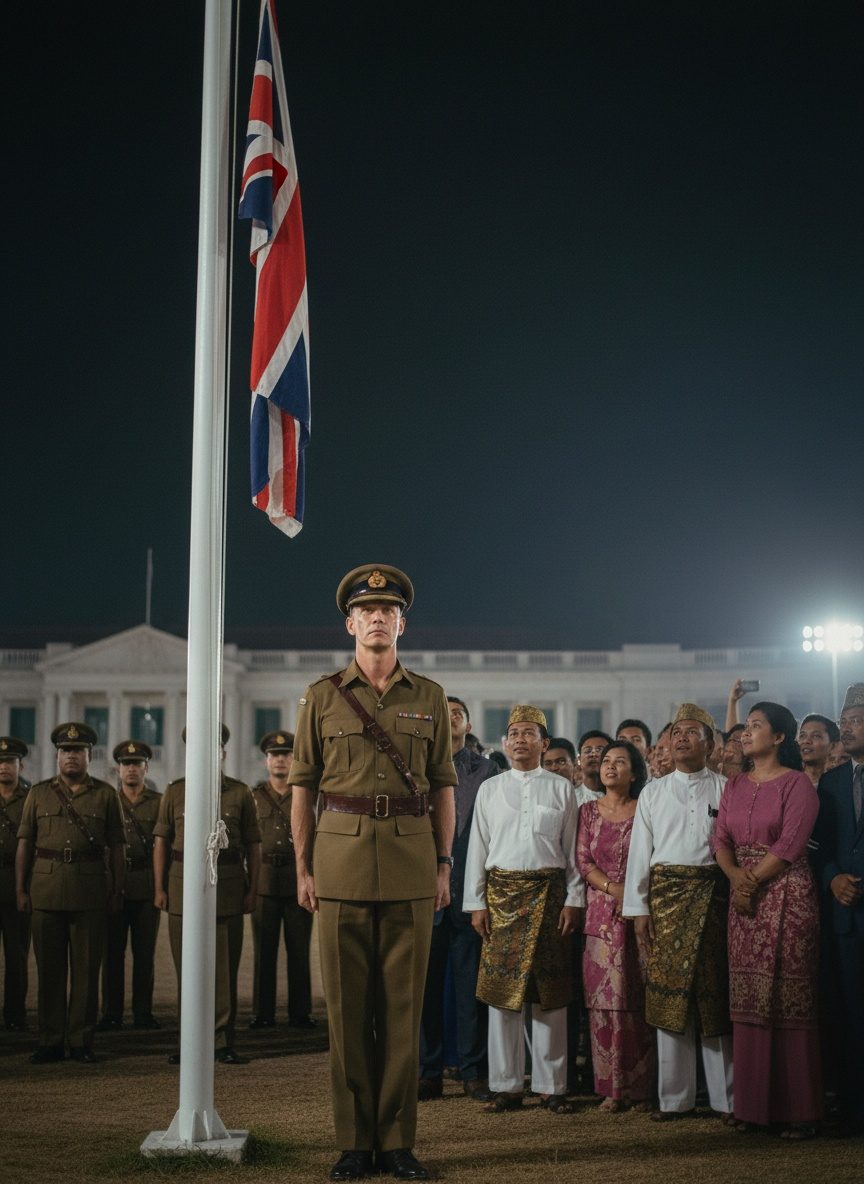
May 14, 1948. The silent streets of Haifa echoed underfoot as the last British soldiers made their retreat.
The Quiet Departure
As the stars blinked overhead like distant signals from history itself, the small contingent of British troops navigated the cobblestone paths of a land soaked in millennia of conflict and conquest. Unlike the grandiose exits expected of a former imperial power, this was a subdued retreat. In the dim glow of street lamps that lined their route to the seaport, there was no ceremonial parade, no brass band proclaiming their exit—just the rhythmic shuffle of worn boots on the ancient stones and a lone sergeant with careful hands folding the Union Jack. This moment, encapsulated in darkness, marked the end of the British Mandate in Palestine.
The Weight of Mandate
The British Mandate for Palestine had begun with the fall of the Ottoman Empire at the close of World War I. Officially entrusted to Britain by the League of Nations in 1920, this region demanded wisdom and tact from its new administrators. It was a land of dramatic contrasts, not only in its arid deserts and fertile plains but socially and politically as well. A tapestry of Jewish and Arab communities interwoven with religious fervor and nationalist aspirations lay beneath the thin veneer of British control.
The mandate was born from a promise: the Balfour Declaration of 1917, which supported the establishment of a national home for the Jewish people in Palestine, while simultaneously stating that nothing should prejudice the civil and religious rights of existing non-Jewish communities. This promise, trying to be 'all things to all people', proved a Herculean task for the British, who found themselves increasingly caught between competing nationalist claims and mounting violence.
Footsteps Echo in History
The departure of May 1948 was more than a mere evacuation of troops; it was an acknowledgment of the end of an era. For thirty years, British officers had patrolled these landscapes, attempting to impose order on a territory indifferent to colonial borders. The soldiers who left that night were not just departing from a geopolitical hotbed but leaving behind a legacy tangled in broken promises and dreams unfulfilled. These footsteps, lost to the rush of modernity, once carried the hopes for peace and stability in a land that seemed perpetually at odds with itself.
As they boarded their transport ships under the shroud of night, the soldiers likely reflected on the countless events indelibly linked to their presence: the 1936-39 Arab Revolt, the tumultuous post-war influx of Jewish refugees keen on establishing a homeland, and the subsequent violent clashes that underscored the failure of diplomatic efforts. It was a heavy burden to carry, the realization that they were leaving an unresolved conflict that was far from a peaceful solution.
A Kingdom’s Reluctant Withdrawal
This quiet departure also mirrored a larger trend of British decline on the global stage post-World War II. The Empire, once boasting territories on which the sun never set, was rapidly retrenching, exhausted by war and unable to finance its expansive commitments with a war-torn economy. The labour government, led by Prime Minister Clement Attlee, recognized that Britain's imperial overstretch could not continue. The era of decolonization was approaching its zenith.
Palestine was one of the crown jewels marked for relinquishment. Pressured by escalating violence and international diplomatic failures, Britain handed the intractable question of Palestine to the newly formed United Nations in 1947. The UN proposed a partition plan, which only served to sharpen hostilities. The British thus decided, in a move marked more by necessity than willingness, to end their mandate and leave the future of the Holy Land to its inhabitants.
The Silent End and Its Resonance
The faint echoes of those departing boots may have dissipated quickly that night, but their resonance lingered on through history. The day after the British withdrawal, David Ben-Gurion proclaimed the establishment of the State of Israel, igniting the 1948 Arab-Israeli War, and setting off decades of conflict that continue to shape global affairs. The British departure was not merely a retreat but an acknowledgment that their role was at an end, underlining the limits of imperial power and the complex legacies it leaves behind.
As the world turned its eyes away from the last British steps on Palestinian soil, it looked tentatively to a new world order taking shape amid the Cold War tensions. That night, under a shared canopy of stars, a part of the imperial past slipped into memory, leaving behind a region poised on the knife-edge of history’s unfolding drama—a stark reminder that sometimes in silence, the most profound historical shifts are made. In leaving Palestine, the British not only ended a mandate but underscored the fundamental truth of empires: they rise and fall, but the stories they engender remain, waiting to be told and retold in the textbooks of posterity.