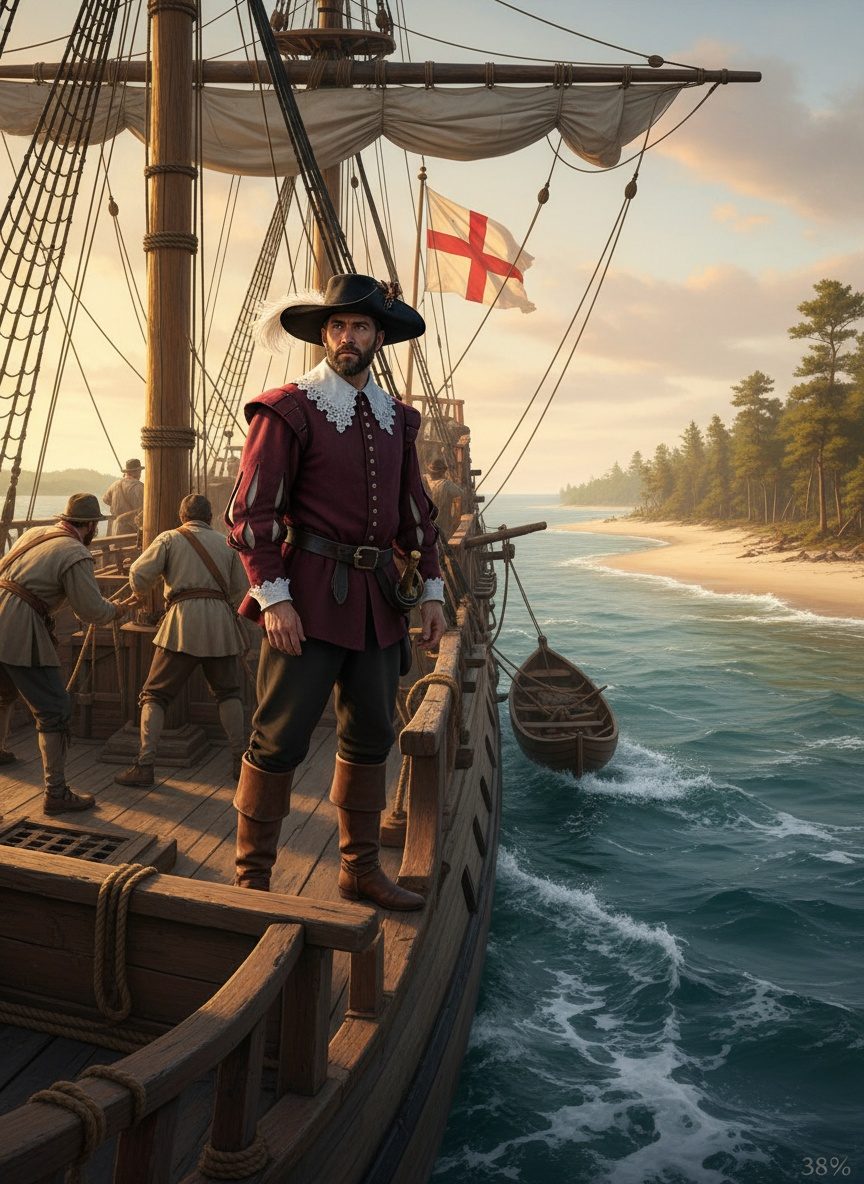
The sea was a heaving mass of chaos, the deck tilting precariously as Sir Richard Grenville tightened his grip on the ship's railing, the salt spray stinging his wind-weathered face. Around him, the eager bustle of the crew mingled with the roaring of the Atlantic, a living testament to Elizabethan valour and ambition striking forth into the great unknown. The year was 1585, and the very idea of a New World promised limitless possibilities for glory and riches. Grenville, a man both bold and unyielding, had been entrusted with the task of establishing England’s first colony in North America — a testament to his unwavering conviction in the dream of empire.
Among the seven ships under his command, the largest enterprise yet undertaken by England to cross the vast Atlantic, anticipation was palpably mixed with apprehension. Navigation charts were scarce and unreliable, mere whispers of the treasures and dangers that lay ahead. The crew and 108 settlers aboard were stepping off the map into uncharted territory. Their destination: a slender strip of Carolina sand, its shimmering mirage fraught with promise and peril, known today as Roanoke Island.
As the cumbersome vessels approached the unfamiliar coastline, an ominous beauty spread before their eyes. The dense foliage of the island crowded the shore, a lush green bracing against the relentless rhythm of the waves. With no roads, no fortifications, and no certainty of return, it seemed an outlandish backdrop for the nascent outpost of an empire. Yet, on that strip of land, Grenville envisioned the dawn of an English legacy in America, despite the palpable absence of tangible infrastructure or assurance.
As the settlers set foot on the new land, the task ahead unfolded with daunting immediacy. There was no time to bask in the wonder of their surroundings. Tools hit the earth with determined regularity, sweating brows drawn with purpose. Under Grenville’s stern supervision, they began to erect rudimentary shelters, a burgeoning testament to England’s claim over this corner of the world. It was a task that bordered on the impossible, and yet, there they stood, driven by duty, the spirit of adventure, and dreams of prosperity that lay hidden beyond the horizon.
Yet Grenville was no mere bystander to this historic venture. In an unenviable act of leadership, he ventured off-camp to gather crucial provisions from the surrounding lands, accompanied by a select group of men. They sought corn from native tribes—a substance both strange and vital to their survival. The Native Americans, with whom relations were as yet untested, watched with a wary eye as these strangers forged an uneasy understanding, granting them aid but guardedly protective of their own resources.
Time in Roanoke seemed to stretch and blur, each day a blend of hard labour and tentative discovery. The settlers' struggles soon revealed the harsh realities underpinning their romanticized odyssey. Yet their spirit proved indomitable; the vision of a future carved from the wilderness bound them in shared purpose. John White, an artist among them, painted vivid depictions of the strange new world, capturing in intimate detail the very essence of their surroundings, while also documenting the daunting challenges inherent in this fledgling society’s birth.
But time and tide wait for no man. Grenville, needing to return to England for supplies and additional settlers, faced the turbulent Atlantic alone. The bond between him and his expedition now tested by distance and uncertainty, he carried with him hopes as fragile as the canvas sails billowing above. Back in England, his report was to serve as a beacon shining for other investors and adventurers to continue what had been started amidst the dunes and marshes of Roanoke.
But what of the settlers Grenville left behind? Abandoned to their own fates under the leadership of Ralph Lane, these pioneers grappled with unforeseen challenges. The island’s beauty borrowed heavily from the danger lurking beneath its idyllic facade. As rations dwindled and relations with Native American tribes grew strained, survival bred angst and discord. Tensions ignited, echoing the broader geopolitical tensions that raged half a world away. With storm clouds gathering, the promise of Grenville’s return seemed a distant glimmer trailing the horizon's edge.
Human resilience can wax as fiercely as it wanes. For these men, far from the cobblestones and bustling markets of home, each decision was of life-and-death magnitude. With leadership split between hope and scepticism, Lane took decisive action to relocate the settlement inland — a confounding manoeuvre requiring every ounce of cooperative spirit among the settlers, and one that dealt fateful consequences when Grenville eventually returned to find the site deserted.
As the winds of fate shifted, the narrative of Roanoke became one more intricate thread in the tapestry of English colonial aspirations. These hardy souls, setting forth with nothing assured and everything at stake, forged the piercing question that history would forever echo: what happened to the community Grenville and his intrepid settlers fought to establish? In their shadows, the lost colony of Roanoke offered no answers, only mysteries to whisper in the annals of time.
It matters now not just because it was first, nor because it was a puzzling enigma barely pierced by the passage of time. Rather, Roanoke’s tale serves as a reminder of the human spirit’s boundless quest for something beyond the familiar; a legacy of courage and vision despite insurmountable odds. When Richard Grenville sailed into the unknown for the threads of empire in 1585, he ignited a journey — one that rendered the distance from a firm English foothold to a contentious new world incalculably profound and ceaselessly intriguing.