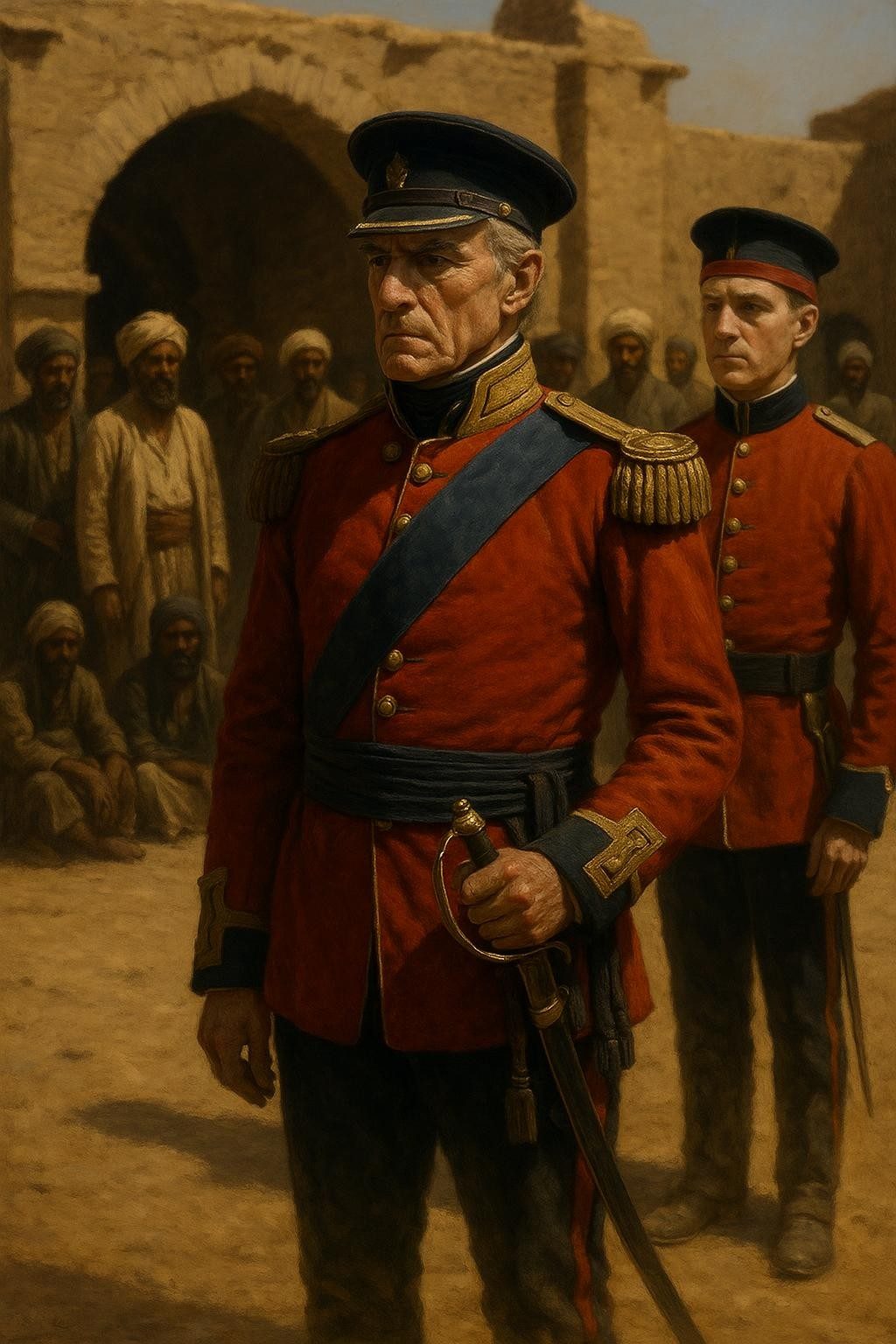
The air in the bustling market was thick with the cries of hawkers and the pungent scent of livestock mingling with human sweat. Sir Charles Napier, with steely resolve etched into his weathered face, stepped into the dusty throngs of Sindh's slave market. His sharp eyes cut through the swarming mass of traders and shackled souls like a blade. Barely a fortnight had passed since his astonishing victory over the Amirs of Sindh. Now, he found himself staring at the vestiges of a practice that grated against both his moral fiber and his nation's lofty ideals. He had little patience for debates back in London, where policy was mulled over in committee rooms with lacquered mahogany tables. Here, action was the currency of the realm.
The year was 1843, and the Victorian Empire had set its sights on the Sindh region of what is now Pakistan. General Sir Charles Napier, commanding a modest force of 2,800 men, had achieved a tactical miracle by overcoming the numerically superior force of 30,000 soldiers loyal to the Amirs. The battle itself was the stuff of legend, a testament to British military strategy and the audacity of Napier himself. But this triumph was not to be the defining moment of his career. That acclaim would come not from bullets and banners, but from a single, audacious act of defiance against the social conventions of the land he had conquered.
Napier surveyed the market with a determined gaze that belied the chaos around him. He had heard tales of the trade that transpired here, of human beings bought and sold like chattel, mere commodities in a transaction. Yet standing there amid the din, the reality struck him with a gruesome clarity. The irony was not lost on him; as a representative of an imperial power known for its own controversial history elsewhere, he was determined to bring an end to this specific chapter of human misery in Sindh.
With no time to waste and little inclination for bureaucracy, Napier gathered his officers and announced his intentions. There would be no committees, no lengthy discourses to ponder the ethics of his mission. He would shut these markets down by force if necessary, and dare any man to challenge his authority. The clamorous dealings paused, eyes turned towards the centre where Napier stood, soldiers flanking him like sentinels of justice amidst a tyrannical pastime. Authority emanated from his very being; he had conquered Sindh through steely resolve and cunning—now he would conquer its conscience.
The scene that unfolded was harrowing yet profound. Chains clinked as slaves awaited their fate, stoic and resigned. Traders, some aghast, others defiant, narrowed their eyes at the foreign general who dared interrupt their ancient commerce. Napier, unfazed, moved with an imperial air, juxtaposed oddly with the compassion in his voice as he ordered the release of captives whose eyes betrayed flickers of incredulous hope. With a nod, British soldiers dismantled auction stalls, untethered the bonds of the enslaved, and watched them find freedom in slow, hesitant steps. The market, once boisterous with the banter of salesmen, fell silent save for the whispers of the bewildered.
While Londoners sat in drawing rooms debating the expansion of their empire, few realized a new type of conquest was unfurling on the frontier—one of ideals over indifference. What Napier initiated was no small insurrection; it marked a shift, however localized, against the backbone of an entrenched system. Word of his actions would eventually circle back to the corridors of power in Britain, where the inertia of progress often colluded with vested interests. Yet none challenged Napier's unilateral decision, his authority perhaps buttressed by the tangible change he had wrought amidst the dust and desperation of the Sindh markets.
In time, whispers of Napier's deed spread beyond Sindh, a rippling reflection in the broader dialogue of the Empire’s moral responsibilities. The very land under British heels had witnessed many complexities. Where the white man's burden was oft cited, seldom was it exercised with such decisive clarity. Napier had acted not merely as a conqueror, but as a catalyst for a sliver of justice that transcended military triumph. The standards of one land had been planted into another, not only as a symbol of dominion but as a beacon of a potential new social norm.
As the dust settled and the slave market became a specter of the past, Sir Charles Napier’s audacious act lived on in memory, a vivid reminder of the complex interplay between conquest and consequence. In a world still navigating the reverberations of empire and liberty, it is here, in the resolute acts of individuals like Napier, that we uncover the fragmented echoes of struggle and hope. The legend of Napier’s audacious stand in Sindh, though perhaps forgotten amidst the annals of Victorian conquests and imperial policies, endures as a fascinating testament to the power of individual agency against the tide of human exploit. It serves to recall how the contours of history are often determined not just by those who draw lines on maps, but by those who dare to redraw the lines within hearts and minds.