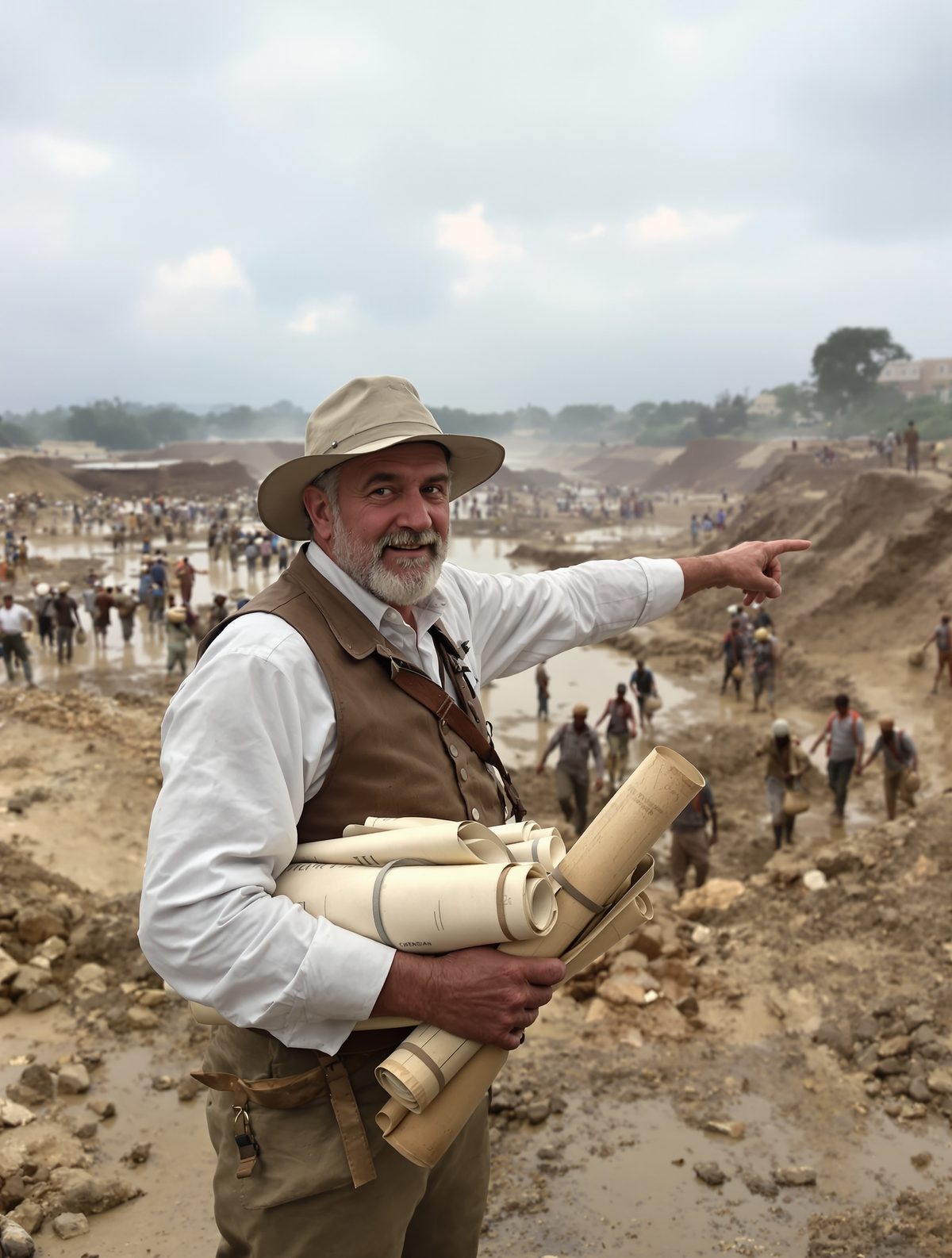
The dust kicked up by two thousand boots marching across the Nigerian savanna could be seen for miles. It was March 1903, and High Commissioner Frederick Lugard was leading what many considered a suicide mission straight into the heart of one of Africa's most powerful empires. Ahead lay Sokoto—a city that had never fallen to foreign invaders, protected by walls that had stood for a century, ruled by a Sultan whose authority stretched across territory larger than France itself.
Lugard's aide-de-camp rode up beside him, squinting through the shimmering heat at the distant minarets. "Sir, the scouts report the Sultan has called up every able-bodied man in the region. We could be facing fifty thousand warriors."
Lugard adjusted his pith helmet and smiled grimly. "Then we'd better make sure we don't give them time to organize."
The Empire That Time Almost Forgot
Most people today have never heard of the Sokoto Caliphate, yet at its peak it was one of the largest empires in Africa—and one of the most sophisticated. Founded in 1804 by the brilliant Islamic scholar Usman dan Fodio, it stretched across what is now northern Nigeria and parts of Niger, Cameroon, and Burkina Faso. This wasn't some collection of scattered tribes, as colonial propagandists later claimed. This was a highly organized Islamic state with its own currency, postal system, and universities that attracted scholars from across the Sahel.
The capital, Sokoto, was a marvel of Sudano-Sahelian architecture. Its Great Mosque could hold ten thousand worshippers, and its markets buzzed with traders speaking Arabic, Hausa, Fulfulde, and a dozen other languages. Caravans arrived daily carrying salt from the Sahara, kola nuts from the southern forests, and Islamic texts from Cairo and Baghdad. The Sultan's palace alone covered several acres, its towers rising like brown fingers against the endless blue sky.
By 1903, Sultan Attahiru I ruled this empire with absolute authority. His word was law from the edge of the Sahara to the banks of the River Benue. Fifteen million people called him Amir al-Mu'minin—Commander of the Faithful. His cavalry could summon twenty thousand horsemen at a moment's notice, their chain mail glinting as they thundered across the plains with lances lowered and war cries echoing like thunder.
The Unlikely Conqueror
Frederick John Dealtry Lugard was an odd choice to take on such a formidable opponent. Born in India to missionary parents, he was a career soldier who had spent most of his adult life in Africa's forgotten corners—fighting Arab slave traders in Nyasaland, establishing trading posts in Uganda, and leading punitive expeditions that rarely made headlines back in London. At 45, he was considered past his prime by many in the Colonial Office.
But Lugard possessed something his younger, more polished colleagues lacked: an intimate understanding of how power actually worked in Africa. He had spent decades watching European administrators fail spectacularly because they didn't grasp local politics. While others saw chaos and primitive tribalism, Lugard saw sophisticated networks of authority that could be co-opted rather than destroyed.
When the British government appointed him High Commissioner of the new Protectorate of Northern Nigeria in 1900, they gave him an impossible mandate: bring 255,000 square miles of territory under British control with an annual budget of just £100,000. For comparison, the British were spending twenty times that amount administering a much smaller territory in southern Nigeria.
Lugard's solution was as brilliant as it was cynical: indirect rule. Instead of replacing local authorities with British administrators, he would work through existing power structures. Chiefs would keep their titles and much of their authority, but they would answer to British Residents who would guide policy from behind the scenes. It was colonialism with a velvet glove—cheaper, more efficient, and far less likely to provoke the kind of massive uprising that had just cost the British dearly in South Africa.
The Gathering Storm
There was just one problem with this elegant plan: Sultan Attahiru had no intention of becoming a British puppet. When Lugard's envoys arrived in Sokoto in 1902 carrying the usual colonial ultimatum—submit to British authority or face the consequences—the Sultan's response was unambiguous. He would rather die as a free Muslim ruler than live as a colonial administrator's lackey.
The Sultan had good reason for confidence. His spies reported that Lugard's entire force consisted of just 2,000 men—a mixture of Hausa soldiers from the south, Yoruba recruits who had never seen the northern plains, and a handful of British officers who looked barely old enough to shave. Against this modest force, Attahiru could field not just his regular army of professional warriors, but also the traditional levies—every able-bodied man in the Caliphate who owed military service to his emir.
What the Sultan didn't fully appreciate was how those 2,000 men were equipped. Lugard had learned from Britain's disasters in the early colonial wars. His soldiers carried the latest Lee-Metford rifles and were supported by four Maxim guns—weapons that could fire 500 rounds per minute with devastating accuracy. More importantly, he had two 75mm field guns that could punch through the mud-brick walls that protected northern Nigerian cities.
But technology alone wouldn't win this campaign. Lugard's real weapon was intelligence. His network of informants had spent months mapping the political fault lines within the Caliphate. He knew which emirs were loyal to the Sultan and which harbored secret grievances. He understood the delicate balance between the Fulani aristocracy who ruled and the Hausa peasants who farmed. Most crucially, he had identified the one weakness in what appeared to be an impregnable empire: speed.
The Lightning Campaign
Lugard's plan was audacious in its simplicity. Instead of the slow, methodical advance that military doctrine recommended, he would strike like lightning directly at Sokoto itself. If he could capture the capital and the Sultan before the scattered emirs could concentrate their forces, the entire Caliphate might collapse like a house of cards.
The campaign began on February 12, 1903, when Lugard's column crossed the Kaduna River and entered Caliphate territory. His first target was Kano, the great trading city that served as the Caliphate's economic heart. The city's walls were thirty feet high and four miles in circumference, defended by thousands of warriors whose ancestors had never known defeat.
The siege of Kano lasted exactly one day. Lugard's field guns opened breaches in the ancient walls, and his Maxim guns swept the battlements clear of defenders. By evening, the Union Jack flew over a city that had been independent for a thousand years. The Emir of Kano, watching from his palace as centuries of tradition crumbled in a few hours, reportedly said, "Today the world has changed, and we must change with it or perish."
But Kano was just the beginning. Leaving a small garrison to hold the city, Lugard pressed on toward Sokoto with almost reckless speed. His column covered twenty miles a day across terrain where European armies weren't supposed to be able to operate at all. Local guides, intimidated by the ease with which Kano had fallen, began deserting their posts with the Sultan's forces and offering their services to the British.
By March 15, 1903—barely a month after crossing into Caliphate territory—Lugard's advance guard was looking down at Sokoto from the surrounding hills. The city spread below them like something from the Arabian Nights, its minarets catching the late afternoon sun, its markets still bustling with traders who didn't yet realize their world was about to end.
The Fall of an Empire
Sultan Attahiru made his final stand on March 15, 1903, leading a desperate cavalry charge against Lugard's square of infantry. Eyewitnesses described the scene as both magnificent and tragic—hundreds of horsemen in flowing robes and gleaming mail, their lances couched, thundering across the plain in one last gesture of defiance against the modern world.
The Maxim guns opened fire at 800 yards. Within minutes, the flower of the Sokoto cavalry lay scattered across the bloody ground. The Sultan himself escaped, but his power was broken forever. That evening, Lugard sat in the palace that had housed the Commanders of the Faithful for a century, writing dispatches by lamplight to inform London that an empire larger than Germany had ceased to exist.
The Sultan fled eastward with his remaining followers, hoping to reach Mecca rather than submit to British rule. He never made it. Lugard's pursuit columns caught up with him at the Battle of Burmi on July 27, 1903, where Attahiru died sword in hand, the last Sultan of Sokoto to rule as an independent sovereign.
The Price of Lightning
In just five months, Frederick Lugard had accomplished what should have been impossible. With fewer men than a modern infantry regiment, he had conquered an empire of fifteen million people and territory the size of France and Spain combined. British casualties for the entire campaign numbered fewer than fifty men—a remarkably small price for such an enormous prize.
But the real cost of Lugard's lightning campaign wouldn't be counted in British lives. The Sokoto Caliphate had been one of Africa's great success stories—a sophisticated Islamic civilization that had flourished for a century, producing scholars, poets, and administrators whose works are still studied today. Its destruction marked the end of an era, not just in Nigeria but across Africa, as the last great indigenous empires fell to European machine guns and field artillery.
Lugard's system of indirect rule, refined in the conquest of Sokoto, became the template for British administration across Africa. It was efficient, cheap, and seemingly respectful of local traditions. But it was also profoundly conservative, freezing Africa's political development at the moment of conquest and making the eventual transition to independence far more difficult than it might otherwise have been.
Today, as we grapple with the ongoing effects of colonial borders drawn with rulers and compasses rather than cultural understanding, Lugard's conquest of Sokoto offers a sobering reminder of how quickly the world can change—and how the decisions made by a handful of determined individuals in a few crucial months can echo through history for more than a century. The dust kicked up by those 2,000 marching boots has long since settled, but we're still living with the consequences of where they chose to march.