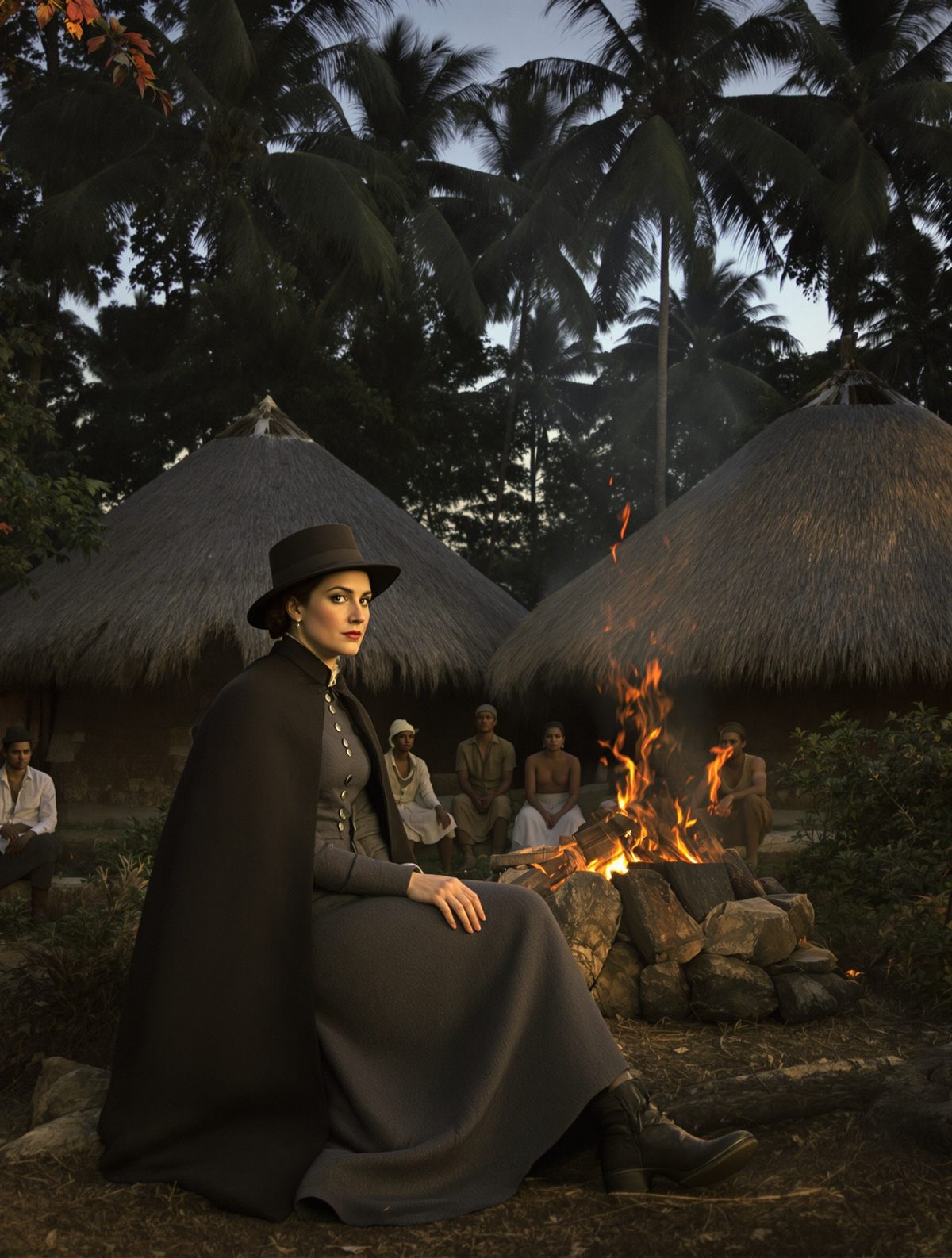
The lamp flickered in the dusty tent as Major William Sleeman spread out his hand-drawn map of India across the wooden table. It was 1840, and the document before him told a story of horror that had unfolded across six centuries. Red pins dotted the trade routes like drops of blood—each marking a spot where innocent travelers had breathed their last breath. Blue pins showed where his men had captured members of the most secretive murder cult the world had ever known. As Sleeman traced the patterns with his finger, he realized he was looking at the death warrant of an organization that had claimed more lives than any army in history.
The Thugs weren't ordinary criminals. They were believers. And for 600 years, they had turned India's highways into killing fields in the name of their goddess Kali.
The Strangler's Highway
In the sweltering heat of central India's trade routes, death wore a friendly face. A merchant caravan would encounter a group of fellow travelers—pilgrims perhaps, or traders like themselves. The strangers would be charming, knowledgeable about the roads ahead, eager to join forces for safety. They might travel together for days, sharing meals around campfires, swapping stories, building trust.
Then came the signal. A casual phrase, the lighting of a hookah, or simply the right moment when the victims were relaxed and vulnerable. In seconds, silk scarves called rumals would tighten around throats. The Thugs had perfected their technique over generations—a quick twist of the wrist that crushed the windpipe, preventing any scream from escaping into the night. Bodies would be stripped, mutilated to prevent identification, and buried in graves that had been dug hours before the murders.
What made the Thugs truly terrifying wasn't just their methodology—it was their scale. Conservative estimates suggest they killed 40,000 people annually at their peak. The Guinness Book of Records credits one Thug leader, Behram, with personally strangling 931 victims between 1790 and 1830. But these weren't random killings. They were sacred acts, performed with ritual precision to honor Kali, the Hindu goddess of destruction.
The Thugs called it their dharma—their religious duty. They believed Kali had created them specifically to rid the world of travelers, and that each murder brought them closer to divine favor. They had their own secret language called Ramaseeana, their own complex hierarchy, and hereditary membership passed from father to son. For six centuries, they had operated with such secrecy that most victims' families never learned their loved ones' fate.
Enter the Hunter
William Henry Sleeman wasn't supposed to become history's greatest detective. Born in Cornwall in 1788, he had arrived in India as a young soldier seeking his fortune in the East India Company. But by 1822, this keen-eyed officer had been appointed magistrate of the Narsinghpur district, where he encountered something that would consume the rest of his career: testimonies from captured Thugs that revealed the existence of a murder network spanning the entire subcontinent.
What struck Sleeman immediately was the matter-of-fact way these men described their crimes. They showed no remorse, only professional pride. One captured Thug, Feringeea, became Sleeman's most valuable informant after agreeing to cooperate in exchange for his life. Through Feringeea's testimony, Sleeman learned that Thugee wasn't a loose collection of bandits—it was a sophisticated criminal organization with standard operating procedures that would have impressed modern corporate managers.
The Thugs had scouts who identified wealthy targets, intelligence networks that tracked caravan movements, and specialized roles within each murder party. Some members were stranglers, others were grave diggers, still others were lookouts. They had established burial grounds along major routes where bodies could be efficiently disposed of, and they operated with such coordination that a Thug from Bengal could seamlessly join an operation in the Deccan using their shared code words and signals.
Sleeman realized he wasn't hunting individual criminals—he was dismantling an institution.
The Science of Systematic Murder
What separated Sleeman from previous British officials was his methodical approach. Instead of treating Thug attacks as isolated incidents, he began collecting data with scientific precision. Every captured Thug was interrogated exhaustively. Every murder site was mapped. Every testimony was cross-referenced with others to verify accuracy.
His breakthrough came when he realized the Thugs' greatest strength—their mobility—was also their weakness. Because they traveled constantly across British-controlled territories, their crimes created a paper trail that could be reconstructed. Working with captured Thugs who agreed to turn informant, Sleeman began mapping not just where murders had occurred, but where Thug bands were likely to strike next.
The map on his desk wasn't just a record of past crimes—it was a prediction engine. By 1830, Sleeman could anticipate Thug movements with startling accuracy. His network of informants and reformed Thugs allowed him to position British forces precisely where they needed to be. More importantly, he had learned to think like the Thugs themselves, understanding their seasonal patterns, their preferred target types, and their escape routes.
One particularly revealing discovery was the Thugs' meticulous record-keeping. Many bands maintained oral traditions that functioned like corporate memory, preserving details of successful operations for training purposes. When Sleeman's men captured a senior Thug named Motee in 1831, his interrogation revealed the locations of over 100 burial sites and implicated nearly 300 accomplices across multiple states.
The Network Crumbles
Sleeman's campaign against the Thugs became one of the most successful police operations in history. Between 1826 and 1848, his forces captured approximately 3,000 suspected Thugs. Of these, 466 were hanged, 1,564 were sentenced to life imprisonment, and nearly 900 were released after providing testimony that implicated their former confederates.
The key to Sleeman's success was understanding that traditional law enforcement wouldn't work against such a deeply entrenched organization. Instead, he created India's first witness protection program, offering captured Thugs the choice between execution and cooperation. Those who agreed to help received new identities and were relocated to agricultural settlements where they could rebuild their lives under supervision.
Some of Sleeman's reformed informants became his most effective agents. Feringeea, the Thug who first revealed the scope of the conspiracy, eventually led British forces to dozens of his former associates. Another reformed Thug, named Sahib Khan, helped map the organization's structure across Northern India, revealing how different Thug bands coordinated their activities across vast distances.
By 1848, organized Thugee had been effectively eliminated. The last major Thug trial took place in 1853, marking the end of an institution that had terrorized Indian roads for six centuries. Sleeman's final report claimed his operations had saved approximately 40,000 lives annually—the number of murders the Thugs had previously committed each year.
The Data Detective's Legacy
Sleeman's war against the Thugs pioneered investigative techniques that remain relevant today. He was among the first law enforcement officials to use systematic data collection to combat organized crime. His use of turned informants, protected witnesses, and coordinated operations across multiple jurisdictions created a template that modern police forces still follow when dismantling criminal networks.
Perhaps most remarkably, Sleeman achieved his success without modern communication technology. His intelligence network relied entirely on human messengers, yet he managed to coordinate operations across an area larger than modern-day Germany. His detailed records, preserved in the British archives, provide one of history's most complete portraits of how organized crime operates at scale.
The Thug investigation also demonstrated something that seems obvious today but was revolutionary in the 1830s: that patterns in criminal behavior could be used to predict future crimes. Sleeman's map wasn't just a historical document—it was an early form of predictive policing that anticipated where criminal activity would occur next.
When Data Saves Lives
In our age of big data and algorithmic crime prediction, Sleeman's hand-drawn map seems almost quaint. But his achievement remains extraordinary: using nothing but careful observation, systematic record-keeping, and human intelligence, he identified patterns that allowed him to dismantle a criminal organization that had operated successfully for centuries.
The story of the Thugs raises uncomfortable questions about how institutions of violence can hide in plain sight. For 600 years, the Thugs had murdered travelers on routes used by thousands of people daily, yet their activities remained largely invisible to authorities. It took one observant official with a gift for systematic thinking to reveal the scope of their operations.
Today, as we grapple with modern forms of networked violence and hidden criminal enterprises, Sleeman's methodical approach offers timeless lessons. Sometimes the most dangerous threats are those that operate openly, hiding their true nature behind facades of normalcy. And sometimes, all it takes to expose them is someone willing to connect the dots that others have overlooked.
The red pins on Sleeman's map marked more than murder sites—they marked the spots where careful observation and systematic thinking began to save lives, one data point at a time.