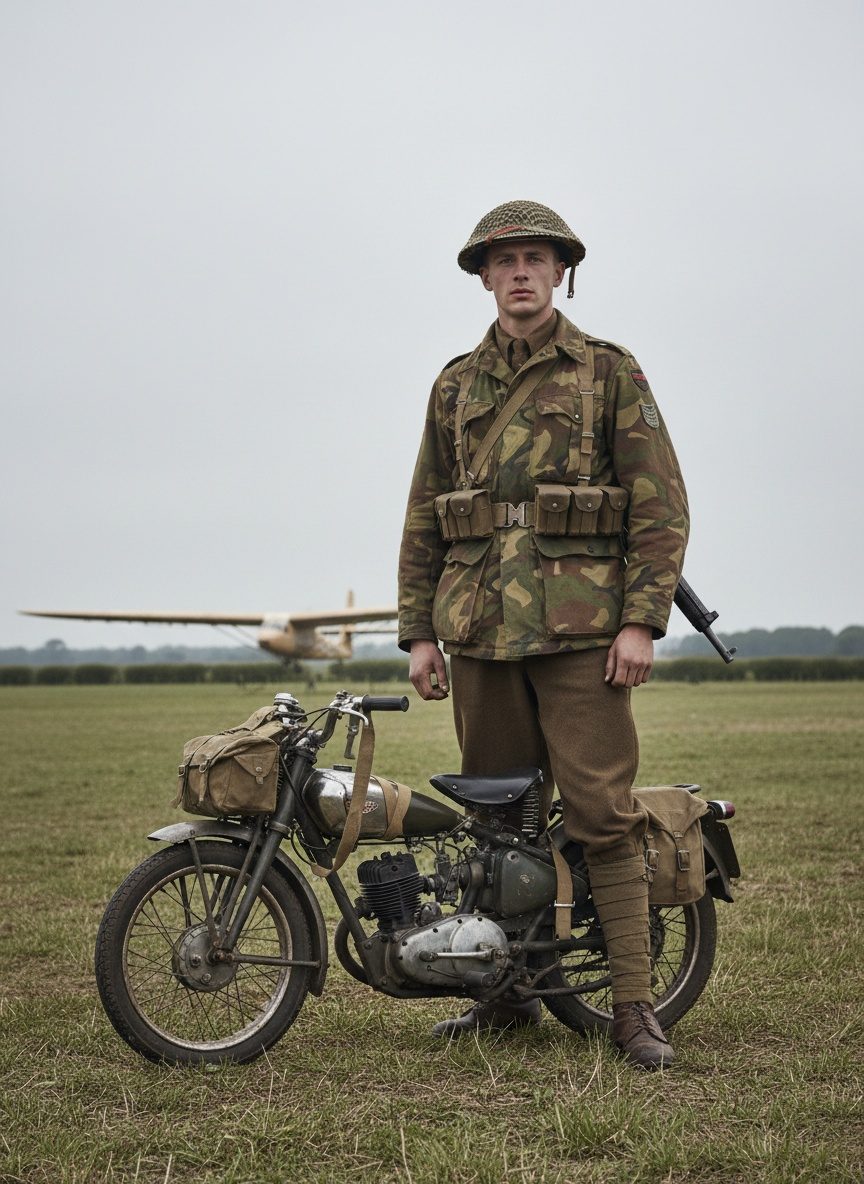
It was no bigger than a bicycle yet vital for battle. A motorcycle that would never see a road but instead, the open sky.
The Birth of a Battlefield Marvel
During World War II, armies across nations innovated at a breathtaking pace, crafting machines that could redefine warfare. For Britain, one such innovation was the Royal Enfield WD/RE, affectionately known as the "Flying Flea." Designed for British paratroopers, this motorcycle was a featherweight wonder, weighing less than 55 kilograms and uniquely built to be dropped from the sky. Unlike its heavier counterparts, the Flying Flea did not roll off production lines designed for suburban streets or war-laden highways; it was built to be released into battle via parachute or disembarked from Horsa gliders.
The need for such a vehicle burgeoned from the grim realities of warfare. Paratroopers often found themselves deep in enemy territory, rapidly needing mobility that traditional vehicles could not provide. In 1944, as the clamor of war echoed across Europe, the British believed that speed and agility could be their true allies. The Flying Flea symbolized this intent. Its creation was part ingenuity and part necessity—a small machine aiming to shoulder a mighty task.
Through the Skies and Into Battle
Imagine a scene: the looming shadow of a Horsa glider darkening fields below, doors opening mid-air like a giant bird shedding its metallic feathers. Out from its belly, along with the British paratroopers, came a new kind of warfare ally. Paratroopers, jumping with their Flying Fleas secured beside them, looked to this humble vehicle as a conduit of survival and tactical advantage.
The Flying Flea was not just a piece of equipment; it was revolution in motion. With its lightweight frame, it could navigate the rough terrain that characterized many battlefields. Unlike bulkier vehicles, it could twist through trees and across fields, delivering messages, running reconnaissance, and even hauling light artillery. This was quite a feat for a machine that appeared so innocuous.
These motorcycles offered a simple yet effective message: that smaller, smarter warfare could outmaneuver the enemy’s expectations. This clever warbird stood ready, whether nestled inside the confines of a glider or daringly dropped beneath a parachute, proving that it could withstand the rigors of aerial transport and the harsh realities of the ground upon descent.
Inside the Mind of its Creators
The Royal Enfield WD/RE was an engineering marvel from British manufacturers who knew the stakes. To fit the daring requirements of war, every component was examined for weight and strength. Designers worked tirelessly, motivated by the war effort, designing and testing within a framework that challenged their creativity and technical prowess.
Less exposed to the scrutiny of history books, the minds behind the scenes were clear in their objectives. They envisioned a motorcycle tough enough to endure skids on hard landings, robust against the mud and grit of battlefield conditions. Its design was stripped to the essentials, prioritizing mechanical simplicity to ensure that any paratrooper, with basic mechanical skills, could undertake field repairs.
The industrial hands shaping the Flying Flea were driven by more than just the clanking of metal and the whirr of assembly; they were spurred by a profound understanding that their creation was not just machinery—that it would soon become an integral appendage of the paratroopers' survival and strategy.
The Legacy That Dropped From the Sky
While the Flying Flea wasn't a triumph immortalized in glossy photographs or epic tales of the war, it left a legacy that went beyond traditional recounting. A machine born out of necessity became a testament to an era where mobility and dynamic warfare redefined military strategies. The Flying Flea stood alone as a symbol of the adaptive, unconventional tactics that the Allies embraced to turn the tides of World War II.
Through its daring descents and relentless service in rugged terrains, the Flying Flea illustrated how innovation could leap past conventional military doctrine to answer the primal demands of war. The little motorcycle was more than an artifact of metal and utility; it drove home a pivotal narrative—that impact isn't always in how mighty or grand a machine is, but in how it expands the horizon of possibilities.
The Flying Flea served its purpose with understated valor. Though largely absent from mainstream tales, its contribution subtly redefined multi-dimensional warfare and left a whispering legacy for future military strategies. In an era marked by extremes, where power and force were often hallmarks of intent, the Flying Flea fluttered silently, carrying with it the ethos that often, the key is not changing the world, but changing how we move through it.