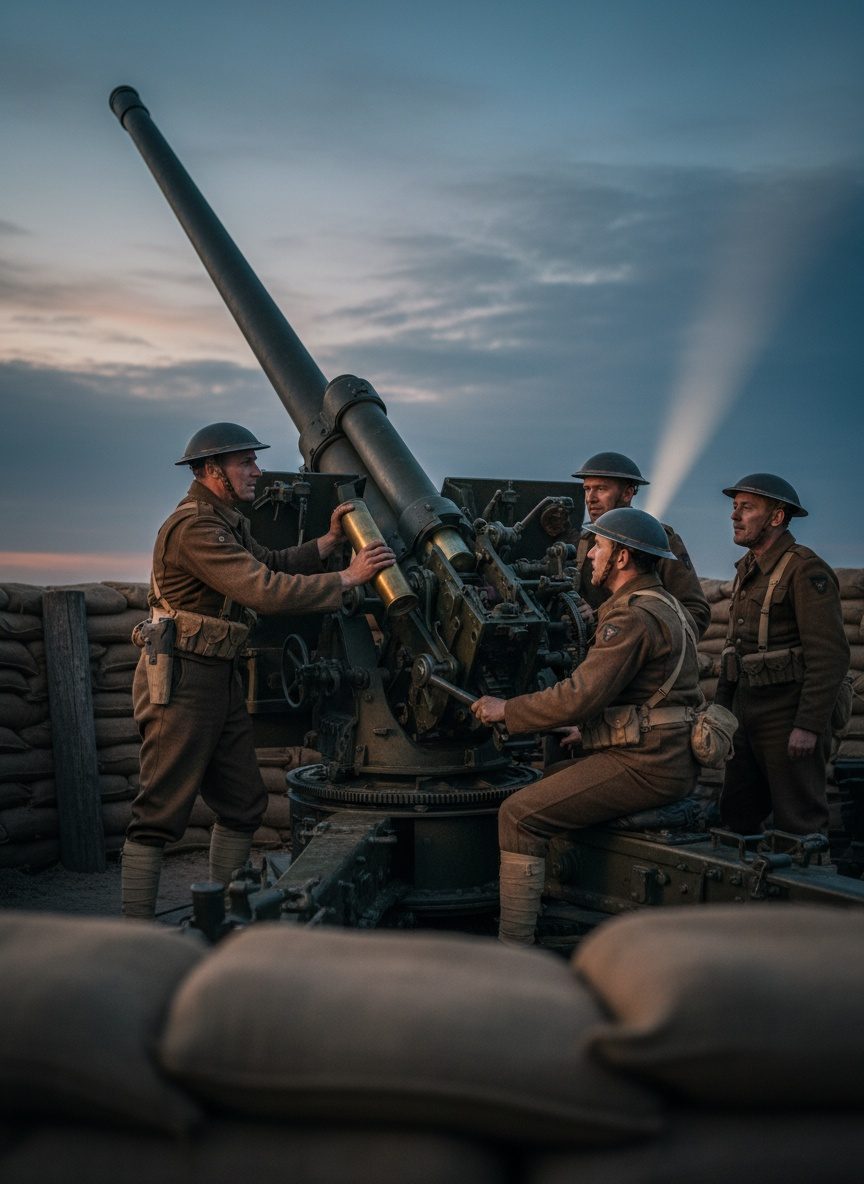
The fog rolled in over the Kent countryside, a soft grey blanket that muffled the world, leaving only the silhouettes of skeletal trees rising solemnly against the dim light of early morning. It was an understated, almost poetic scene, yet nearby stood the Cold War's greatest game-changer, not then a harbinger of aerial doom, but a giant in its infancy, ready to take its place — or so history hoped — on the theatre of war. This was the nascent stage of the QF 3.7 inch gun, poised to play a decisive but unexplored role.
The Birth of a Giant
In the anxious days of 1938, as storm clouds gathered over Europe, Britain found itself grappling with the urgent need for an anti-aircraft weapon capable of withstanding the anticipated onslaught from the Luftwaffe. Enter the QF 3.7 inch gun — a formidable fusion of British engineering ambition and military necessity. With its 32-pound shell capable of reaching altitudes beyond 30,000 feet, the gun was theoretically the perfect deterrent against the bomber raids that many feared.
The gun's development was an answer to both a specific problem and a broader strategic vision: to establish British skies as a fortress, impenetrable and secure. It was not just the technical prowess of the QF 3.7 gun that made it remarkable but also the storied struggle of those who endeavored to bring it to servicable reality. Unknown to many, the gun was a technological marvel of its time, utilizing advanced predictive sighting and fire control systems that were at the very cutting edge of artillery technology.
Rules of Engagement: A Restrictive Doctrine
The QF 3.7 inch gun was undisputedly effective against high-altitude aircraft. Yet, in the chaos and noise of World War II, its creators foresaw a much more varied potential. Tank-killing was a task it could have theoretically mastered due to its powerful ammunition and accuracy. But military doctrine, steeped in tradition and caution, constrained thinking. The gun was shackled to its existing anti-aircraft role, and doctrines of the British Army bureaucracy were impenetrable barriers, not to be crossed lightly, particularly by a weapon lady-like in refinement yet monstrous in destruction.
During the course of the war, particularly after the fall of France in 1940, the need for flexible usage of available resources became apparent. German panzers, like phantoms, circled Allied armor, exploiting weaknesses with impunity. Yet the QF 3.7, could potentially have been the spanner in their swift works, laying waste to the advancing columns by reaching into their very metal hearts with indiscriminate speed and power. Still, nothing changed, a testament to rigid military planning, an adherence to the prescribed use of armament despite evolving battle conditions.
Glimpses of Unfulfilled Potential
As the war wove its tragic tapestry, alternative use for the QF 3.7 inch gun appeared in fleeting glimpses. Barrage balloons often hosted these guns, a strategy to test their versatility against low-flying aircraft. Furthermore, a whispered opportunity arose during the North African Campaign, where these guns were occasionally used against ground targets, showcasing their effectiveness against German armor. Unfortunately, these instances were rare and undocumented with gravity; they were incidental rather than intentional, overshadowed by triumphant Allied tank engagements.
Deep-rooted military traditions and the separation of anti-aircraft and anti-tank disciplines sneered at innovation, dismissing adaptation as distraction. A parallel story unfolded with Germany's 88 mm gun, similarly dual-purpose yet allowed to flex its versatility, becoming infamous as a tank buster and anti-aircraft piece. Thus, while the 88 garnered an enduring legacy, the QF 3.7 remained confined, its potential hauntingly dormant, resonating as an echo of what could have been.
The Forgotten Giant's Legacy
The uneventful fate of the QF 3.7 inch gun serves as a sobering footnote in the chronicles of wartime ingenuity, buried beneath layers of more popular narratives and overshadowed by weapons that liberated themselves from doctrinal shackles. What it represents is the fragility of military foresight and the consequences of bureaucratic rigidity. Here lay a weapon capable of altering the dynamic structure of warfare, a force multipler against Nazi blitzkrieg tactics, yet it was barred from such roles by an unwilling tradition tethered to the skies alone.
Its story reverberates today, a reminder of the cost of potential unrealized and innovation left to stagnate. In its rust-encrusted mirrors, reflecting the detritus of war, one sees not only a technical marvel obscured by circumstance but a poignant lesson in strategic myopia. Let the tale of the QF 3.7 inch gun linger as a contemplation on military wisdom, urging future generations to not just build tools of might, but to wield them with foresight and adaptability.