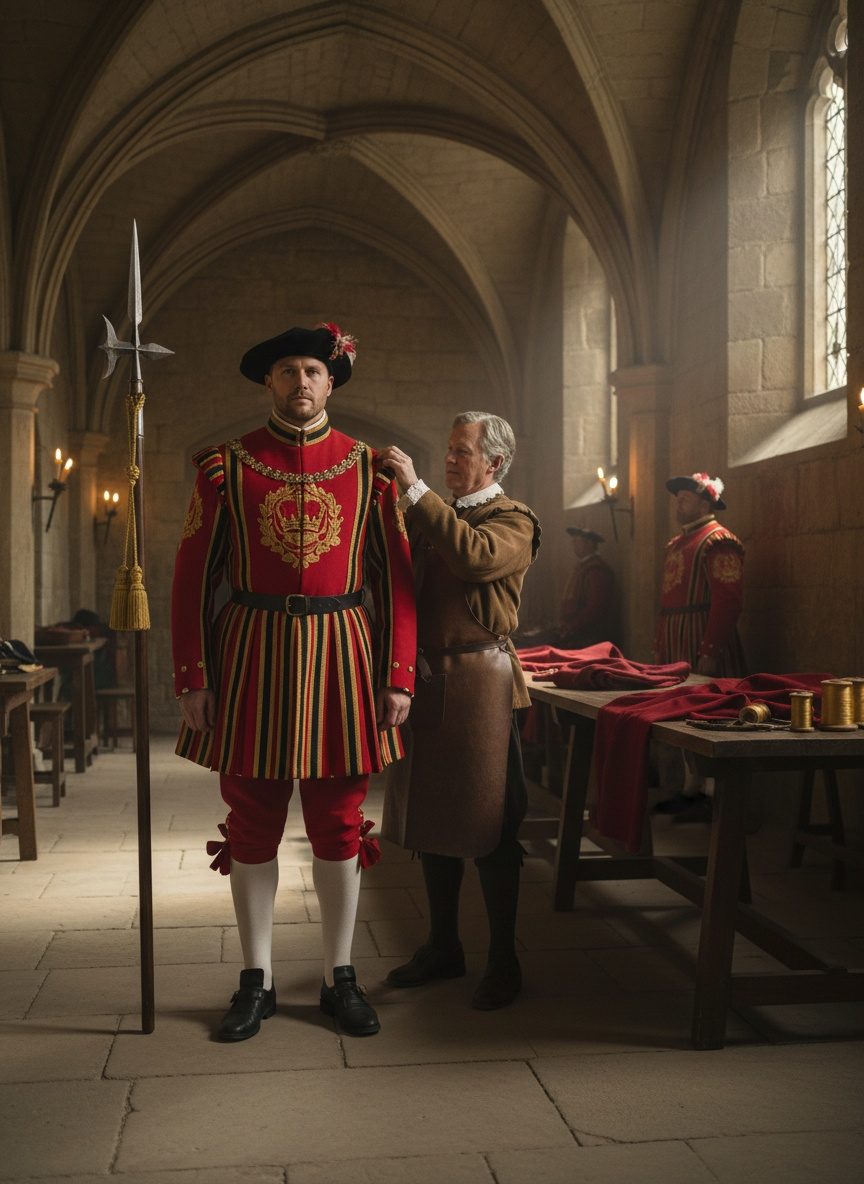
The velvet brushed heavily against Tom’s outstretched arms as he stood amidst the murmur of tailors and the metallic clatter of sewing shears. He could feel the electric thrill of the cloth sliding red and gold against his skin, the smell of rich dyes mingling with the sharp scent of sweat and starch. The Yeomen of the Guard, an elite force since the days of Henry VII, lined up this spring morning in 1509 for their new wardrobe, each man a fortress of muscle and dignity clad in Tudor finery.
The Birth of a Tradition
Founded in 1485, the Yeomen of the Guard, England’s oldest continuous military bodyguard, was tasked with safeguarding the very heart of English royalty. Their mission was brought sharply into focus under the newly crowned Henry VIII, a youthful and vigorous figure determined to project an image of supreme sovereignty. To this end, the livery of the Guard was not mere clothing. The scarlet tunics and green-and-white insignias woven into their uniforms were symbols of monarchical might and prestige.
The process by which these uniforms were crafted was complex, involving the procurement of materials from various corners of the realm. English wool, renowned for its quality, formed the backbone of the fabric, boiled and beaten into a rough serge that was then embellished with silks and gilt braid. The work itself was painstaking, a dance between needle and thread that mirrored the intricate tapestry of loyalty and power. Each stitch was an oath, each knot a covenant in the colorful pageantry of Tudor splendor.
The garments served not only to display the wealth of Henry's court but also to draw clear lines of loyalty. Each Yeoman's uniform was a statement, a non-verbal proclamation of a bond between the sovereign and his most trusted protectors. It was a tradition inextricably tied to England’s socio-political fabric, reflecting the dual necessity of defense and display, both on the battlefield and in the ceremonial halls of power.
The Meticulous Ritual
The fitting of the Yeomen was a ceremony unto itself, a meticulously orchestrated ritual. Tailors swarmed around the guardsmen, honing each cut and seam to perfection. Vivid colors leapt from bolts of fabric, soothed by the rigidity of regimented lines. The tailors’ hands moved with a peculiar kind of reverent agility, as though they wove the very soul of the kingdom into every tunic. It was the living heart of the medieval guilds.
Drills in the Tower of London courtyard accompanied these fittings, where the Yeomen rehearsed marching protocols and weapon skills with disciplined precision. The stones of the courtyard echoed with the rhythmic clash of pikes and the synchronized shuffle of boots. Each Yeoman, clad in the new livery, exuded gravitas, a living testament to the power they protected and the traditions they now embodied.
Every aspect of their appearance was scrutinized with the sharp eye of experienced officers. Armor was adjusted, mounts inspected, and weaponry aligned. This attention to detail carried with it deadly weight, for it signified readiness in all things, especially the potential threat of rebellion or assassination. In the Tudor Court, appearances could be as perilous as the sharpest blade.
The Stakes of Sovereignty
The stakes riding on these ceremonial wardrobes were higher than mere appearance. In an era before modern communication, visual spectacle was a primary vehicle for royal messaging. The Yeomen needed to project the power, prestige, and stability of the Tudor dynasty across every serving and subservient stratum. The bright, uniformed presence at court pronounced unity, while the yeomen’s disciplined ranks in public conveyed strength to both allies and adversaries.
In the quiet moments of vigil, when the Yeomen stood sentinel beneath the shadowed battlements of the Tower, the true weight of their duty became evident. To guard a sovereign was to shield the realm—the Crown—and to do so was a blend of ritual and reality, both richly sewn into their regal livery. As civilization teetered on the cusp of Renaissance splendour, these loyal guardsmen were not just sentinels; they were symbols of continuity, loyalty, and unwavering strength in a world evolving before their eyes.
The significance of the Yeomen's uniforms stretches far beyond the simple act of wearing them. They marked the beginning of a tradition that would extend through centuries, a living history intricately woven into the very fabric of the British Empire itself. Every ceremonial act since owes homage to this legacy—military resplendence and sartorial elegance combined in equal measure. The Yeomen of the Guard fashioned a template still visible today, embodying the essence of serving not just a king, but a country, an ideal, and an enduring history. This is the unheralded legacy sewn with threads of duty and valor, a narrative that quietly persists at the heart of Britain’s heritage.