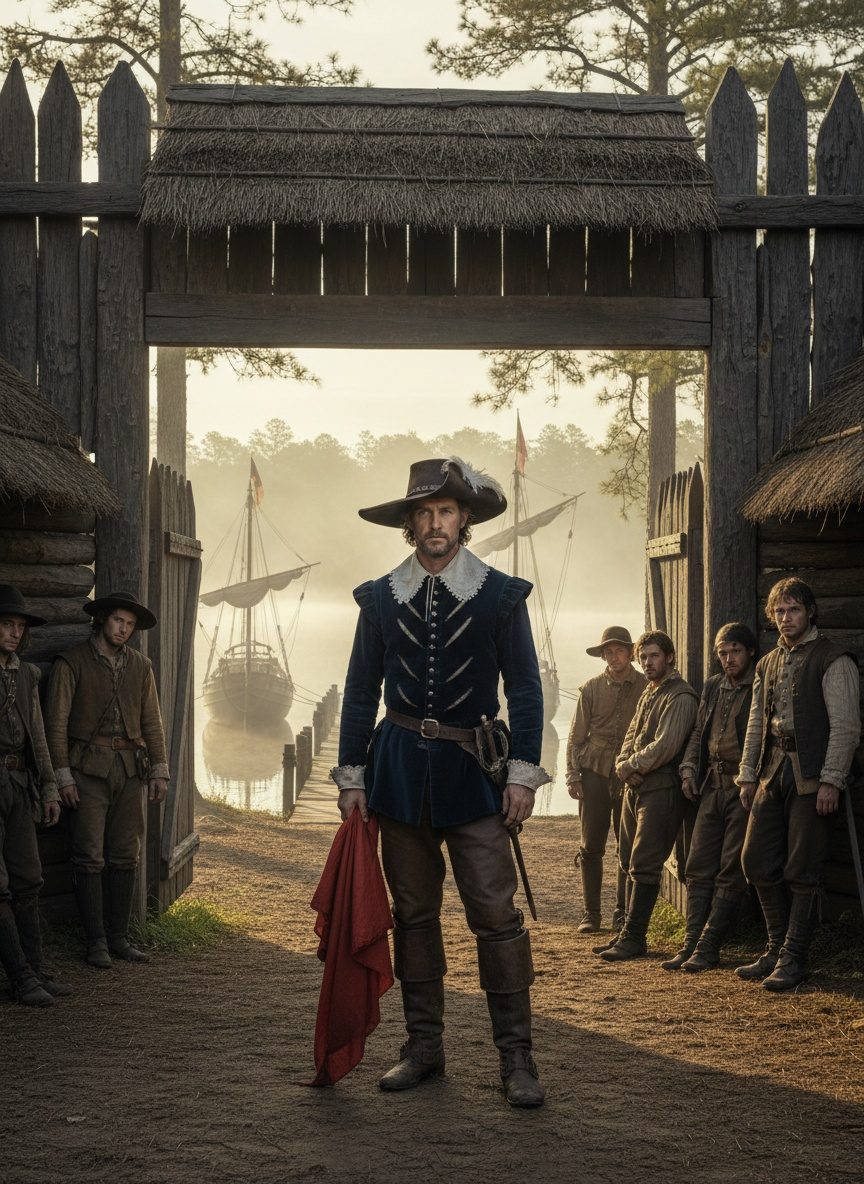
The early morning mist clung to the James River with the tenacity of a world not quite ready to reveal itself. In May of 1610, the sun struggled to pierce through the gray pallor shrouding the land where Jamestown whimpered its existence. The settlement, meant to be a beacon of the New World’s promise, sat ensnared in a silent despair. Its wooden palisades leaned this way and that, battered by relentless conditions that had for so long molded hope into misery. But the most haunting feature of this scene was the silence, an absence of sound that spoke volumes of the town's desolation.
Thomas Gates, a man hardened by the Maritime hardships of late Renaissance exploration, felt the weight of this ominous quiet as he walked through what remained of the colony. Jamestown had become a spectral image of its founders' dreams—its population, once burgeoning with anticipation, had withered to sixty souls clinging to life. Starvation had set its grip on the inhabitants following a winter so cruel it earned the harrowing name of 'The Starving Time.' This was the living nightmare faced by the colony’s new governor, a man whose leadership had yet to truly begin, and it seemed as though his tenure would be marked by finality rather than renewal.
The remains of the settlers whispered desperation back to him. Emaciated bodies, thin like shadow puppets against the morning light, clustered with the one shared desire to escape. Cries to abandon this godforsaken place had reached a pitch of frantic inevitability. Turning his eyes towards the river, Gates contemplated the open sea—a possible escape to something, anything, other than death by privation.
Yet, beneath the veneer of despair, Thomas Gates possessed a core of steel. The burden to decide whether to retreat or endure weighed heavily upon him. With Jamestown crumbling to its knees, Gates knew that his decision had the potential to resonate beyond the muddy confines of this struggling settlement. To the settlers, Virginia seemed inhospitable and lethally indifferent, yet to Gates, every footstep on the crumbling earth echoed the power of dreams grounded in unyielding resolve.
In the days that followed, Gates considered and reconsidered. He knew that turning away might doom the English endeavor to colonize the New World, but staying seemed a pact with death. Nonetheless, his final decision bore more than just the hope of survival. It symbolized something profoundly powerful—something that must transcend desperation. Against the counsel of many, Gates resolved to raise Jamestown's flag one last time as if to defy the abyss that threatened to swallow every ounce of the settlers’ spirit.
Onlookers watched quietly as the flag, tattered yet defiant, climbed its pole, capturing the scant breeze suffusing the Virginia air. This singular decision epitomized Gates' audacity—a belief unfurling with the wind, reaching beyond mere temporal salvation. And then, almost as if it were a divine nod of approval, ships appeared on the horizon. These ships bore supplies, emblematic of the lifeblood needed to convert moribund dreams back into burgeoning aspirations.
Unbelievably, the retreat halted as the vessels drew nearer, providing just enough to pivot the fate of the colony. The ships were more than just vessels filled with provisions; they were a literal breath of life infused into the stagnant lungs of those who had forgotten the taste of hope. With this unforeseen tide, Jamestown’s fortunes experienced a shift, not solely due to the replenishment of sustenance but because human resolve had been vindicated against nature’s cruelty.
But who could have anticipated that from the depths of such despair, something monumental would be born? Overlooked often in the annals of history’s grand chronicles is the simplicity with which Gates’ lone decision became a fulcrum—a tipping point that ensured English presence in America would not be snuffed out in its infancy. Instead, it flourished, expanding beyond Jamestown to lay the foundations of a nation. Virginia, indeed surviving, became emblematic of persistence, a harbinger of tenacity against seemingly insurmountable odds.
Thomas Gates never sought glory or renown, yet his decision continues to echo through time not as the solitary rescue of a dying colony but as testament to the guiding tenet that hope and action, entwined, can script history by the nth degree. This moment, often brushed aside by grander narratives, reveals the extent of human endurance and the powerful potential of a single choice to forge a continuum not just of mere existence but of lasting influence.
This quiet drama beneath a troubled gray sky in Virginia underscores an eternal truth: the pluck of the individual amidst collective ruin can shift the veils of destiny itself. As we ponder the smallness of Jamestown against the vast canvas of history, let us find in Gates’ gamble the resonance of epic undertakings—how they often hinge on the simplest of courage executed at the bleakest of times.