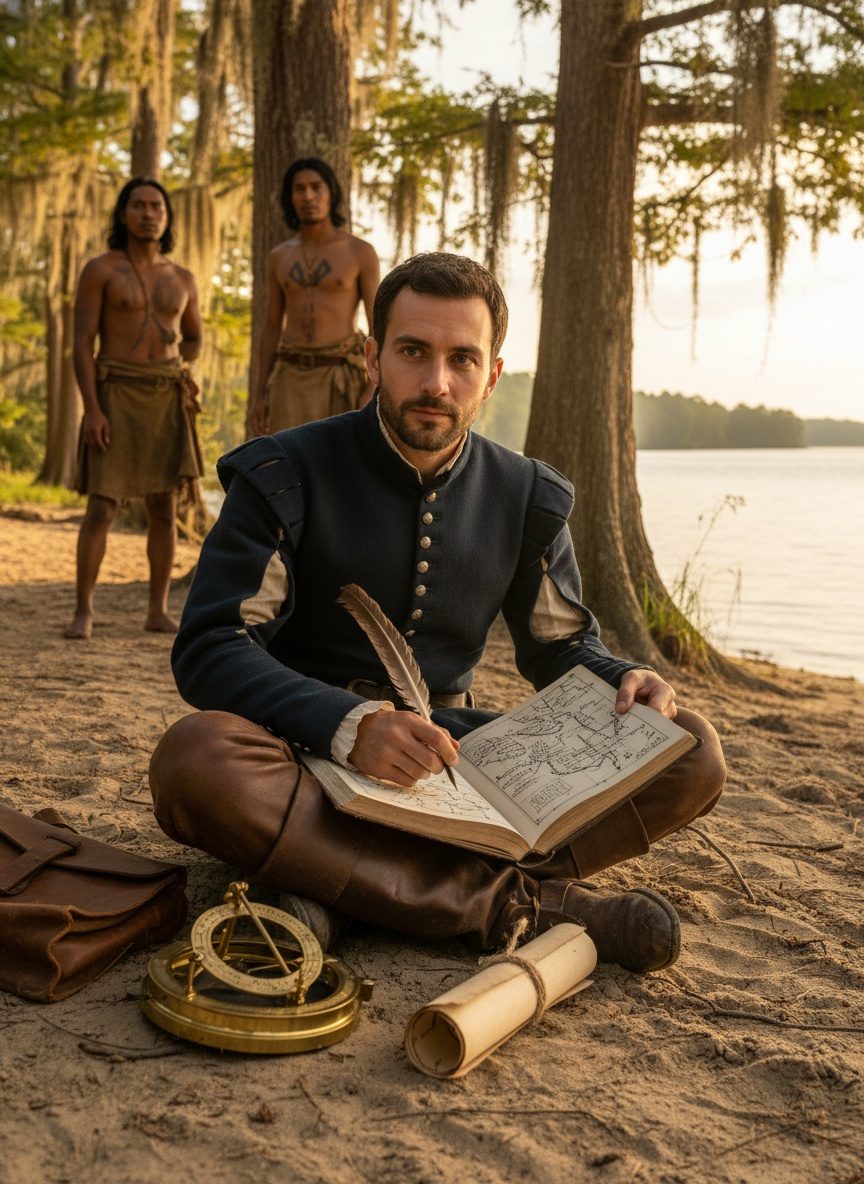
The dense fog clung to Thomas Harriot's skin as he stepped onto the marshy sands of Roanoke Island, his heart thudding with that peculiar mix of fear and excitement that only true explorers know. He had crossed the Atlantic with nothing but a few instruments, a mind honed by academia, and an audacity to see the world through lenses ground by his own hand. The waves lapped tirelessly at the shores behind him, a rhythmic reminder of the unpredictable oceans he had left behind and the untamed lands before him. Armed only with curiosity and the challenge issued by Sir Walter Raleigh, Harriot was about to begin a journey that would alter understanding across Europe.
The Scholar in the Wild
Harriot's sojourn to the New World was as unconventional as the man himself. Known for his keen intellect and insatiable curiosity, he was more adept with a compass and a chart than the traditional conquistador's tools of muskets and swords. Sir Walter Raleigh, in his ambitious pursuit of establishing an English foothold in America, sought proof of this strange new land's worth. But instead of dispatching an army or cartload of settlers, he sent Harriot, a mathematician from Oxford, with a simple dare: return with knowledge, not conquest.
On Roanoke Island, Harriot immersed himself in the environment, trading scholarly robes for a raw encounter with nature. He documented the flora and fauna with precision, his notebook chronicling everything from towering pine forests to the soft, aromatic sagebrush that blanketed the plains. Inquisitive and thorough, Harriot meticulously mapped every creek and inlets he encountered, crafting the first detailed cartographic representations of the area. His enterprise was a solitary one, but it defined the frontier not by battles won or lands seized, but by understanding and respect for the natural world and its peoples.
Learning the Algonquian Way
Perhaps Harriot's most remarkable accomplishment was his interaction with the indigenous Algonquian peoples. Unlike many of his countrymen, who viewed native populations with suspicion or hostility, Harriot saw the Algonquian as invaluable sources of knowledge. He took the extraordinary step of learning their language, recognizing that communication was the key to unlocking the mysteries of the New World.
His immersion allowed him to record the intricacies of their culture, tales, and technologies. He noted their techniques in agriculture, particularly their adept use of the three sisters planting method—corn, beans, and squash grown together in a balanced ecosystem. This practice not only made for efficient farming but also revealed to him the subtle ways in which the Algonquian had adapted to and thrived in their environment for generations. Harriot’s respectful engagement provided a nuanced view of native life, contrasting sharply with the dismissive perspectives so often ascribed to in the Elizabethan narratives of exploration.
A Book to Stun Europe
A year after his arrival, Harriot returned to England, not with treasure chests filled with gold, but with priceless treasures of knowledge compacted within a stack of notebooks that would ultimately become his famed publication. His detailed accounts of the New World and its peoples were compiled into a groundbreaking work, a scientific expeditionary tale that electrified European audiences hungering for tales of the unknown.
His book shed light not only on geography and indigenous communities but also included imaginative insights into the potential of colonization through agricultural transformation. The lush descriptions of tobacco, a plant with which Harriot had become familiar during his travels, illustrated its agricultural promise and economic potential—a foresight that played into the burgeoning craze for the plant back in Europe. But his narrative went beyond botanical interests, bringing a human face to the Algonquian, portraying them not as exotic curiosities but as people with traditions and wisdom that deserved respect and understanding.
The Map That Mapped Minds
The impact of Harriot’s studies extended far beyond the cartographic lines on paper. His work quietly fostered a shift in mindset, from conquest-driven to curiosity-driven engagement with the world. By presenting a comprehensive scientific account of North America, Harriot challenged his contemporaries to value observation and learning, aligning with a broadening intellectual horizon in Renaissance Europe that increasingly favored evidence and rationality over dogma and myth.
Though Harriot’s journey began with a simple dare, the legacy of his work transcended his notebook. He triggered waves of curiosity and inquiry, encouraging further exploration driven not just by the sword, but by the pen. This passage from exploration to enlightenment underscores a pivotal moment in the rise of empire, showing that sometimes the bravest acts are not those of war, but of understanding. Harriot taught that the essence of exploration was not in what could be taken, but in what could be learned.