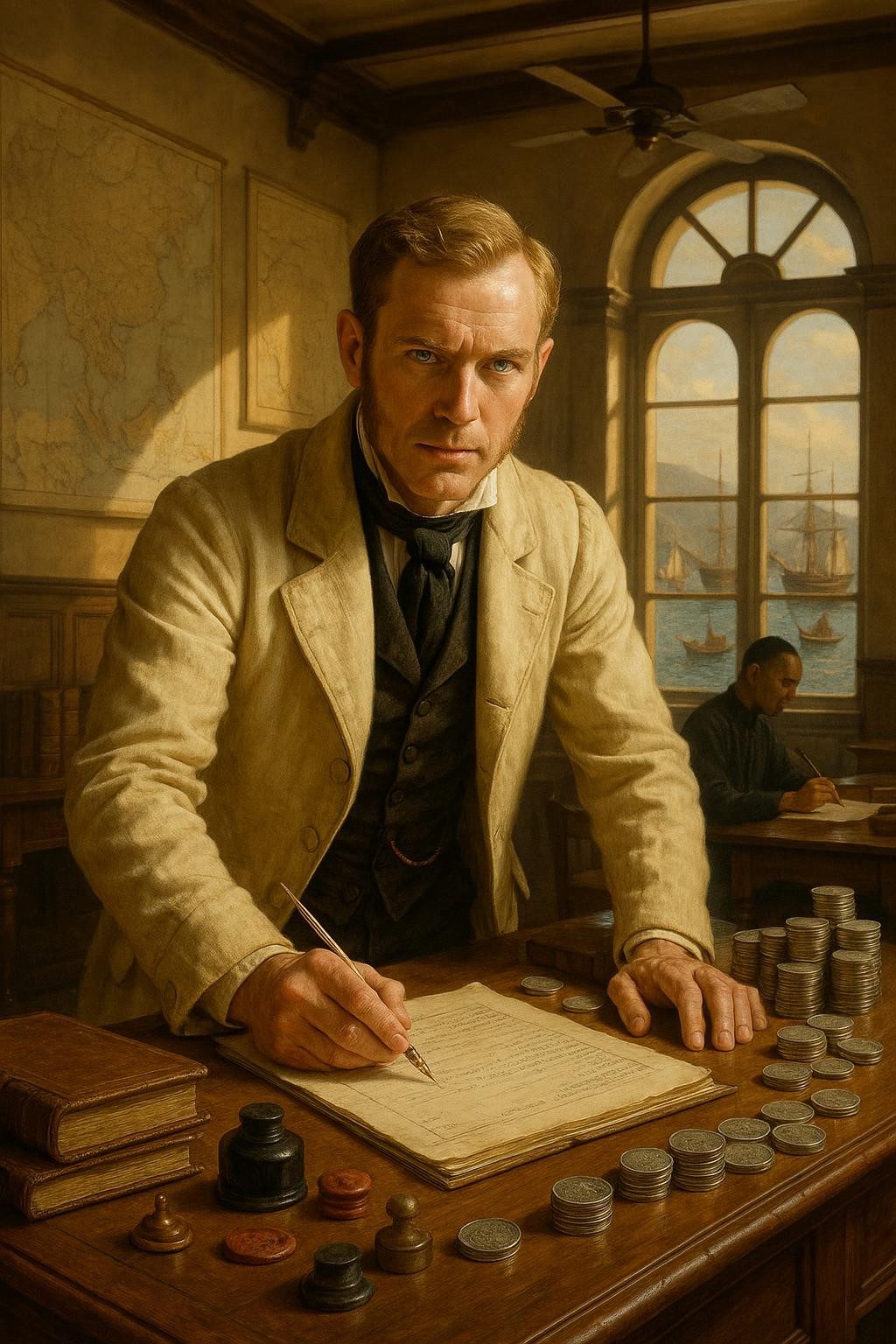
Thomas Sutherland was just a Scotsman in Hong Kong. He became a financial visionary who changed the game.
A Young Scotsman in the Pearl of the Orient
In the bustling streets of Victorian Hong Kong, the air was filled with the scent of opportunity mingled with a palpable undercurrent of despair. It was here in 1865 that Thomas Sutherland, a Scottish shipping clerk, found himself witnessing the frenetic pace of commerce in what was swiftly becoming one of the busiest trading ports in the world. Yet, beneath the chaos and hubbub, there was a crisis brewing—a scarcity of credit that threatened to halt the expansion of trade across Asia. London's banks, entrenched in their own cautious traditions, were hesitant to extend their reach to this distant corner of the British Empire. While the cargo-laden ships navigated the harbor, merchants from Calcutta to Canton found their aspirations becalmed by a sheer lack of financial lifelines.
The Visionary Idea that Launched a Bank
Sutherland, who had sharpened his skills navigating the logistical labyrinths of shipping routes, recognized the hindrances choking the region’s commercial veins. He saw that Asia’s booming trade required a financial institution willing to cater directly to its unique dynamics—a bank that would grow with the expanding empire rather than be bound by the cautious conservatism of older European financial models. When Sutherland proposed the audacious idea of creating a bank right there in Hong Kong and Shanghai, it was met with skepticism. Establishing such a bank so far from the financial centers of Europe was unprecedented. However, Sutherland was steadfast, driven by what he saw as an undeniable need.
Marking the Dawn of the Hongkong and Shanghai Banking Corporation
On a sweltering March day in 1865, the doors of the Hongkong and Shanghai Banking Corporation (HSBC) opened for the first time, promising to bridge the gap between European capital and Asian commerce. Set amidst the vibrant and cosmopolitan chaos of late 19th-century Hong Kong, the bank quickly became a symbol of a new wave of commercial modernity. Through its linking of Western capital to Eastern enterprise, HSBC financed infrastructure projects, trade routes, and emerging industries that would fortify the economic integuments of the British Raj. Sutherland's enterprise not only filled the financial vacuum but spearheaded an era of trade that further cemented Britain’s imperial prowess in Asia.
Pillars of the Imperial Economy
As the bank grew, its influence spread like wildfire across the continent. It wasn't long before the bank became an integral part of the colonial fabric. Through its vast network of branches, it provided much-needed credit to industries mining precious resources from the depths of the Indian subcontinent and facilitating the once-impossible trading voyages. Artful negotiations and shrewd financial dealings saw HSBC providing indispensable financial extensions to other British colonies, embedding itself as a linchpin of not just a banking institution, but a foundational prop of the imperial economy. Merchants and tycoons, once beleaguered by London's banking reticence, now looked to HSBC as the font of their commercial ambitions.
The Legacy that Still Resonates
The founding of HSBC by Thomas Sutherland launched not merely a bank but a financial movement that would finance—and redefine—an empire's dominion across Asia. The impact of that singular decision, to create finance where none had existed before, echoes in the bustling cities of today's global economy. Yet, what resonates most profoundly is how a lone visionary amidst the colonial grandeur could channel the forces of trade and power to alter the course of history. The story of Sutherland and his bank reminds us that sometimes, change doesn’t require power, but the courage to see what others choose to ignore. The Empire it paid for might be a relic of the past, but the pathways of precious lines of credit it established continue to ripple through every corner of the financial world. Thomas Sutherland—often left out of the textbooks—remains especially relevant in contemporary discussions on globalization and finance, a testament to the powers of ingenuity and resolve.