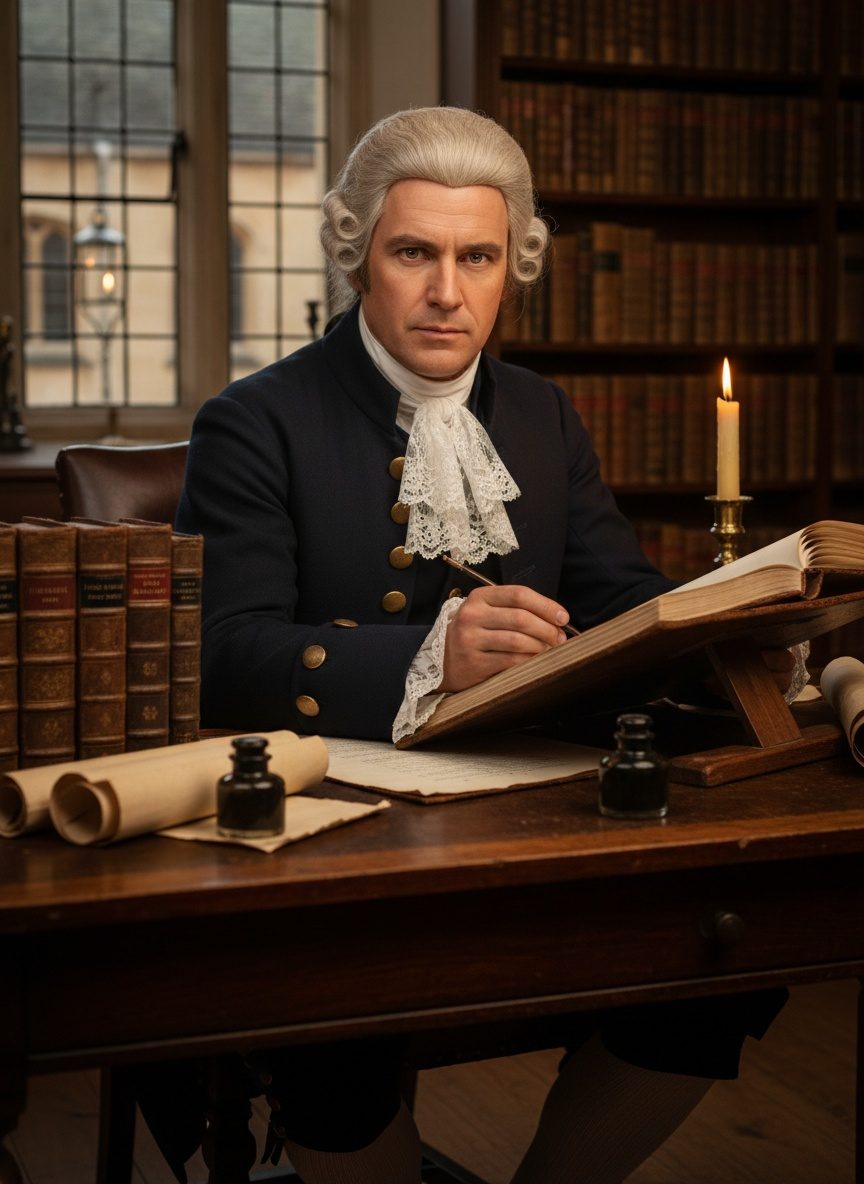
He never had his sights set on global influence. William Blackstone simply intended to clarify legal principles for his students at Oxford. His pen, however, ended up shaping the world’s judicial landscapes far beyond the quiet lecture rooms of England.
The Birth of a Legal Marvel
In 1765, nestled in the cobblestoned heart of Oxford, William Blackstone, an English lawyer, scholar, and judge, undertook a Herculean task with little perception of its impending impact. Blackstone began codifying centuries’ worth of English legal traditions into four authoritative volumes, known as the "Commentaries on the Laws of England." Surrounded by dusty manuscripts and the faint rustle of quill on parchment, Blackstone was consumed with a singular vision: to demystify the complex maze his students faced when grappling with the tenets of common law.
The beauty of Blackstone's work lay in its clarity. Prior to his "Commentaries," English law was an intricate tapestry woven from case law, medieval statutes, and age-old customs—largely inaccessible to those without specialized training. What Blackstone did was revolutionary: he distilled and presented these elements in a comprehensive, accessible manner. No longer was common law an obscure practice; it was a body of knowledge that could be grasped by any literate person. This democratization of legal knowledge set the stage for far-reaching impacts beyond England's shores.
Carrying Justice Overseas
The reverberations of Blackstone’s "Commentaries" were felt almost immediately across oceans. When one considers the sprawling expanse of the British Empire in the late 18th century, it becomes clearer why these volumes gained such critical traction. American colonists, straining under the indifference of British rule and the chaos of frontier justice, found in Blackstone a cohesive framework upon which to build the burgeoning nation’s own legal codes.
Blackstone’s texts journeyed to the New World, carried in the trunks of lawyers and jurists settling along the East Coast. In young American courts, they became indispensable companions to legal officials seeking to carve out a cohesive justice system from the wilds of American independence. It was a textbook for crafting a society where the rule of law reigned supreme—clarifying that even fledgling nations needed a structured legal foundation.
But Blackstone's influence didn’t stop in America. As the British Empire extended its reach, so too did the "Commentaries." They crossed the Indian Ocean, informing the colonial administration’s grasp on order in India’s vast and diverse territories. In Australia and Canada, Blackstone’s insights formed the backbone of judicial proceedings, bringing a sense of consistency and shared legal heritage throughout the empire’s widely dispersed dominions.
Reshaping Legal Education
Notably, the impact of Blackstone’s work was not confined to the practice of law alone—it heralded a significant shift in legal education. His "Commentaries" wasn’t just a legal manual; it was a comprehensive framework for educating future generations of lawyers. Before Blackstone, legal training had lacked a standard curriculum or central text, but with these volumes, learning the law became systematic.
Law schools, both in England and abroad, adopted Blackstone’s texts, which had become akin to a bible in the study of common law. Twist the pages of lecture notes in any university law class from those days, and you would find his influence heavily marked. His ideas permeated legal ideology, equipping young minds with the tools necessary to navigate and expand the burgeoning legal systems of their respective countries.
Moreover, Blackstone’s structured approach became the benchmark for legal writing itself, influencing how future authors wrote about law. Like the scaffoldings of an emerging judiciary, his meticulous prose helped establish a global legal lexicon, which today appears as familiar to a Canadian judge as it does to a barrister in London.
The Unseen Threads of Influence
William Blackstone’s "Commentaries," intended as a guide for his students, became cultural and intellectual reports that crossed boundaries and decades. These classics of English jurisprudence resonate even now in countless legal systems across the globe, echoed in courtrooms from Johannesburg to Jerusalem. Blackstone’s codification crystallized and exported common law, contributing to what would become the defining judiciary trait of a majority of the world's nations.
As we approach modern disputes over rights, governance, and freedoms, it’s intrinsic to pause and ponder the lineage of our laws. Those quiet days in Oxford, under the cloak of candlelight and parchment dust, laid the foundation for how many of us interpret justice today. Blackstone may never have intended to alter global judicial courses with the stroke of his quill—but his work continues to shape a world seeking fairness, order, and dignity under the law. In essence, common law’s wanderer-classicist has left a legacy that binds nations into a common thread of justice through time and tide.