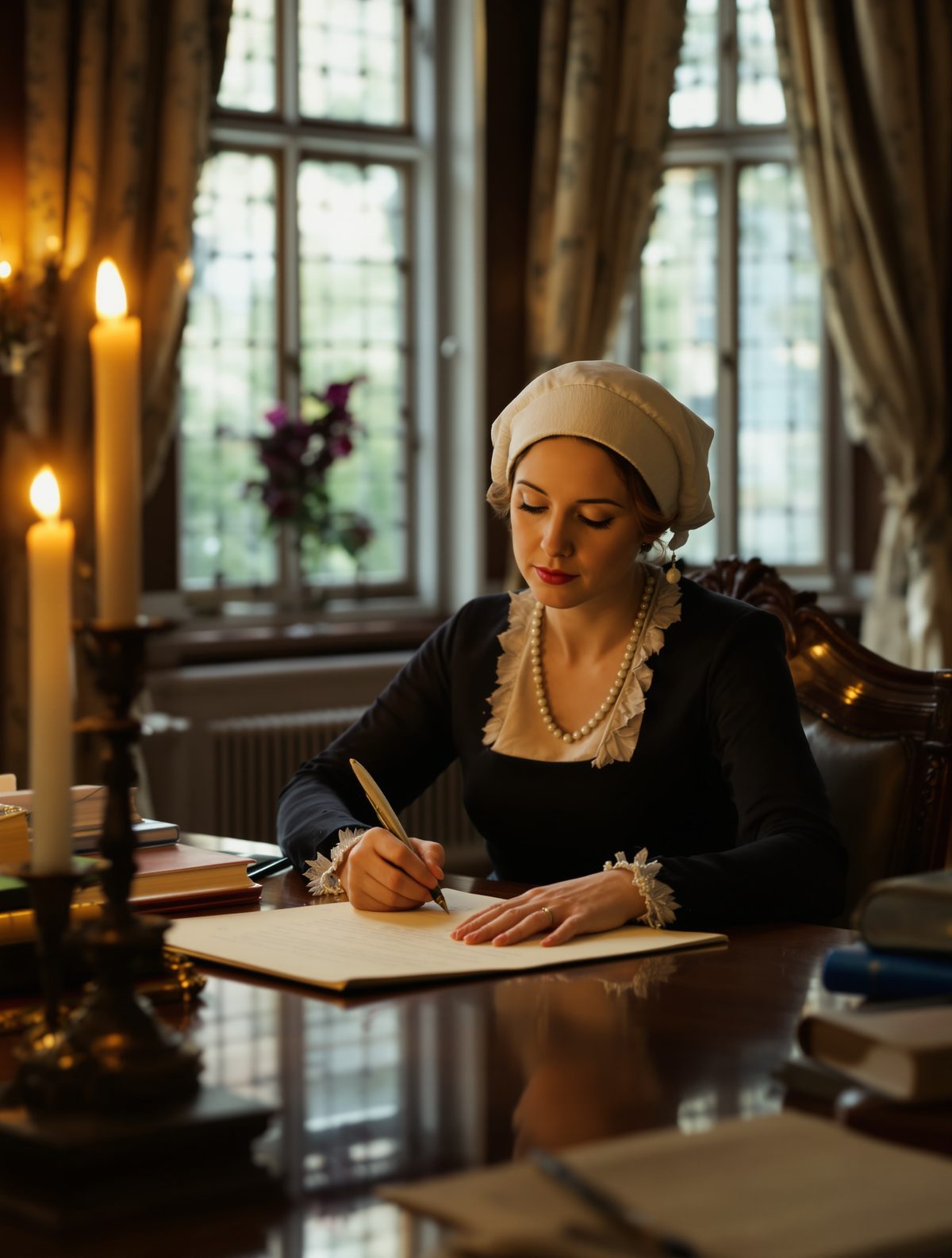
Picture this: it's a cold Yorkshire evening sometime around 670 AD, and the great hall of Whitby Abbey echoes with laughter, the crackle of fire, and the rhythmic plucking of harp strings. Monks, lay workers, and servants gather in a circle, passing the instrument from hand to hand. Each person takes their turn, improvising verses about Christ's glory or the day's labors. But there's one face missing from this cozy scene—a weathered cowherd named Caedmon has just slipped out into the bitter night, cheeks burning with shame.
He couldn't sing. He couldn't compose. And in a world where improvised poetry was as common as breathing, this made him feel less than human. What Caedmon didn't know, as he trudged through the darkness toward the animal sheds, was that he was about to become the most important poet in English history—a man whose divine dream would birth an entirely new tradition of sacred verse.
The Shame of Silence in a Singing World
In 7th-century Anglo-Saxon England, poetry wasn't the precious, rarified art form we might imagine today. It was the social media of its time—the primary way people shared news, preserved memory, and entertained themselves during the long, dark evenings. Every feast, every gathering, every religious celebration involved the communal composition of verses, usually accompanied by the six-stringed harp that passed from person to person like a talking stick.
The Anglo-Saxons had inherited this tradition from their Germanic ancestors, but by Caedmon's time, it had evolved into something uniquely English. Poets—called scops—held positions of tremendous respect, serving as living libraries who could recite genealogies stretching back generations, epic tales of heroes and monsters, and improvised praise-songs for their patrons. Even ordinary people were expected to contribute verses when the harp made its rounds.
For Caedmon, a man who tended cattle at the monastery of Streoneshalch (modern-day Whitby), this social expectation was pure torture. The monastery, ruled by the formidable Abbess Hild, was a double house—meaning it housed both monks and nuns—and was rapidly becoming one of the most important centers of learning in Northumbria. Here, amid some of the most educated people in Anglo-Saxon England, Caedmon's inability to compose even the simplest verse marked him as fundamentally inadequate.
The Night Everything Changed
What happened next comes to us through the pen of the Venerable Bede, writing in his Ecclesiastical History of the English People around 731 AD. Bede, who knew people who had personally witnessed these events, tells us that Caedmon fled yet another feast where his turn with the harp was approaching. "He got up from the table and went home," Bede writes, describing a man so mortified by his perceived inadequacy that he preferred the company of cattle to his fellow humans.
But that night, as Caedmon slept in the stable, something extraordinary occurred. In his dream, a figure appeared—Bede describes him simply as "someone"—who commanded: "Caedmon, sing me something." The cowherd gave his usual response: "I don't know how to sing. That's why I left the feast and came here—because I couldn't sing."
The mysterious figure was persistent: "Nevertheless, you must sing for me." When Caedmon asked what he should sing about, came the reply that would change English literature forever: "Sing about the Creation."
What poured from Caedmon's lips in that dream was unlike anything that had come before in English poetry. Instead of the traditional tales of warriors and battles, instead of the secular heroics that dominated Anglo-Saxon verse, Caedmon found himself composing sacred poetry—the first known Christian verses in the English language.
The Miracle of Sacred Song
When Caedmon awoke, the verses were still there, crystal clear in his memory. The opening lines, preserved by Bede in Old English, are among the most important in literary history:
"Nu scylun hergan hefaenricaes uard,
meotudaes maecti end his modgidanc,
uerc uuldurfadur, sue he uundra gihuaes,
eci dryctin, or astelidæ."
In modern English, this translates roughly to: "Now we must praise heaven-kingdom's guardian, the Creator's might and his mind's thought, the work of the glory-father, as he of wonders every one, eternal lord, established the beginning."
What made this so revolutionary wasn't just its Christian content, but its fusion of traditional Anglo-Saxon poetic techniques with biblical themes. Caedmon used the familiar four-stress alliterative verse that his audience knew and loved, but applied it to stories from Scripture rather than pagan heroics. He called God "hefaenricaes uard" (heaven-kingdom's guardian)—using the same kind of compound epithets that were typically applied to earthly kings and warriors.
Word of this miracle spread quickly through the monastery. Abbess Hild, a woman who had hosted bishops and kings, was skeptical but intrigued. She gathered the most learned men in the community—biblical scholars, poets, teachers—and had them test Caedmon. They gave him a passage from Scripture and asked him to turn it into verse. By morning, he had composed poetry "sweeter than honey," according to one witness.
From Cowherd to England's First Named Poet
The transformation was so complete that Hild invited Caedmon to join the monastic community as a brother. Here's what makes this remarkable: in a highly stratified society where birth determined destiny, an illiterate agricultural worker was elevated to one of the most respected positions in the intellectual elite, based purely on his extraordinary gift.
Caedmon spent the rest of his life at Whitby, composing what Bede describes as a comprehensive poetic retelling of Christian history—from the Creation through the Last Judgment. He sang of "the first creation of the world, the origin of the human race, and the whole story of Genesis; about the exodus of Israel from Egypt and their entry into the Promised Land; about many other stories from the sacred Scriptures; about the incarnation, passion, resurrection, and ascension into heaven of the Lord."
Tragically, most of Caedmon's work has been lost to time. We have only that original nine-line "Hymn" preserved by Bede, making Caedmon something of a literary ghost—hugely influential yet barely visible to modern readers. But his impact on Anglo-Saxon culture was immediate and profound. He essentially created a new genre: English religious poetry that could compete with the exciting secular epics for popular attention.
The Revolutionary Impact of a Simple Dream
What Caedmon accomplished was nothing short of a cultural revolution. Before him, Anglo-Saxon poetry was dominated by tales of gold-ringed warriors, mead-hall celebrations, and pagan heroics. After him, English poets had a new vocabulary for expressing Christian faith in their native tongue. He showed that biblical stories could be just as thrilling as any battlefield epic, that Christ could be portrayed as the ultimate warrior-king, and that divine love could inspire the same passionate verses once reserved for earthly lords.
The influence rippled outward for centuries. Scholars believe Caedmon's work directly inspired later Anglo-Saxon religious poems like "Christ and Satan," "Genesis A and B," and "The Dream of the Rood." His fusion of Germanic heroic ideals with Christian theology created a uniquely English form of religious expression that would influence writers well into the medieval period.
Even more remarkably, Caedmon's story demonstrates something profound about the democratic nature of divine inspiration. In a world obsessed with bloodlines and breeding, here was proof that God's gifts could fall upon anyone—even an illiterate cowherd who fled social gatherings in shame.
The humble man from Whitby died around 680 AD, but not before establishing himself as the father of English Christian poetry. His story reminds us that the greatest revolutions often begin in the most unlikely places—sometimes in the dreams of embarrassed cowherds who just wanted to belong. In transforming his personal shame into sacred song, Caedmon didn't just find his voice; he helped an entire culture find a new way to sing about the divine. Perhaps that's the most miraculous part of all: that what began as one man's deepest inadequacy became the foundation for centuries of English sacred verse.