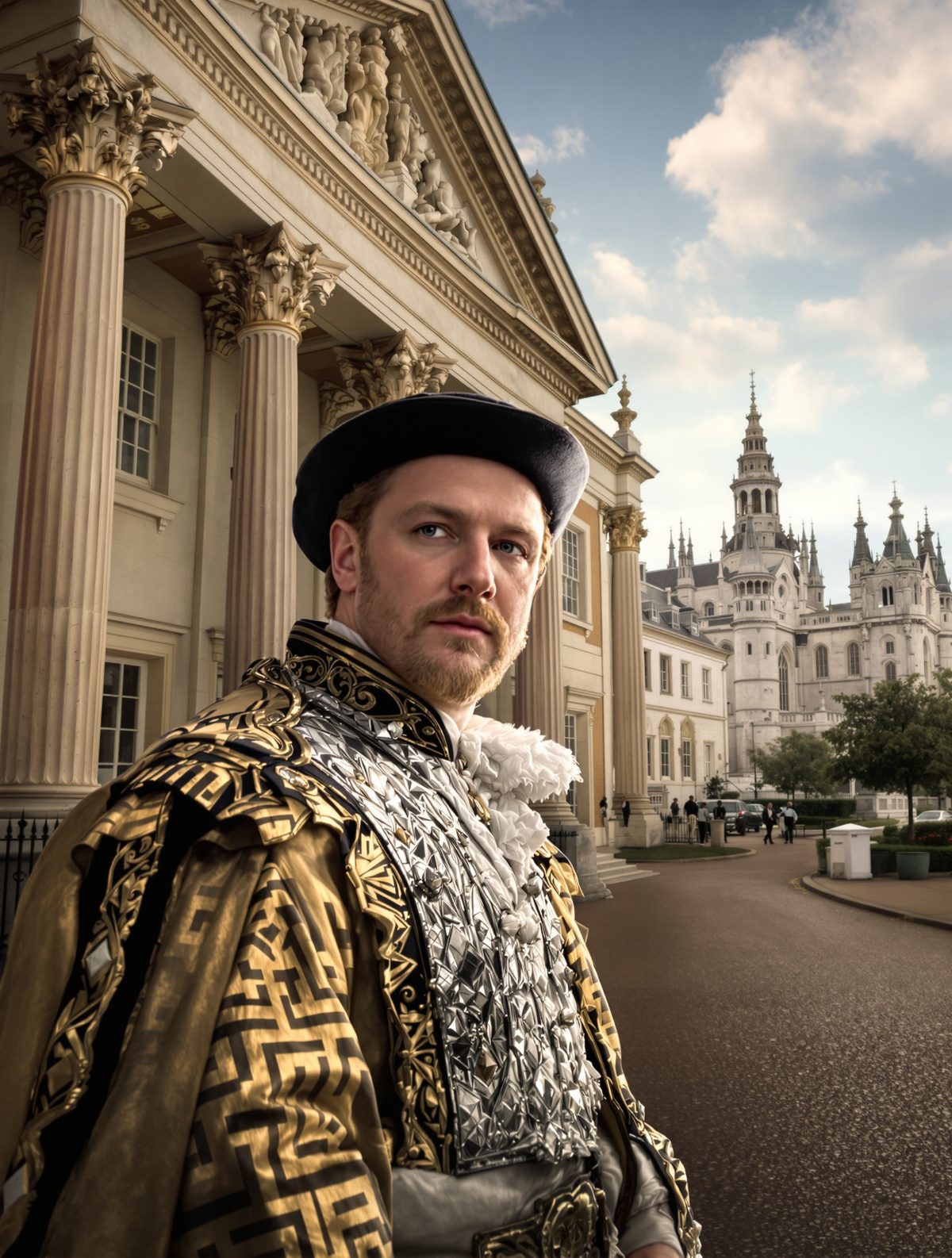
The year was 1619, and King James I sat in his drafty palace, surrounded by the familiar chaos of Tudor England—crooked timber beams, leaning walls, and the perpetual smell of damp stone that seemed to seep from every medieval corner. Then Inigo Jones walked in with a portfolio that would change everything. The architect's hands trembled slightly as he unrolled his drawings, revealing something no English monarch had ever seen: plans for a building of perfect mathematical harmony, inspired by the sun-soaked palazzos of Italy. What happened next would spark the greatest architectural revolution in British history.
A Young Man's Italian Awakening
To understand the magnitude of what Jones proposed that day, we must first journey back to his transformative years in Italy. Between 1613 and 1614, this carpenter's son from Wales had walked the ancient streets of Rome and Venice with wonder-struck eyes. While most English travelers of the era went abroad seeking trade or adventure, Jones was hunting something far more precious: beauty itself.
In the shadow of St. Peter's Basilica, Jones discovered the architectural treatises of Andrea Palladio, the 16th-century Venetian master who had revolutionized Renaissance building. Here was architecture as philosophy—structures governed by mathematical ratios that the ancients believed mirrored the harmony of the universe itself. Jones filled notebook after notebook with sketches, measurements, and revelations. He wasn't just studying buildings; he was absorbing an entirely different way of thinking about space, proportion, and human dignity.
The contrast with England couldn't have been starker. Back home, builders still followed medieval traditions passed down through generations of craftsmen. Houses grew organically, room by room, with little thought for overall design. The grandest Tudor palaces, for all their magnificence, were essentially medieval castles dressed up with Renaissance decorative details—like putting silk ribbons on a suit of armor.
The Revolutionary Moment in Whitehall
When Jones returned to London as the King's Surveyor of Works, he found his opportunity in tragedy. The old Banqueting House at Whitehall Palace had burned down in January 1619, and James I needed a replacement for his most important ceremonial space. This was where the king would receive foreign ambassadors, host state dinners, and display the full majesty of the English crown to the world.
Standing before King James that pivotal day, Jones must have felt the weight of history on his shoulders. His drawings showed something unprecedented in England: a building of pure classical form, with no concessions to English tradition whatsoever. Gone were the familiar gables, mullioned windows, and decorative chimneys that defined English architecture. Instead, Jones proposed a structure that could have been lifted straight from the Venetian Grand Canal—all clean lines, perfect proportions, and mathematical harmony.
The king, perhaps surprisingly, was captivated. James I fancied himself a Renaissance monarch in the mold of the Medicis, and here was architecture that would announce to Europe that England had finally joined the civilized world. The project was approved, with a budget of £15,000—an astronomical sum that could have built dozens of conventional houses.
Building the Impossible Dream
Construction began in 1619, and immediately Jones faced a problem that would plague classical architecture in Britain for centuries: how do you build Italian-style in the English climate? The answer lay in ingenious adaptation. While the external appearance remained faithfully classical, Jones secretly incorporated English building techniques to handle the rain, wind, and cold that Italian architects never had to consider.
The building that rose on Whitehall was a revelation. At 111 feet long and 55 feet wide, it presented a perfectly symmetrical façade to the street—two stories of honey-colored Portland stone, punctuated by windows of precise mathematical intervals. Jones had calculated every element according to Palladian principles: the height of each column, the spacing of the windows, even the depth of the architectural moldings followed classical ratios that created an almost musical harmony in stone.
But the real magic was inside. The Banqueting Hall itself was a double cube—110 feet long, 55 feet wide, and 55 feet high. This wasn't accident or approximation; it was deliberate geometry, based on Renaissance theories about perfect proportions. Standing in the completed space, visitors reported an almost mystical sense of harmony and balance that no English building had ever achieved.
The Shocked Reactions of a Medieval Nation
When the Banqueting House opened in 1622, it caused a sensation that rippled far beyond architectural circles. Foreign ambassadors were astounded to find such sophisticated classical design in London—many had assumed England was still a half-civilized northern kingdom. The Venetian ambassador wrote home that the new building "would not be unworthy of the greatest princes of Italy."
English reactions were more complicated. Many courtiers were puzzled by the building's stark simplicity after generations of decorative Tudor excess. Where were the heraldic beasts? The elaborate carved stonework? The picturesque irregularities that made English buildings so charming? This new structure seemed almost foreign—which, of course, it was.
The building trade was equally bewildered. Master masons who had spent decades perfecting Gothic stonework suddenly found their skills obsolete. Jones had to import Italian craftsmen to teach English workers how to carve classical details and achieve the precise finish that Palladian architecture demanded. It was nothing less than a complete retooling of an entire industry.
The Tragic Irony of Royal Success
Perhaps the most poignant detail of this architectural revolution is that the Banqueting House became the stage for both the greatest triumph and the ultimate tragedy of Stuart kingship. In the 1630s, Peter Paul Rubens painted the spectacular ceiling celebrating the reign of James I—nine enormous canvases showing the king ascending to heaven in apotheosis, surrounded by allegories of wise government and divine approval.
But on January 30, 1649, Charles I stepped through one of Jones's perfectly proportioned windows onto a scaffold erected outside the building. The mathematical harmony that was supposed to represent the divine order of monarchy became the backdrop for the king's execution. The crowd that gathered in the street below could look up at Rubens' paintings of royal glorification while watching the Stuart dynasty meet its bloody end.
The symbolism was inescapable: the classical architecture that Jones had imported to celebrate royal authority had outlasted the very monarchy it was designed to serve. The Banqueting House stood serene and unchanging while the political world collapsed around it.
The Enduring Revolution
Today, as you walk through London's Georgian squares or admire a colonial mansion in Virginia, you're seeing the descendants of that revolutionary moment in 1619. Jones's Banqueting House didn't just introduce classical architecture to England—it fundamentally changed how the English-speaking world thinks about buildings and their relationship to human dignity.
The classical tradition that Jones established would dominate British architecture for three centuries, spreading throughout the Empire to create the distinctive "colonial" style that still defines much of American architecture. From the Capitol building in Washington D.C. to the humblest Georgian townhouse, Jones's revolution continues to shape the spaces where we live and work.
But perhaps the most profound legacy is less tangible: the idea that architecture should aspire to something greater than mere function or tradition. Jones showed that buildings could embody philosophical ideas about beauty, proportion, and human potential. In a world increasingly dominated by utilitarian construction, that Renaissance vision of architecture as a noble art—capable of elevating the human spirit through mathematical harmony and classical dignity—remains as revolutionary today as it was in 1619.
Standing before the Banqueting House today, one can still feel the power of Jones's vision. In an age of architectural chaos and urban sprawl, his message resonates with surprising urgency: that the spaces we create shape the people we become, and that beauty, far from being a luxury, might just be the most practical thing of all.