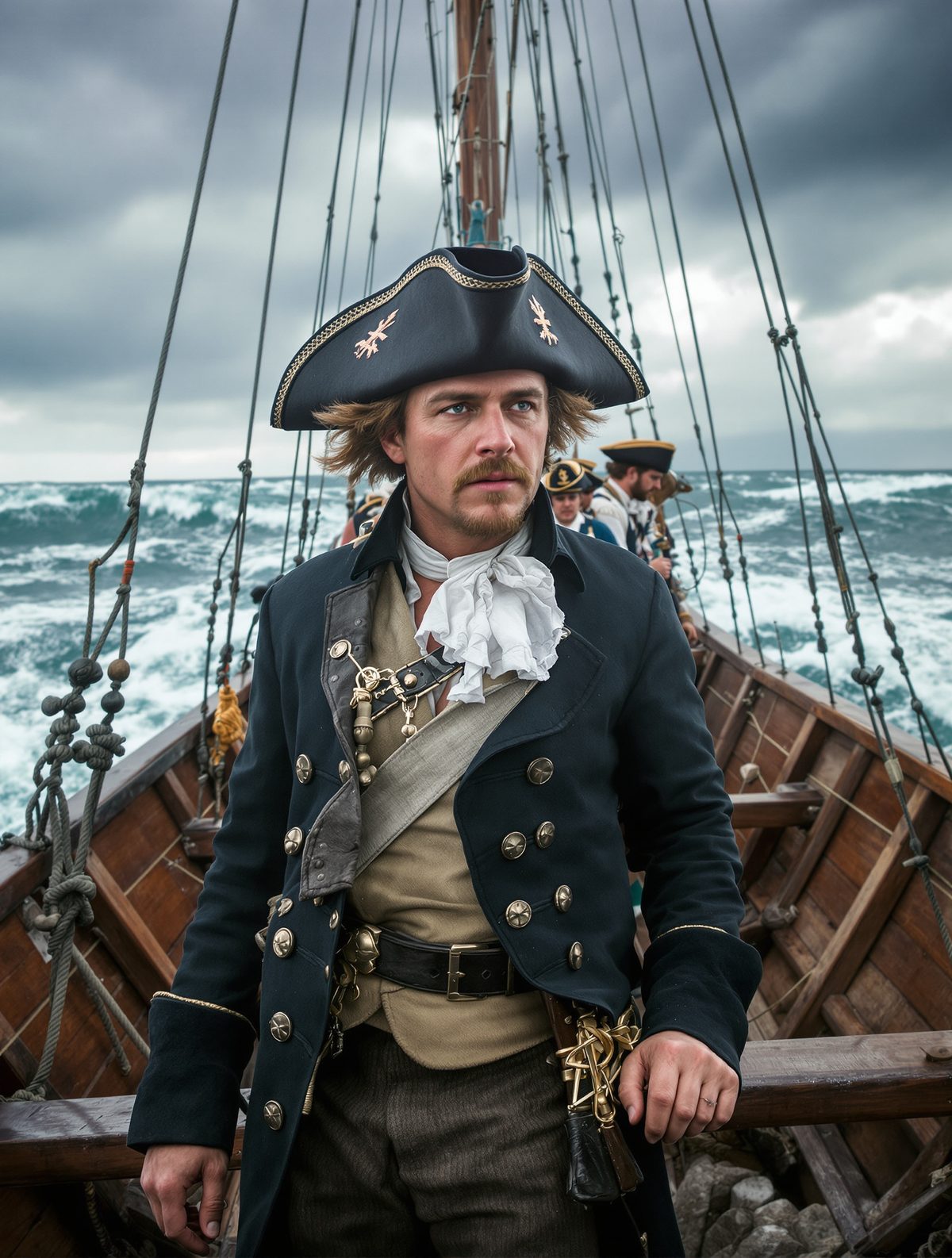
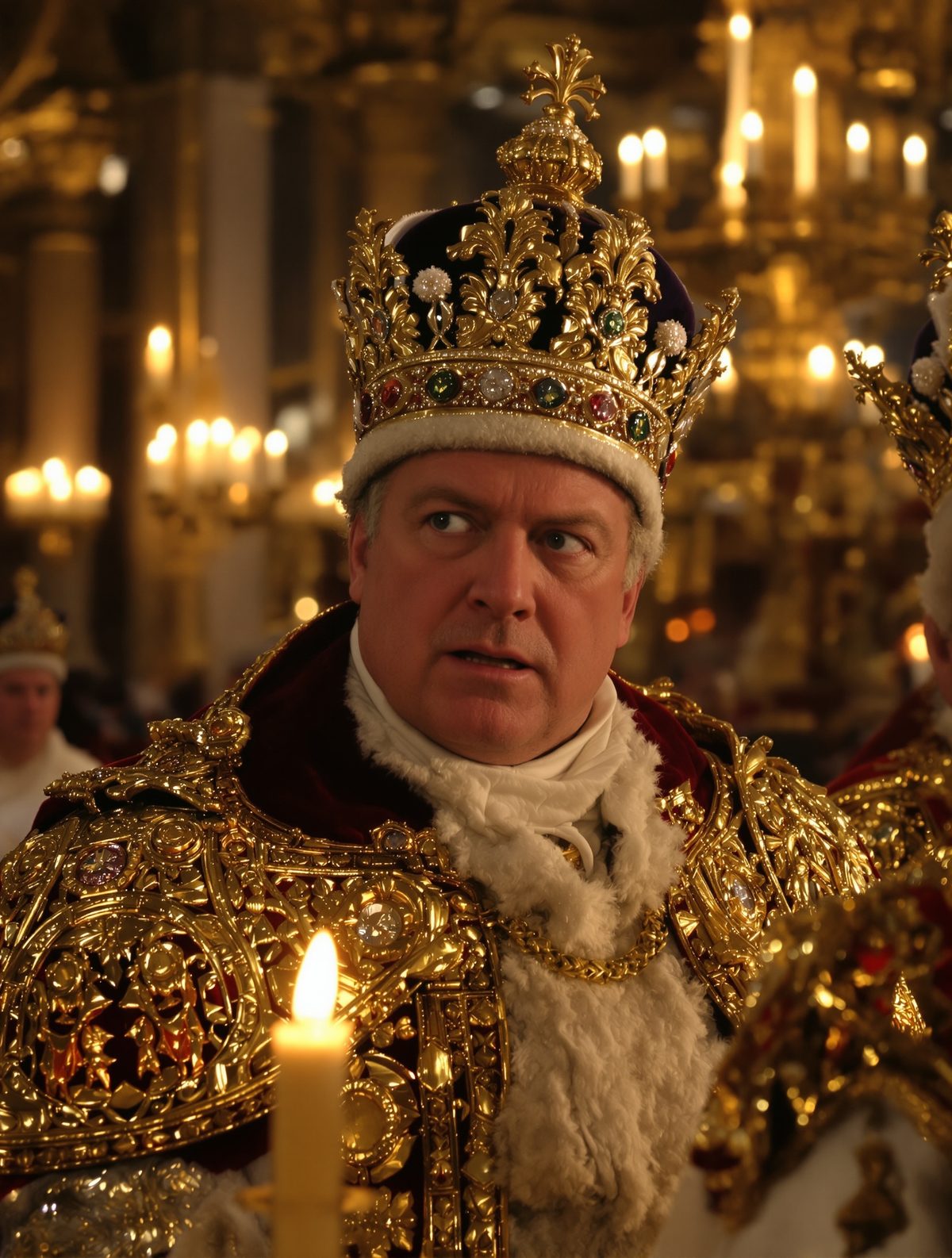
The crown jeweller had warned him it would be heavy, but King George IV hadn't anticipated this. As the solid gold St. Edward's Crown was lowered onto his powdered head on July 19th, 1821, the monarch's knees buckled slightly. The five-pound weight of precious metal and gemstones sent shooting pains down his neck, and beads of sweat began to form beneath the elaborate headpiece. Around him, Westminster Abbey sweltered in the summer heat, packed with 8,000 spectators who had no idea they were about to witness one of the most physically punishing ordeals in royal history.
What followed was a five-hour marathon of medieval pageantry that nearly killed a king—and cost more than building a fleet of warships.
The Prince Who Would Spare No Expense
George IV had been waiting for this moment his entire adult life. After serving as Prince Regent during his father's madness for nearly a decade, he had finally inherited the throne in 1820 at age 57. But George wasn't content with a simple ceremony. This coronation would be a spectacle to rival the glory days of medieval monarchs, a dazzling display that would cement his reign in the annals of history.
The price tag was staggering: £240,000—equivalent to roughly £24 million today. To put this in perspective, his father George III's coronation had cost a modest £10,000. The new king's ceremony would cost twenty-four times more, making it the most expensive coronation in British history. Parliament was apoplectic, but George was unmovable. "I will have magnificence," he reportedly declared.
The king's vision extended to every detail. He commissioned a new crown from the royal goldsmith, demanded robes of unprecedented grandeur, and insisted on a banquet in Westminster Hall that would feature exotic delicacies and rivers of wine. No expense was too great, no detail too small. Even the ceremonial shoes were crafted from cloth-of-gold and adorned with diamond buckles worth more than most people earned in a lifetime.
A King Crushed by His Own Grandeur
As the morning of July 19th dawned hot and humid, George began the elaborate process of dressing for his coronation. The ceremony required multiple costume changes, each more elaborate than the last. His main coronation robes alone weighed 27 pounds—nearly two stone of velvet, ermine, and gold thread that would press down on his already substantial frame for hours.
The centerpiece of his agony was the Imperial State Crown, specially modified for the occasion and loaded with some of the largest diamonds in the Crown Jewels. The Black Prince's Ruby, the St. Edward's Sapphire, and hundreds of other precious stones created a glittering masterpiece that was also an instrument of torture. Within minutes of its placement, the king was already struggling.
Contemporary accounts describe George's visible distress as the ceremony progressed. The Marquess of Anglesey, watching from the congregation, noted that the king "appeared to be in great suffering" and looked "ready to sink under the weight of his crown and robes." The Archbishop of Canterbury had to pause the service multiple times as George swayed visibly, his face flushed and perspiring heavily beneath his elaborate makeup.
But perhaps the most telling moment came during the recognition ceremony, when the king was supposed to turn to face each section of the Abbey. Witnesses reported that George could barely manage the turns, his movements slow and labored, like a man underwater. The weight of his regalia had transformed the simple act of standing into a herculean effort.
Theater of the Absurd in Westminster Abbey
The ceremony itself was a study in baroque excess that bordered on the ridiculous. George had insisted on reviving medieval traditions that hadn't been used for centuries, including the bizarre ritual of the King's Champion. This involved a man in full medieval armor riding into Westminster Hall during the coronation banquet and challenging anyone who disputed the king's right to rule to single combat.
The Champion, Henry Dymoke, had practiced for weeks, but no one had considered that his horse might be spooked by the crowd and spectacle. As Dymoke entered the hall, his mount reared and nearly threw him, causing a ripple of nervous laughter through the assembled nobility. The Champion managed to deliver his challenge, threw down his gauntlet as tradition demanded, and rode backward out of the hall—a feat that impressed the crowd far more than the antiquated ritual itself.
Meanwhile, George struggled through each element of the ceremony. The anointing with holy oil left stains on his elaborate vestments. The presentation of the orb and scepter required him to hold additional pounds of gold and jewels. By the time the ceremony moved to Westminster Hall for the banquet, the king was visibly exhausted, though he rallied enough to enjoy the feast—a four-course meal that included turtle soup, venison, and exotic birds, washed down with champagne and rare wines.
The Uninvited Queen and Public Spectacle
Adding to the day's drama was the notable absence of Queen Caroline, George's estranged wife. The king had explicitly barred her from the ceremony, despite her legal right to be crowned alongside him. Caroline had actually appeared at Westminster Abbey that morning, demanding entry, but was turned away by guards with fixed bayonets. The crowd outside, largely sympathetic to the spurned queen, booed and hissed as her carriage departed.
This very public rejection of his wife cast a shadow over George's moment of triumph. Pamphlets mocking the king circulated freely, with one particularly cutting verse describing him as "a king who locks out his queen to dance alone in his golden cage." The controversy followed George throughout the ceremony, with many observers noting his apparent discomfort wasn't entirely physical.
The public's reaction was mixed at best. While some marveled at the spectacle—the Abbey had been specially decorated with crimson velvet and gold, creating a scene of unprecedented splendor—others were scandalized by the cost. With Britain still recovering from the Napoleonic Wars and facing economic hardship, the king's extravagance struck many as tone-deaf and selfish.
The Aftermath of Excess
By the ceremony's end, George IV was utterly exhausted. Courtiers reported that the king had to be helped from his robes and that he immediately collapsed into bed, complaining of severe neck and back pain. The crown had left visible marks on his forehead, and he would suffer from headaches for days afterward. Dr. Matthew Baillie, the royal physician, noted that the king showed signs of heat exhaustion and physical strain that took weeks to fully resolve.
The financial aftermath was equally painful. The £240,000 cost had blown through the allocated budget and then some, leaving Parliament scrambling to cover the expenses. Angry taxpayers demanded investigations, and the ceremony became a symbol of royal excess that haunted George's reign. Political cartoonists had a field day, with James Gillray's famous cartoon showing the king literally crushed beneath his crown while his subjects starved outside.
Perhaps most ironically, George's quest for a memorable coronation succeeded beyond his wildest dreams—but not in the way he intended. Rather than being remembered as a glorious celebration of monarchy, it became a cautionary tale about the dangers of unchecked royal spending and the physical limits of pageantry.
Legacy of a Crown Too Heavy to Bear
George IV's coronation stands as a fascinating intersection of ambition, tradition, and human frailty. Here was a king so determined to project power and magnificence that he nearly killed himself in the process. The image of the monarch swaying under his golden crown serves as a perfect metaphor for the weight of expectations and the sometimes crushing burden of ceremony.
Modern coronations have learned from George's ordeal. When Elizabeth II was crowned in 1953, her ceremony lasted just three hours, her crown was considerably lighter, and provisions were made for her comfort throughout. The spectacle remained grand, but human limitations were acknowledged and planned for—a lesson learned from watching a king nearly collapse under the weight of his own ambitions.
In our age of viral videos and social media spectacles, George IV's coronation reminds us that the pursuit of the perfect public moment can sometimes overshadow the human being at its center. The king who wanted to dazzle the world instead showed us something far more relatable: that sometimes our grandest dreams can become our heaviest burdens, and that true strength might lie not in bearing impossible weights, but in knowing when enough is enough.