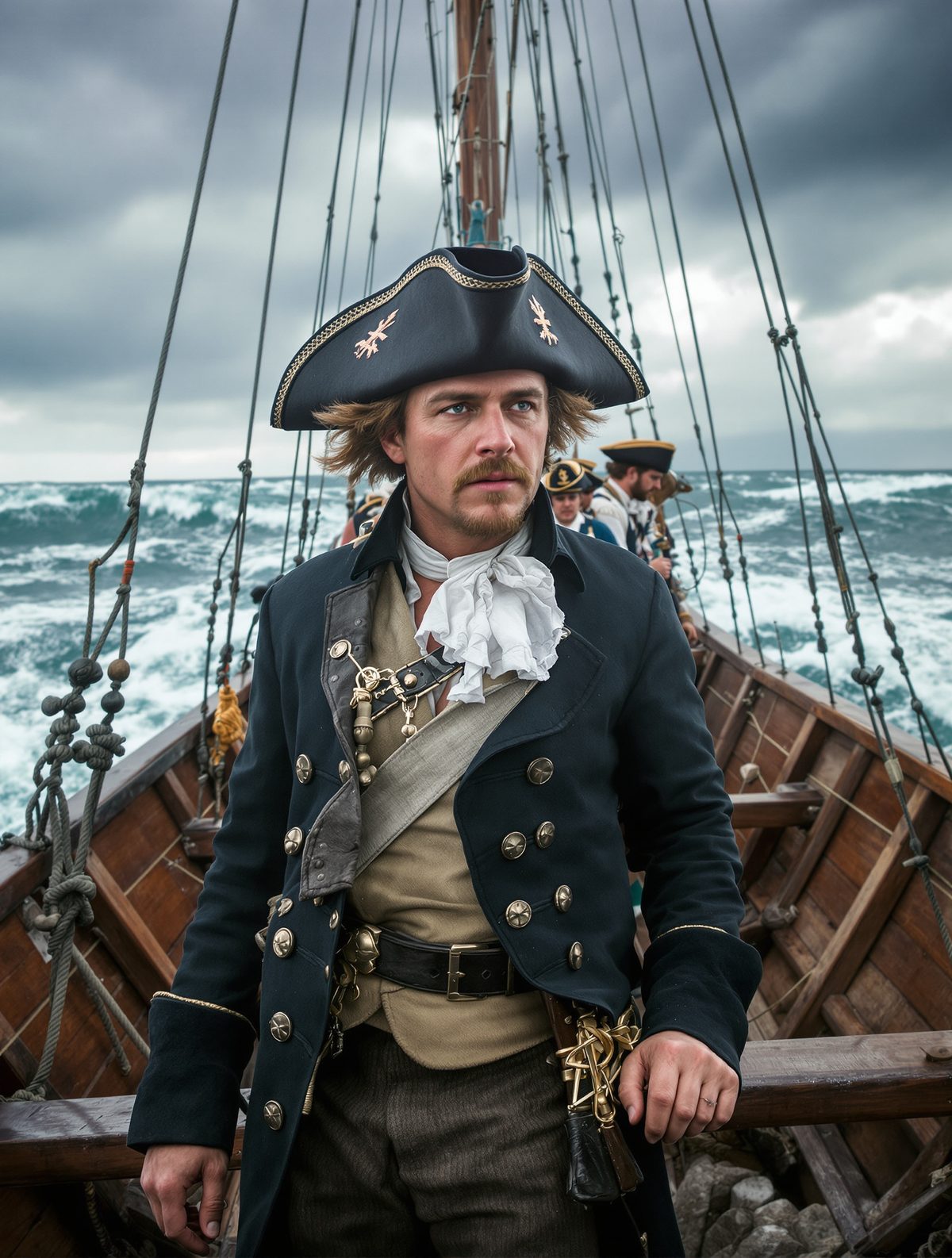
Picture this: it's dawn on April 28, 1789, somewhere in the vast blue emptiness of the South Pacific. Captain William Bligh awakens not in his comfortable cabin aboard HMS Bounty, but crammed into a 23-foot open boat with eighteen other men, watching his ship—and the mutineers who seized it—disappear over the horizon. Around them stretches nothing but ocean in every direction, over 3,600 miles from the nearest safe harbor. They have no charts, no compass worth trusting, and provisions that might last a week if they're careful. Most men would have resigned themselves to becoming shark food within days. Bligh had other plans.
The Mutiny That Shocked an Empire
The trouble had been brewing for weeks. HMS Bounty's mission—to transport breadfruit plants from Tahiti to the Caribbean as cheap food for slaves—had kept them in tropical paradise for five months. Many of the crew had formed relationships with Tahitian women, and the prospect of returning to the harsh realities of naval discipline didn't sit well with everyone. Master's Mate Fletcher Christian, once Bligh's protégé and dining companion, had grown increasingly resentful of what he saw as the captain's tyrannical behavior.
At dawn on that fateful April morning, Christian and twenty-five armed men burst into Bligh's cabin. "Hold your tongue, sir, or you are dead this instant!" Christian reportedly shouted, pressing a cutlass to his former friend's throat. Within hours, Bligh found himself in the ship's launch with the eighteen men who had remained loyal—or whom the mutineers simply wanted gone.
What the mutineers didn't count on was that they had just set in motion one of the most extraordinary survival stories in maritime history. They had cast adrift perhaps the finest navigator in the Royal Navy, a man whose memory contained detailed charts of half the Pacific Ocean.
A Captain's Impossible Mathematics
As the Bounty's sails vanished into the distance, Bligh faced a choice that would define the next forty-seven days. The nearest European settlement was the Dutch colony at Coupang on the island of Timor—3,618 nautical miles to the west across some of the most dangerous waters on Earth. The alternative was certain death.
Here's what makes Bligh's achievement almost supernatural: he had no reliable compass, no chronometer to determine longitude, and no detailed charts of the route. What he did have was a sextant (miraculous that the mutineers allowed it), a few basic navigation tables, and something far more valuable—a photographic memory for every chart he'd ever studied during twenty years at sea.
Bligh immediately established what can only be described as military-grade rationing. Each man would receive one-twenty-fifth of a pound of bread and a quarter-pint of water per day. To put that in perspective, it's roughly two tablespoons of water and a few breadcrumbs. The men were already starving by day three.
Threading the Needle of Death
The first major test came within days. Bligh knew they needed supplies, but landing anywhere in the region meant risking encounters with hostile islanders. When they attempted to land at Tofua in the Friendly Islands, warriors attacked them with stones and clubs. Quartermaster John Norton was killed—clubbed to death as he tried to untie the boat's painter. The survivors escaped, but barely, and Bligh made a crucial decision that saved all their lives: no more landings until Timor.
This meant navigating through one of the most treacherous stretches of ocean imaginable—the waters between Australia and New Guinea, where razor-sharp coral reefs lurk just beneath the surface and currents can dash a small boat to pieces in seconds. Bligh had sailed these waters before with Captain Cook, and every detail was burned into his memory.
Night after night, he calculated their position using the stars, making minute course corrections based on wave patterns, bird behavior, and the color of the water. During the day, he rationed not just food and water, but hope itself, keeping detailed logs and maintaining the routines of naval discipline that kept nineteen desperate men from descending into chaos.
When the Human Body Begins to Fail
By the third week, the men were no longer recognizable as the sailors who had left England. Their bodies had begun consuming themselves. Skin hung loose on skeletal frames, and some had developed the telltale signs of scurvy—bleeding gums, loose teeth, wounds that wouldn't heal. The saltwater sores covering their bodies from constant exposure had become infected. Several men were delirious.
Yet Bligh's navigation remained flawless. On May 8, after eleven days without sight of land, he announced they would see Australia by evening. His men thought he had lost his mind. At 4 PM, a thin line appeared on the horizon—the coast of Australia, exactly where Bligh had predicted it would be.
But Australia offered only temporary respite. They managed to gather some oysters and berries, but the mainland held no salvation. Bligh knew their only hope remained Timor, still over 1,000 miles away across the Arafura Sea. The most remarkable part of their journey was yet to come.
The Final Push to Civilization
The last two weeks tested not just their physical limits, but the very bonds holding their small society together. Food was virtually gone—they were surviving on tiny portions of bread that had turned moldy and rancid. Water was so scarce that they collected every drop of rain in whatever containers they could improvise. Some men spoke of cannibalism; others wanted to surrender to the sea.
Bligh held them together through sheer force of will and the promise that his navigation would prove true. On June 12, after forty-seven days at sea, he made another impossible prediction: they would sight Timor within two days. On June 14, 1789, the mountains of Timor appeared on the horizon, and grown men wept like children.
When they finally staggered ashore at Coupang, the Dutch governor could hardly believe what he was seeing. Nineteen skeletal figures, burned black by the sun, barely able to walk—yet alive after nearly seven weeks in an open boat. Not a single man had been lost to the ocean after that first attack at Tofua.
The Navigator Who Defied Death
Bligh's 3,618-mile journey remains one of the greatest feats of navigation in human history. Without GPS, radar, or even accurate charts, he had threaded a tiny boat through coral reefs, around hostile islands, and across open ocean with mathematical precision that wouldn't be matched until the age of satellites.
But perhaps more remarkable than his technical skill was his leadership. Nineteen men, pushed beyond the limits of human endurance, remained a disciplined crew because one man refused to let them become anything else. In our age of GPS and emergency beacons, when we panic if our phones lose signal for an hour, Bligh's story reminds us what human beings are capable of when survival demands nothing less than perfection.
The mutineers who cast him adrift thought they were condemning him to death. Instead, they had given him immortality. Captain Bligh didn't just navigate his way to safety—he navigated his way into legend.