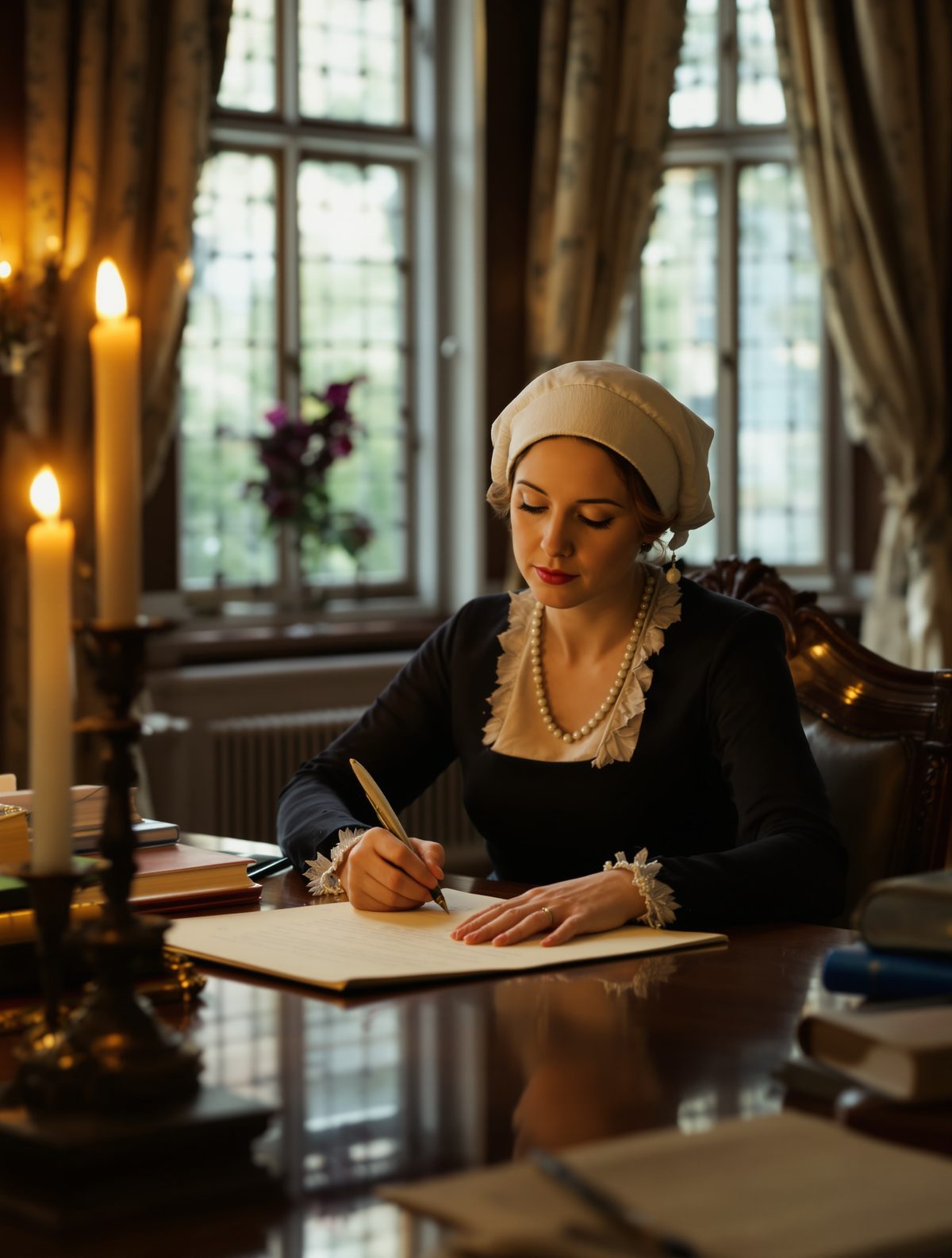
Picture this: a well-dressed woman sits by candlelight in her Bristol drawing room, her quill scratching against parchment as the clock strikes midnight. Outside, the port city sleeps, but ships bob gently in the harbor—some recently returned from the triangular trade that has made Bristol wealthy beyond measure. Hannah More has no idea that the words flowing from her pen will soon ignite the most powerful grassroots campaign Britain has ever seen, or that her simple verse will reach more people than any piece of writing in the nation's history.
The year was 1788, and slavery was woven into the very fabric of British society. Sugar sweetened tea in London parlors, tobacco filled pipes in Manchester clubs, and cotton mills in Lancashire hummed with profits built on human misery. Most Britons had never seen an enslaved person, but their lives were intimately connected to the institution nonetheless. Into this world of comfortable ignorance stepped Hannah More, armed with nothing but words—and they would prove more powerful than any weapon.
The Unlikely Revolutionary in Silk Stockings
Hannah More was an unlikely candidate to lead a revolution. Born in 1745 to a village schoolmaster in rural Somerset, she had clawed her way up from modest beginnings to become one of Georgian England's most celebrated playwrights. Her tragedy Percy had packed London's Drury Lane Theatre, and her comedy The Fatal Falsehood had earned her the friendship of literary giants like Samuel Johnson and David Garrick.
By the 1780s, More had transformed from a ambitious young writer into what we might today call a social influencer. Her Bristol cottage, Cowslip Green, became a salon where bishops rubbed shoulders with bluestocking intellectuals, and where the great moral questions of the day were debated over tea and syllabub. She moved effortlessly between worlds—equally at home discussing theology with evangelical reformers or theatrical techniques with London's cultural elite.
But it was precisely this unique position that made More so dangerous to the status quo. She had access to both the powerful and the pious, the wealthy and the working classes. When she decided to wield her pen against slavery, she possessed something most abolitionists lacked: the ability to make her message heard in drawing rooms, factories, and churches across the nation.
When Words Became Weapons
The spark came from an unexpected source. In 1787, More attended a dinner party where she met several members of the newly formed Committee for the Abolition of the Slave Trade, including Thomas Clarkson and Granville Sharp. These men had been fighting an uphill battle against slavery, armed with facts, statistics, and legal arguments that seemed to bounce off public indifference like raindrops off stone.
What they needed, they realized, was not more data—but more emotion. They needed someone who could make distant suffering feel immediate and personal. They needed Hannah More.
More retreated to her study and emerged with a poem that would change everything: "Slavery, A Poem." But this wasn't the genteel verse expected from a lady playwright. It was a literary thunderbolt, 350 lines of searing moral indignation that painted slavery in images so vivid they seemed to burn on the page.
"She speaks of torture, as men speak of death, / Pants for the blow that stops the vital breath," she wrote, forcing readers to confront the humanity of people they had been taught to see as property. More understood something profound about the power of poetry: while statistics numbed the mind, verse could pierce the heart.
The Poem That Broke the Printing Presses
When "Slavery, A Poem" was published in June 1788, something extraordinary happened. The first edition sold out within days. Printers across London scrambled to produce more copies, but they couldn't keep up with demand. By the end of the year, an estimated 300,000 copies were in circulation—in a country where a bestselling novel might sell 2,000 copies.
The poem spread through British society like a fever. Wealthy ladies read it aloud in their salons. Methodist preachers quoted it from their pulpits. Factory workers passed dog-eared copies from hand to hand. It appeared in newspapers from Edinburgh to Exeter, was reprinted in cheap pamphlets for the masses, and was even set to music for popular songs.
What made More's poem so infectious was its accessibility. Unlike the dry legal arguments of most abolitionists, her verse told a story that anyone could understand. She wrote of mothers torn from children, of human beings reduced to cargo, of Christian Britain's complicity in un-Christian cruelty. She made slavery personal, immediate, and impossible to ignore.
But perhaps most cleverly, More wrote as a patriot rather than a revolutionary. She didn't attack Britain—she appealed to Britain's better angels. "Shall Britain, where the soul of freedom reigns, / Forge chains for others she herself disdains?" she asked. This wasn't treason; it was a call for the nation to live up to its own ideals.
From Drawing Rooms to Dockyards: A Nation Awakens
The impact was immediate and measurable. Petitions against slavery, which had previously struggled to gather signatures, suddenly attracted thousands of names. The port city of Manchester alone collected 10,639 signatures—nearly two-thirds of its adult male population. Birmingham contributed 13,000. By 1792, 519 petitions with nearly 400,000 signatures had flooded Parliament.
More didn't stop with one poem. She became the unofficial poet laureate of the abolition movement, producing a steady stream of verses, ballads, and moral tales that kept the issue in the public eye. Her "The Sorrows of Yamba" told the story of an enslaved African woman in language so simple that barely literate readers could understand it—and so powerful that it moved them to tears.
The economic impact was equally dramatic. The sugar boycott that followed More's literary campaign saw consumption plummet by a third. Grocers advertised "slave-free sugar" to customers who had been awakened to the human cost of sweetness. Even the East India Company, never known for its moral sensitivity, sensed opportunity and began promoting sugar from India as an ethical alternative.
More had accomplished something remarkable: she had made slavery unfashionable. In a society obsessed with respectability, she had rebranded abolition as the mark of a refined conscience rather than dangerous radicalism.
The Pen That Outlasted the Sword
The consequences rippled far beyond Britain's shores. More's poems were translated into French, Dutch, and German, spreading anti-slavery sentiment across Europe. American abolitionists reprinted her work, finding in her verses a moral authority that their own arguments often lacked. Even in the slave-owning colonies, planters complained bitterly about the "poetry poison" that was turning public opinion against them.
When Parliament finally abolished the slave trade in 1807, and slavery itself in the British Empire in 1833, More could claim a unique victory. She had proven that in the hands of a skilled writer, literature could be more powerful than legislation, that poems could accomplish what politics could not.
The woman who had started as an entertainment for London theatergoers had become something far more significant: the architect of moral revolution. She had shown how a single voice, raised at the right moment with the right words, could awaken the conscience of a nation.
Why Hannah More's Midnight Mission Still Matters
Today, as we live through our own age of moral reckonings and social media campaigns, Hannah More's story feels remarkably contemporary. She understood something that modern activists are rediscovering: that changing minds requires changing hearts, and that the most powerful arguments are often the most personal ones.
More's success reminds us that individual actions can have extraordinary consequences. When she sat down with her quill that evening in 1788, she was simply a playwright with strong feelings about injustice. By morning, she had written words that would help bring down an entire economic system built on human suffering.
Perhaps most importantly, More proved that moral progress doesn't require violence or revolution—sometimes it just requires the right person finding the right words at the right moment. In an age when cynicism about change runs deep, Hannah More's midnight miracle offers hope that a single voice, raised with courage and conviction, can still move mountains.
The next time you read something that moves you to action, remember Hannah More. The pen she picked up in her Bristol drawing room didn't just write poetry—it rewrote history.