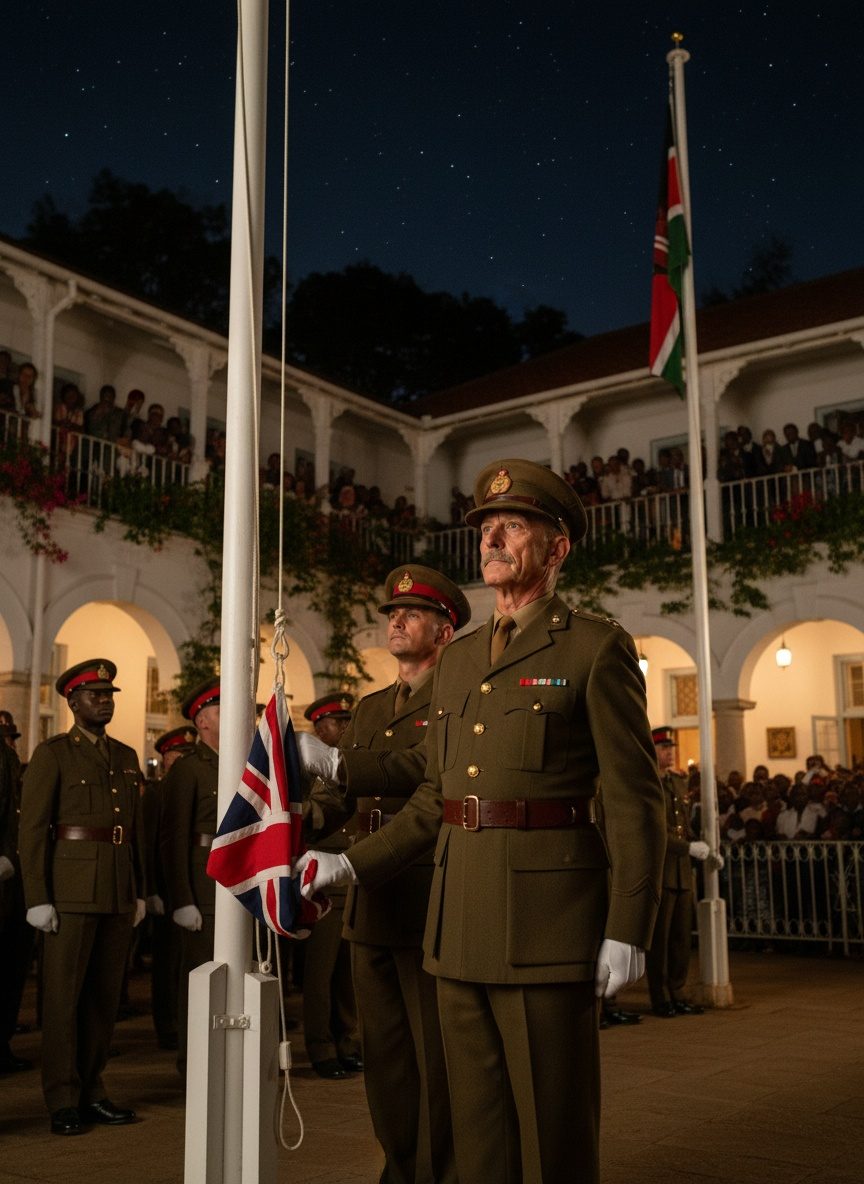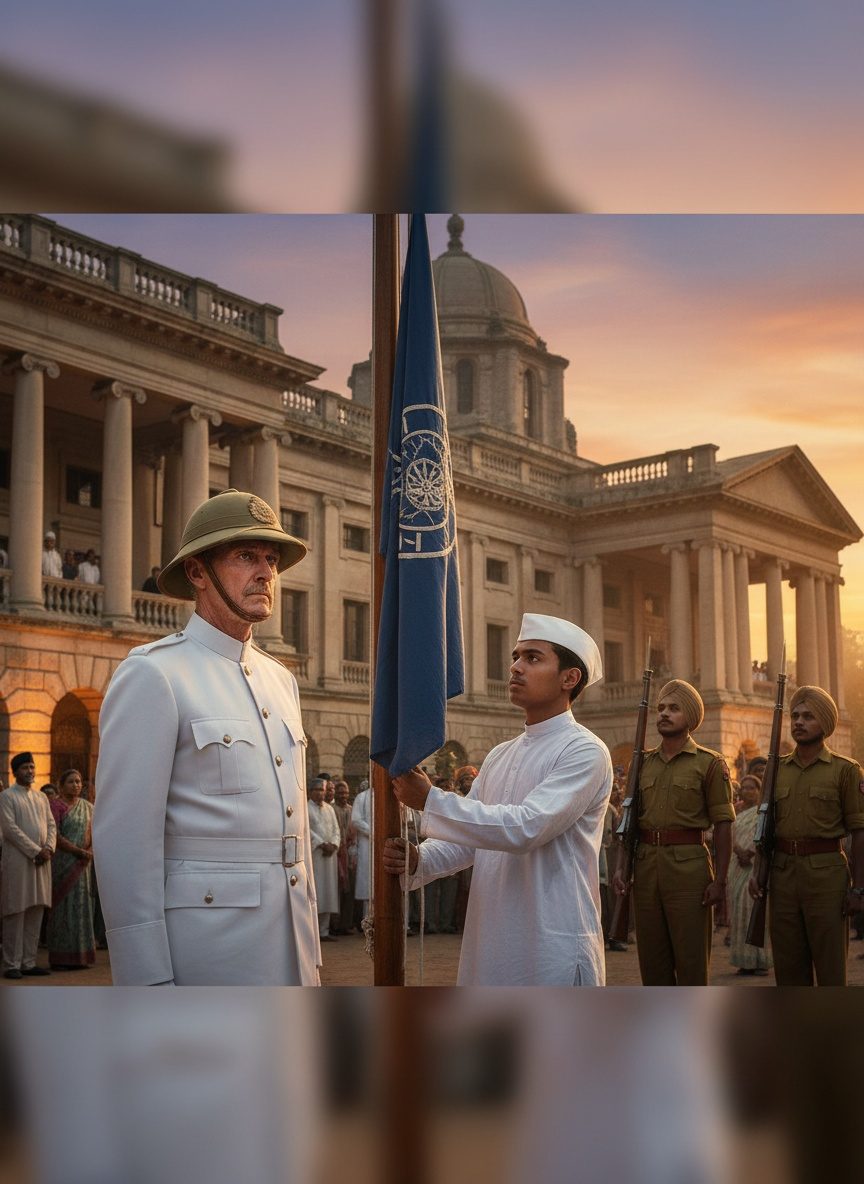
The steely creak of the flagpole rope echoed against the crisp night air. The fabric descended slowly, its stars twinkling dully under the dim glow of the moon. At the stroke of midnight on August 14, 1947, the Blue Ensign embedded with the Star of India slipped into history, its descent marking the end of a British epoch on the Indian subcontinent. After nearly ninety years of dominance, the Union Jack's emblematic offspring was finally lowered, ceremoniously ceding its place to the resplendent hues of India's own tricolour flag. As spectators held their breaths in anticipation, the significance of the moment was palpable — a silent witness to the birth of a nation and the eclipse of an empire.
The Emblem of Dominion
Before the Indian Tricolour waved triumphantly in the winds of freedom, the Blue Ensign, adorned with the Star of India, signified the British colonial authority. From the busy docks of Bombay to the verdant hills of Shimla, this flag was the ubiquitous symbol of British provenance. It was a banner under which countless laws were decreed, and extensive civil administrative work was conducted, yet it never enjoyed the prestigious standing of a national flag, always remaining a mark of imperial order.
The Blue Ensign, itself a curious choice of symbol, was adapted to signal British India’s maritime connections. Commanding the prows of formidable warships and fluttering boldly over colonial edifices, it embodied the sheer expanse of British power in foreign lands. The Star of India, representing the chivalric order of the British Indian Empire, was far from merely a decorative flourish. Its luminous five-pointed design, encircled by the motifs of the Garter, stood as a testament to British aristocratic influence and order.
Yet, the flag was more than just an insignia; it was a tool that communicated the authority and aspirations of the colonial rulers. For many, the Blue Ensign was synonymous with an identity thrust upon them. The flag served not only as a reminder of colonial rule but also as a silent witness to the stirring unrest and the increasing momentum for independence among the Indian populace.
The Dawn of Independence
As the clock struck midnight on August 14, 1947, and the last glimmers of daylight surrendered to the night across the Indian landscape, a wave of anticipation coursed through the hearts of millions. The transference of power, characterized by the ceremonial lowering of the Blue Ensign, was more than just the replacement of one flag with another. It symbolized the profound and arduous journey of India's struggle for self-rule, a struggle that had left a distinct imprint in every village and city.
The scene in New Delhi was emblematic of the mood across India. Politicians, freedom fighters, and onlookers gathered in eager anticipation. With bated breath, they watched as the imperial symbol was finally drawn down from its proud post, silent but ineradicably poignant. The Blue Ensign, a flag that many colonial subjects had known all their lives, slipped silently from its mast — its absence leaving behind a void that would soon be filled with the vibrant green, white, and saffron tricolour.
Yet the lowering of this flag was not merely an act symbolizing the end of British rule; it was the shattering of an illusion, the closing of an era where millions of Indians had lived under foreign governance, both empowering and exploitative. It meant different things for different people. For the colonials who had served under its flapping wings, it signified the end of an adventure fraught with challenges as well as the privilege of commanding a vast and diverse territory. For India's emerging leaders, it was the realization of hard-fought dreams and the commencement of building a nation from the fragments left behind.
The Legacy Left Aflame
To mark the end of the Blue Ensign's tenure and the rise of a new, independent India, the solemnity and festivity of Indian Independence Day celebrations are unmatched. The hauler down of this historical emblem was akin to the closing of a heavy, dusty volume, filled with stories of conquest, oppression, marvels of architecture, and strides in administration. The Star of India, although tarnished by its association with colonial rule, was also a symbol that inadvertently brought forth connections, developments, and transformations that modern India would eventually build upon.
But what can we make of this piece of history that, for decades, was swept under textbooks? The subject of textbooks and archived discussions, today, the Star of India remains an emblem curiously absent from mainstream memory, subdued within the vibrant narratives of independence and partition. Yet, acknowledging it reminds us of the complex layers woven into India's socio-political tapestry. It is a narrative charged with irony — a flag of dominion and identity, whose falling marked the liberation of three hundred and fifty million souls.
In a broader context, the memory of the flag's descent serves as a symbol of metamorphosis, of how conquests can become conduits for cultural exchanges, of how dominance can transition into diplomacy, and of the indomitable spirit of nations rising from the shadows of empires. Although overshadowed by the splash of the tricolour, the Blue Ensign's place in India's colonial history is indispensable in understanding the complete picture of the past that shapes the nation's present and future.