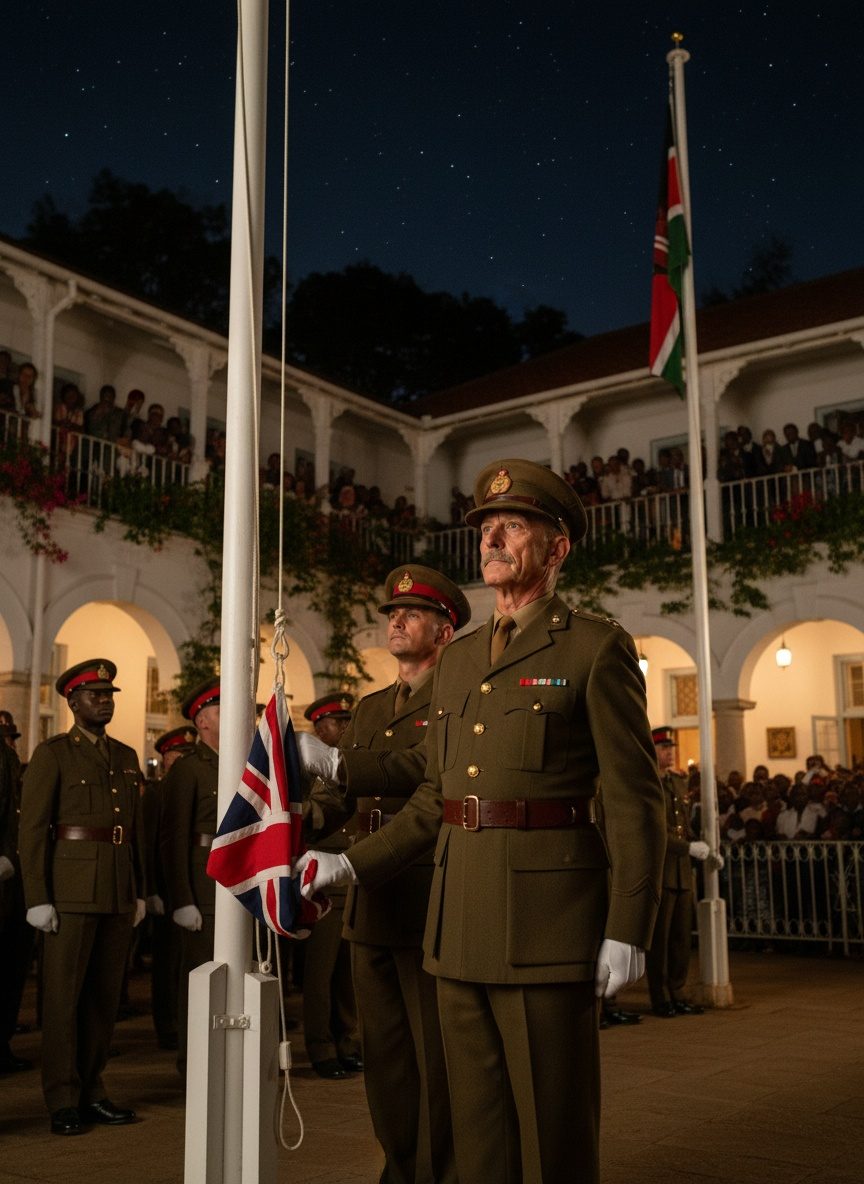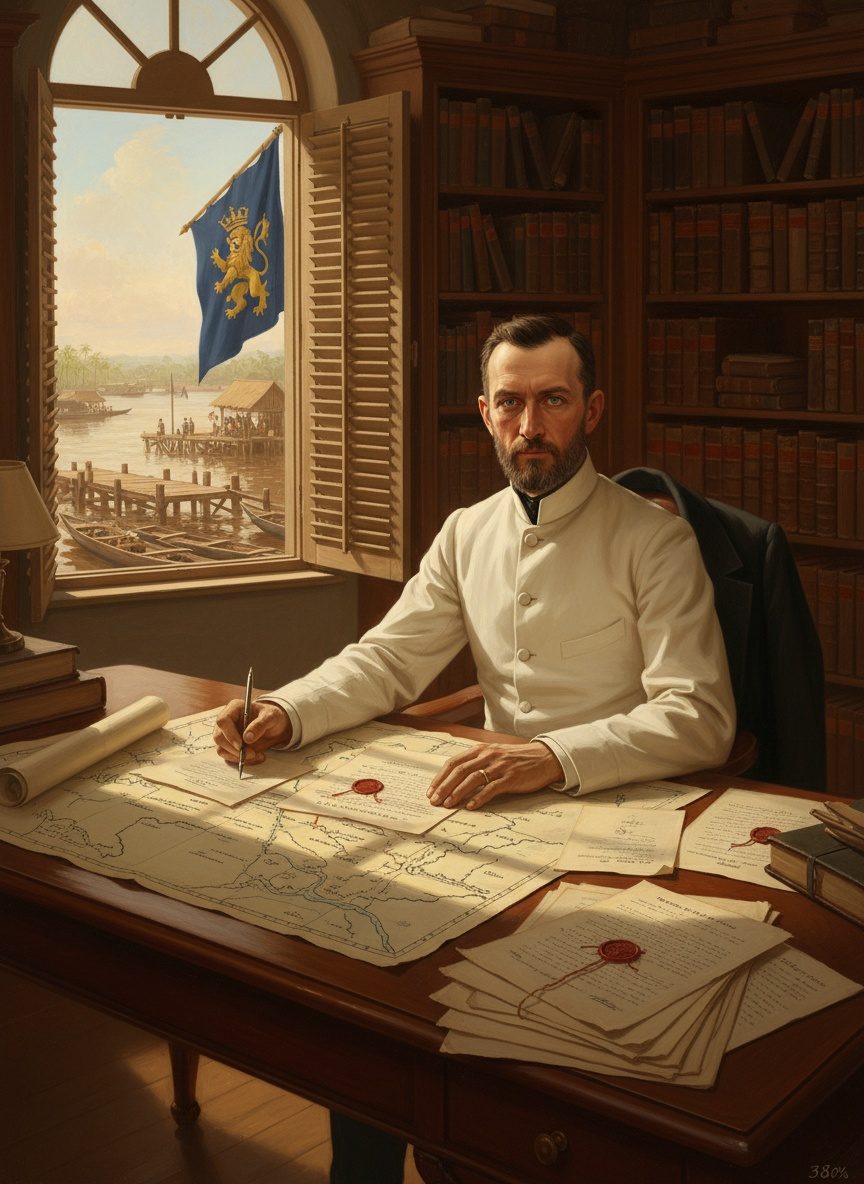
The rain, heavy and incessant, pounded the palm leaves like drumming fingers on a long-neglected table. Undeterred by the storm, Stamford Raffles wove his way through the sea of colorless, rain-drenched figures huddled around him. The dissonant clang of traditional Malay instruments echoed in the distance as he approached the hastily constructed court of the Sultan - a mismatched assembly of weathered tents and mud-splattered banners. His heart raced beneath his heavy coat, a beacon of modernity amidst the timelessness. The air felt charged, not with the static of storms, but with the anticipation of history yet to unfold. A thick, oppressive humidity embraced him, a stark reminder of the restless jungle surrounding this tenuous outpost of civilization.
The Uncharted Gamble
Stamford Raffles, just thirty-seven and entirely self-taught, stood as a man on the brink of a turbulent venture. The echoes of the expansive Napoleonic Wars had cast long shadows over European ambitions, leaving the British Empire scrambling to secure its foothold in Asia against its relentless rival, the Dutch. Yet here, on the fringes of the dying Johor Sultanate, Raffles saw opportunity rather than obstacles. He had no army to back his cause, no formal mandate from London, only the capricious promise of a more than dubious treaty.
Was it folly or fortune that drove him? The deathbed of old alliances and the erratic patronage of a faltering sultanate marked his path. But Raffles, ever the visionary, saw beneath the ruin. Ahead lay the rich, untapped currents of commerce that flowed through the Far East like molten gold through an untamed crucible. Compelled by the illusions of a burgeoning trade city, he ventured deeper into the jungle of diplomatic exploit, steadying his resolve with the knowledge that his silence on the edge of the unseen British Empire might be broken only by the pen's ink.
Upon reaching the court, Raffles was met with solemnity and skepticism. The sultan's court was a maze of intricate customs and veiled alliances, a stage set for a theater of power plays that drew from the wellsprings of antiquity. Every glance, every whispered word by the attending advisers, bore the weight of empires past and future. Yet Raffles, with his avant-garde vision, knew the threads of empire often relied less on their ancient strength and more on their potential to weave new domains.
Seeds of a Metropolis
In the tense, dimly lit tent that served as the sultan's audience chamber, Raffles stood as an outsider among this tapestry of declining order. But he had a mind honed for strategy, partially shaped by his mentor, Sir Thomas Stamford Bingley, who taught him that history's tide turned on seemingly insignificant decisions. Here, Raffles had no guarantees, only the specter of obscurity should he fail. Yet he remained steadfast, straddling the line between diplomacy and destiny.
Negotiations were a delicate dance—a whispered ballet amidst creaking cots and watchful eyes. Raffles had to tread cautiously, for the specter of Dutch retribution loomed large in his mind’s theatre. He spoke of partnership and mutual prosperity, drawing vivid pictures of future gain that were as colorful as the tropical birds nesting in the nearby canopies. The little island of Temasek, destined to become Singapore, was merely a pawn in a much larger game. Insight told him the sultan, weakened and wearied, would see through the veil of opulence cloaking his court—a court now drawn between survival and modernity.
One could only wonder if the gravitas of the moment imparted its weight upon the courtiers. In the warmth of that ragged enclosure, ink stained paper under his steady hand. It was a transformation, from visions whispered in the moonlight to the tangible promises of alliance. With the final flourish of his signature, Raffles not only carved a new path for the British Empire but also sowed the seeds of Singapore’s future as a cosmopolitan hub.
The Empire Behind the Curtain
Raffles’ piece of parchment was more than a calculated risk; it was a hammer blow in the clashing symphonies of colonial dominance. Yet, as the ink dried, unknown to him was the tempest that brewed both in his home empire and within the court he now temporarily belonged to. Would his government back this brazen move or condemn him for stepping into regions yet uncharted by imperial ink? Raffles had rolled the dice, his reputation dangling on the thin thread of a burgeoning Singapore.
The days following the treaty were marked by a careful sequencing of moral compréhensions and fiscal ambitions. Seafarers, merchants, and wanderers draped in disparate garbs converged, drawn to the once silent island by the currents of empire. Raffles’ dreams began their tentative touch upon reality as his name slowly etched itself into the annals of history, less a mere lordling than a maestro orchestrating a symphony of human aspiration against a backdrop of colonial tumult.
Like the ripples emanating from a single pebble breaking the water's surface, the inception of Singapore as a trading goliath began to shape the maritime destinies of Southeast Asia. The sultanate’s court, once on the fringe, now thrummed at history’s heart. The empire behind the curtain revealed itself not just in territorial colors on a map, but within the intricate dance of opportunity and alliance woven by a solitary clerk’s son. This was Stamford Raffles’ legacy, not merely in chartered lands but in the audacity of his vision—an enduring testament to the power of one man's belief in the uncharted possibilities. As history remembers, it was here, cloaked in the penumbra of imperial twilight and equatorial storms, that one of the greatest stories of modern commerce began, redefining the fate of an empire and altering the destiny of the world upon the ink-stained sands of Singapore.