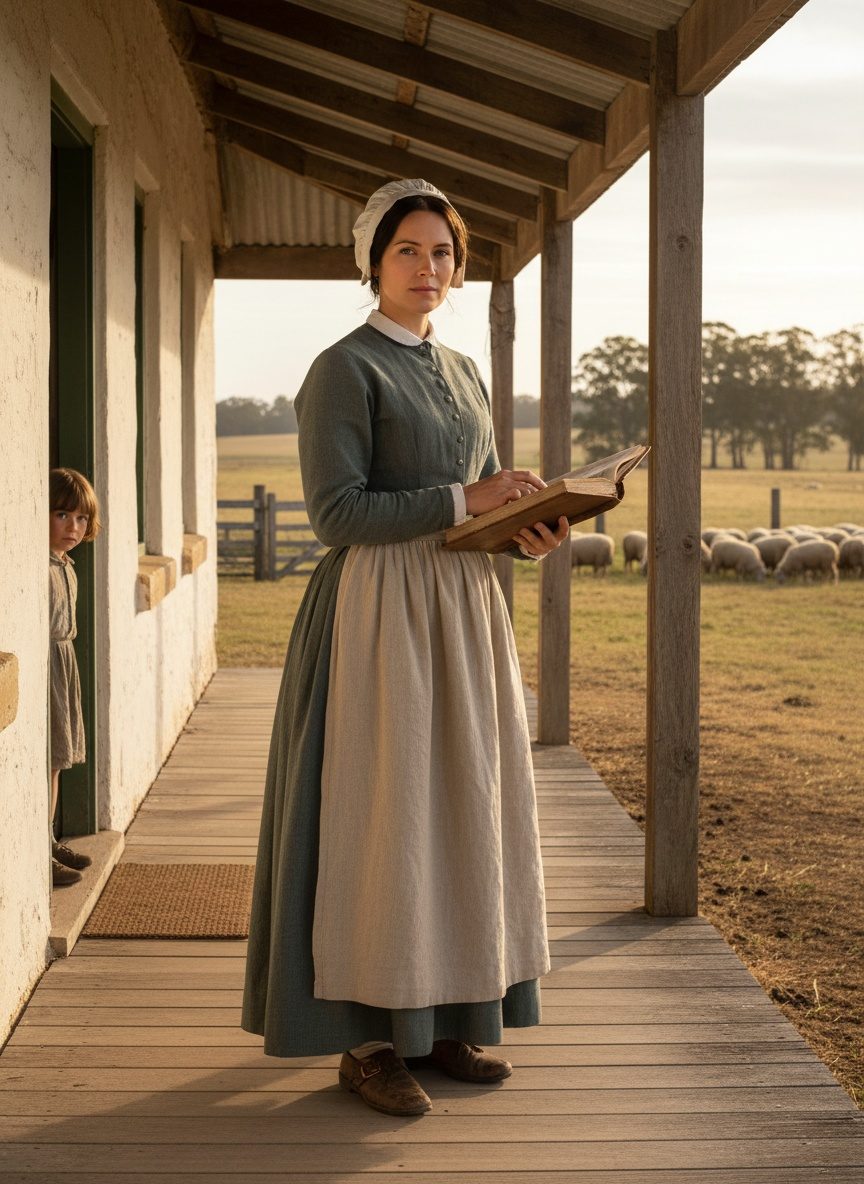
Elizabeth Macarthur's name is nearly forgotten. Yet, her legacy vibrantly shaped the future of Australia's wool industry and preserved the nascent colony she called home.
The Unexpected Moment of Leadership
The year was 1801, and the Georgian Empire's firm grip on its colonies was evident everywhere. John Macarthur, a contentious and ambitious soldier, had been embroiled in disputes that rippled through the colonial administration. His eventual arrest and forced voyage to England in 1801 left an unforeseen void at Elizabeth Farm, near Parramatta. It was in this moment that Elizabeth, his wife, was left standing before an empire of her own—eight children, a nascent wool enterprise, and a rugged land far from the genteel England of her upbringing.
Elizabeth Farm was a bucolic anomaly nestled in the harsher realities of colonial life. The farmhouse was simple yet substantive, echoing a quaint English charm amidst the unpredictable Australian wilderness. Each morning, Elizabeth would rise to oversee operations across their homestead, stretching her foresight beyond the usual domestic concerns of a colonial wife. While others saw a struggling outback with scattered dreams, Elizabeth envisaged fertile grounds for innovation and growth.
With John embroiled in legal and political turmoil oceans away, doubts loomed over their sheep station's sustainability. Vision came in tandem with grit, as Elizabeth deftly juggled responsibilities. She managed not just the estate’s day-to-day needs but also its long-term potential, showing a keen strategic mind. Her involvement in the merino breeding program, which John had initiated, evolved in depth and success, laying down the roots for what would grow into a cornerstone of Australia's economic future.
In the Shadow of a Sheep's Fleece
Understanding the potential of merino sheep, whose fine wool was immensely prized, Elizabeth focused on improving the quality and quantity of their flock. In correspondence with John and other colonial leaders, she displayed a nuanced grasp of sheep farming, allowing her to facilitate successful trades and negotiations with merchants. Her detailed letters were filled with descriptions of shearing techniques and the trials of sheep rearing in a landscape so unlike the British fields.
Elizabeth's path wasn't lined with gold. The colony was plagued by financial instability, famines, and social upheaval. Yet, instead of being daunted by these formidable obstacles, she capitalized on them. She adapted to the erratic rhythms of colonial economics, understanding that innovation often arises in times of hardship. Her ability to deploy a shrewd business acumen was a revelation for colonial Australia, reminiscent of the resourceful ingenuity of settlers who came before—and those who would follow.
Running a profitable wool station was no easy feat. Elizabeth faced endless challenges, from unpredictable weather patterns to the need for resilient stock management. Nevertheless, her stewardship turned the farms into a credible venture, championing the burgeoning wool trade that would eventually play a pivotal role in the colony's progress. As merchants and traders reported back to London, the value of Australian wool soared thanks, in no small part, to Elizabeth's leadership.
The Quiet Architect of a Nation's Industry
Eight long years passed with Elizabeth at the helm. By the time John returned to Australia in 1809, what remained was not simply the farm he had left behind, but an operational blueprint for the wool industry that was increasingly central to Australasia's economy. Elizabeth had not just sustained their family and farm; she had paved the way for a thriving enterprise that would ultimately weave the fabric of a nation’s industrial promise.
Her contributions went beyond the immediate confines of Elizabeth Farm. She served as a figure of quiet resilience for other colonial women, embodying a narrative that complemented their shared experiences of hardship and achievement. Elizabeth's legacy stands less in brick and mortar and more in the undulating wool fields of Australia, stretching across time as industrial landscapes transformed from fledgling pastures to bustling industries.
As you stroll through modern Pyrmont in Sydney, you may visit the decorative Elizabeth Macarthur Bay—an emblem not just of geographical insight but of historical resonance. Elizabeth's story is a reminder that colonies were not simply territories to be dominated; they were living, breathing entities cultivated by those who innovated in the face of adversity. Her narrative, hidden in the folds of textbooks overlooked by time, is an invitation to explore the industrious spirit that quietly yet profoundly shaped the empire she was part of. In the quiet strength and determination of Elizabeth Macarthur, we find a lesson on leadership, resilience, and the power of vision unfettered by circumstance.