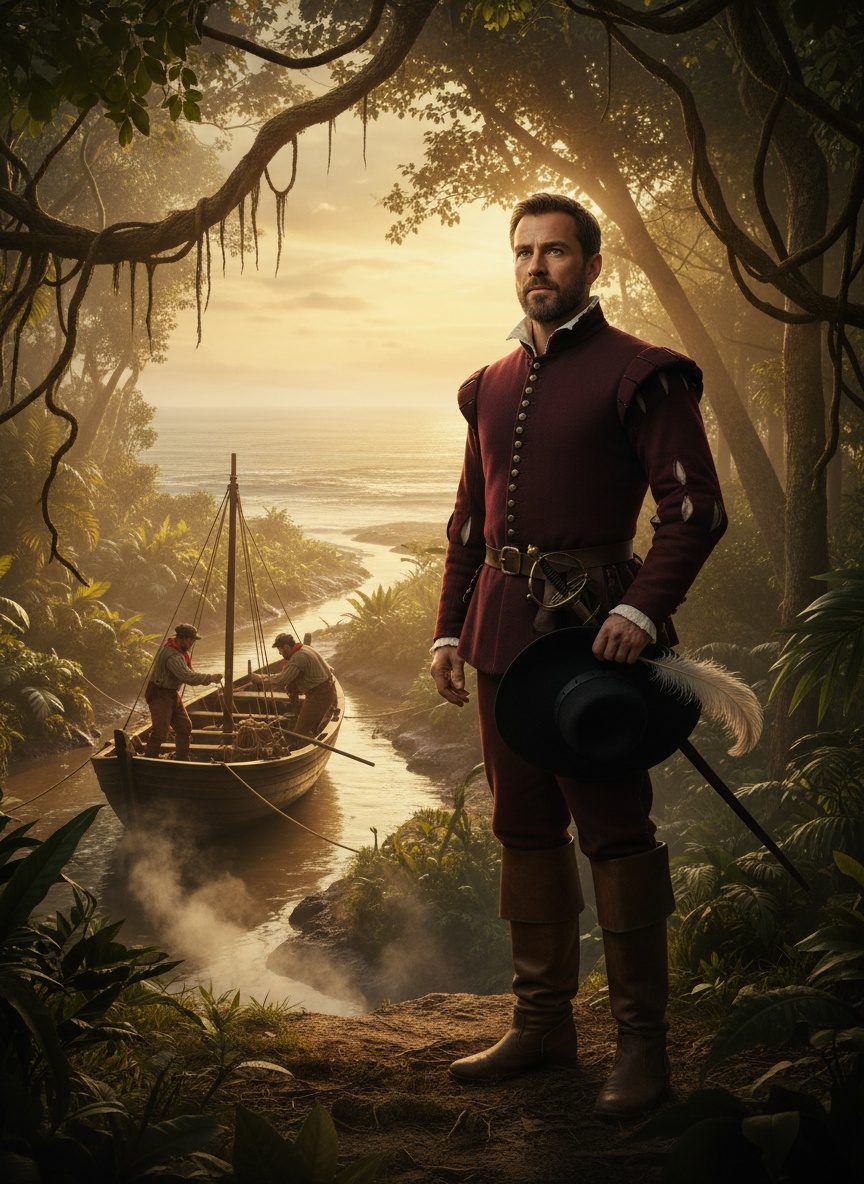
The rainforest floor squelched beneath his boots, every step a struggle through the clinging, humid embrace of the Darien jungle. John Oxenham, a resolute sea captain from Devon, paused to catch his breath, his lungs heaving under the oppressive weight of the tropical air. His eyes strained through the thick, tangled flora as his men hacked a path with machetes, their faces glistening with the sheen of relentless perspiration. Somewhere ahead lay the promise of the Pacific Ocean, a forbidden expanse yet untasted by English keel.
The Decision That Changed the Voyage
It's difficult to pinpoint the exact moment when Oxenham resolved to defy the mighty Spanish Empire's claim over the New World, but his spirit of defiance was as unmistakable as the English flag he planned to hoist on foreign waters. The year was 1575, and England's gaze was increasingly drawn towards the riches of the New World, all but monopolized by the Spanish Crown. Despite the hazards and the specter of Spanish retribution, Oxenham imagined an English sail on the Pacific, a daring vision that drove his ambitious expedition.
A seasoned mariner known for his intrepid nature, Oxenham recruited a loyal crew for a clandestine voyage into territories yet untamed by his countrymen. Forgoing convention, he devised a plan as audacious as it was simple: drag a boat over the rugged spine of the Darien and set sail on the Pacific. The logistics were daunting, but Oxenham's determination mirrored that of a man possessed by a vision larger than life and limb.
Through the Jungles of Darien
Crossing the Darien isthmus was not just a test of skill but one of survival. Renowned as a nexus of inhospitable terrain, the isthmus was a blend of dense jungles and perilous swamps, teeming with fever, snakes, and insects that could bring the strongest to their knees. Yet these natural perils paled in comparison to the troubles of hauling a dismantled pinnace through such harsh landscapes. Every inch forward was claimed by the sweat of Oxenham's men, and every path cleared seemed like another triumph.
The herculean task unfolded under the constant threat of discovery by Spanish patrols. In a land where nearly every path led to Spanish domains, secrecy was as vital as the air they breathed. Despite these obstacles, Oxenham remained focused on the horizon, where the verdant canopy promised to break into the golden expanse of the Pacific, a sight that would make him the first Englishman to witness the vast, untapped ocean.
Setting Sail on Uncharted Waters
At last, the jungle relented, and the men reached the shores of the Pacific. By the sweat of their brows and the strength of their backs, the pinnace was reassembled. The assembly was both an act of defiance and determination; it symbolized more than just a small vessel — it represented English ambition. As the pinnace skated across the Pacific's rippling surface, the flag of St. George fluttered defiantly amidst the salty breeze — a bold proclamation of presence in waters considered inviolably Spanish.
This brief incursion was charged with significance. Oxenham's foray was not just an adventure but a herald of the imperial contest that would unfurl over the coming centuries. For a moment, the English mariner's daring dream materialized, and his crew was buoyed by the audacity of their achievement, each man acutely aware of their place in history's annals. But their triumph was ephemeral, a flicker in the relentless tide of Spanish dominion.
The Price of Defiance
Fate, however, had etched Oxenham's destiny with a darker hand. The Pacific's winds carried whispers of the English incursion to Spanish ears, sparking outrage among the colonial establishment. While Oxenham and his men relished their brief success, Spanish forces mustered with an unyielding intent to reinforce their sovereign claim and retaliate with brutal efficiency.
Surrounded and outmanned, Oxenham's crew soon faced the grim wrath of Spanish justice. Captured and imprisoned, they were forcefully reminded of the precariousness of their enterprise. Oxenham himself paid the ultimate price for this act of bold defiance; his life was claimed by the gallows, forever marking him as both conqueror and lesson in the perilous game of empire-building. His execution underscored the ruthless lengths the Spanish Empire would go to in defending its hard-won realms.
An Unfurled Flag in History's Winds
John Oxenham's audacious journey across the Darien and onto the Pacific was far from a footnote. It underscored the burgeoning spirit of Elizabethan exploration and the burgeoning rivalry between burgeoning European maritime powers. Oxenham's fleeting success was a crack in the façade of Spanish invincibility and a harbinger of England’s future as a seafaring power. The courage and resolve enshrined in his endeavor echo through the corridors of history, offering a timeless testament to human ambition and the perils of challenging the status quo.
Though the waves he sailed returned to Spain’s dominion, the stirrings of change had already been set in motion. Oxenham's story reverberates beyond textbooks, a whispered legend of daring and dreams in the shadowy dance of empires. The image of an English flag fluttering over the Pacific's swell lingers as an enduring moment, a defiant breath against the gales of fate, inspiring those who dare to peer beyond the horizon.