The Guards Armoured Division rumbled towards war with deafening purpose, steeled for battles yet unknown. But the final message they carried wasn’t forged in military command — it was chalked by a factory girl with a few words of hope.
The Journey of Steel and Sweat
September 1942. London was a city throbbing with the intensity of war effort, its industries churning day and night to arm the troops. In Neasden, a munitions factory echoed with the relentless clatter of production, its workers an integral yet often overlooked part of the war machine. Amongst them, factory girls played a critical role in ensuring the relentless flow of weapons and ammunition. Despite the monotony and fatigue, there was determination on the factory floor, a shared resolve to support those fighting on the frontlines.
The factory output was more than just materials; it was infused with hope, much like the tanks crafted for the Guards Armoured Division. The Covenanter tank, with its imposing thirty-ton stature, was a product of such laborious days and nights. These machines were not faceless hulks of metal; each rivet and seam held the sweat and silent prayers of those who built them.
A Moment Stolen from Time
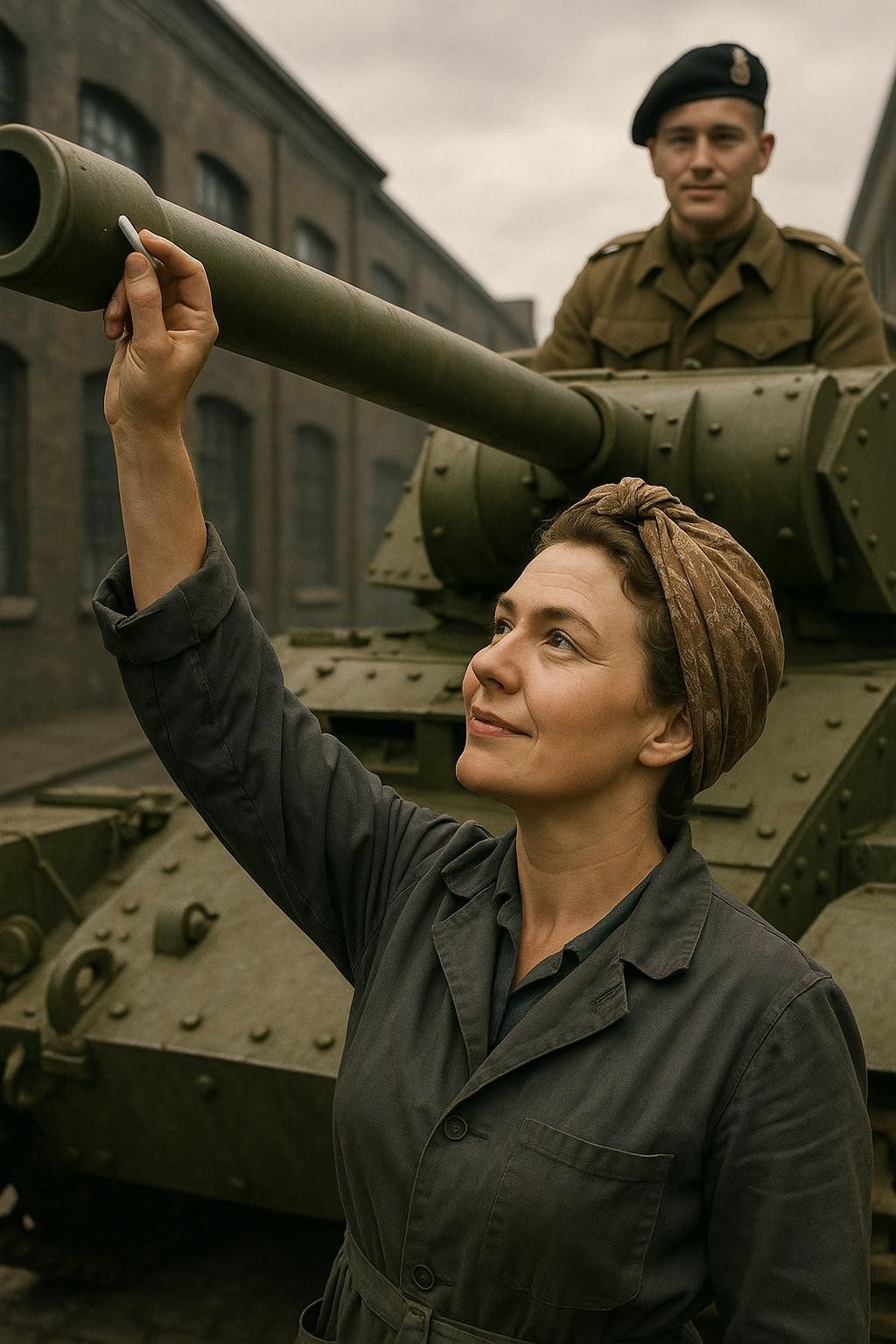
As the convoy lined the streets of Neasden, a brief pause in the march gave unlikely opportunities. Passersby and factory workers alike gathered to bid the soldiers farewell, their faces a mixture of pride and anxiety. It was within this singular moment that a young woman, unknown to history but vital in her gesture, stepped forward with a piece of chalk.
In the industrial din and the haze of war, small acts of humanity often glimmer brightest. Her words, scratched onto the steel barrel of one of the tanks, spoke a universal emotion that resonated with the men inside: *"Good luck and God speed."* In those four words she captured the essence of a nation, articulating what the workforce and the home front rarely had a chance to express amidst their stoic adherence to duty.
Beyond Orders and Strategies
This fleeting interaction underscored a significant collision of worlds: the strategic calculations of military command with the sincere, unpretentious messages of the common people. The Covenanter tank, positioned for war, became a symbol of courage not only in its might but in the quiet vulnerability its message carried. The words written upon it traveled much further than its physical shell, echoing through the hearts of the men it escorted into battle.
Their recipients, the soldiers of the Guards Armoured Division, carried this message as part of their armor. They understood the significance, acknowledging that their mission was supported not just by orders and tactics, but by the very citizens who fashioned the tools of war and wished them safe. It bridged the gap between the battlefield and Home Front, binding them closer at the quiet dawn of Europe’s liberation challenges.
A World Lit by Beacon Fires
This brief episode in Neasden is one of countless personal stories hidden beneath the grand narrative of the Second World War. It highlights how individual acts — seemingly insignificant in the grand strategy of war — can have profound impact. Here, personal expression found an unlikely canvas in the gray, overpowering form of an armored vehicle. Instead of fading into wartime obscurity, this simple act of empathy transcended its environment.
The era was rife with uncertainty, yet the verse on a tank offered a potent anecdote of how resilience and mutual support thrived amidst conflict. It speaks to the essence of war beyond mere clash of forces, illuminating shared human experiences.
A Salient Whisper in a Storm
The story of the factory girl and her message on the tank reminds us that while history often chronicles the exploits of generals and statesmen, the axis upon which it truly turns is populated by the anonymous and the humble. These moments, etched in brief pauses and silent gestures, dissolve the abstract of war into tangible human stories.
The chalk trace in Neasden was much more than words on metal. It was a nexus of the hopes and fears of millions — a reassurance that someone was indeed watching, feeling, and understanding. It remains a testament to the fundamental human need to connect and support, providing depth to the recorded history of battles and strategies. This simple act, historically small, embodies the soul of a conflict that encompassed so many lives. It’s a whisper amidst the roar of war, reminding readers why such stories, however brief, should never be left out of the textbooks.