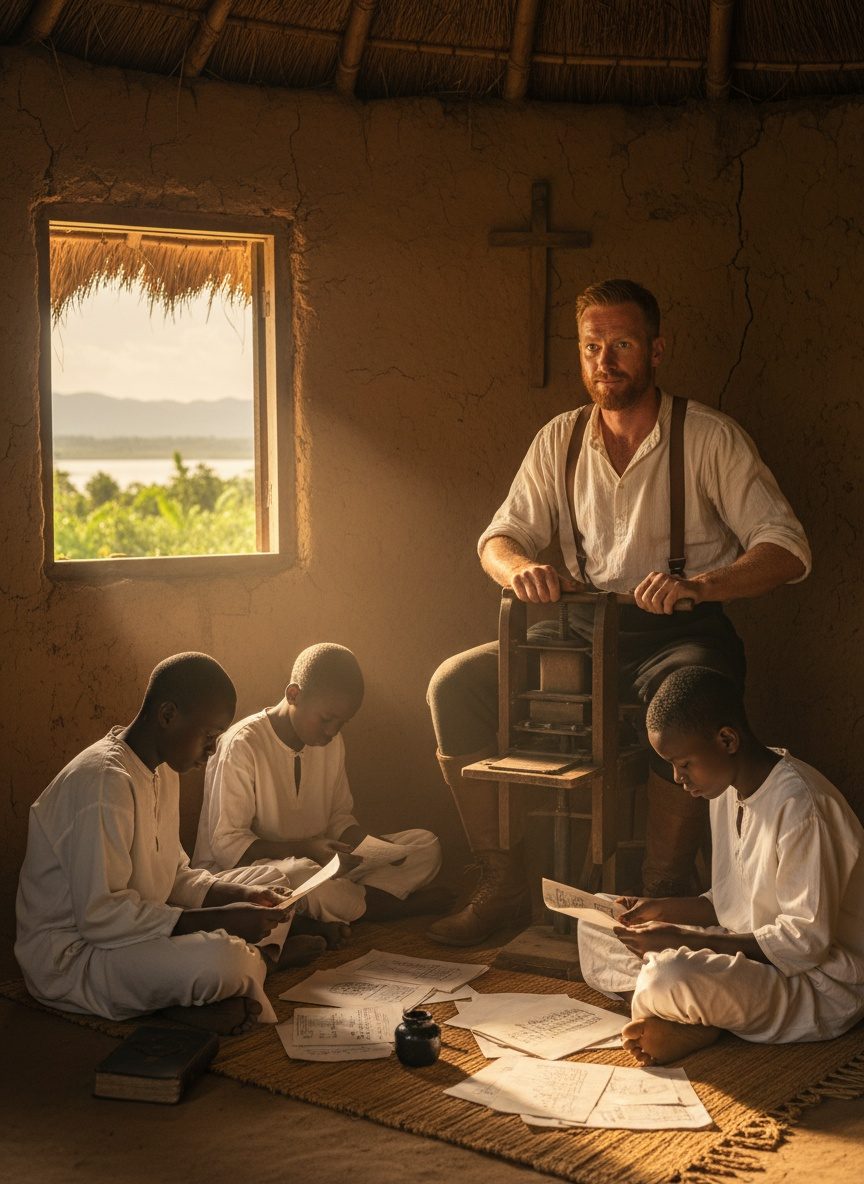
October 1882. The air was thick with the scent of dust and possibility.
The Unyielding Highlander
Amidst the rolling hills and vast expanses of Central Africa lay a small yet potent spark in the form of a lone Scotsman by the name of Alexander Mackay. Picture him: resolute beneath the fiery Ugandan sun, his sharp eyes surveying the reddish earth where he dared to carve out a future. Some called him audacious; others, foolhardy. Yet no one could deny his tenacity. Mackay wasn’t the standard bearer of colonial conquests nor a subjugator of lands; he was an engineer among tribes, assembling not bridges of iron but connections between cultures.
In 1882, Mackay found himself at odds with the powerful King Mwanga of Buganda. The king's fear of the growing influence of foreign religions had already led to the execution of several Christian converts. Mackay’s friends and fellow missionaries had met untimely ends, either executed or driven away. The remnants of discord lingered, yet Mackay, resolute and defiant, had chosen to stay.
An Oasis of Learning
At the heart of his mission, nestled on the sharp edge of the African hinterland, Mackay envisioned a bastion of enlightenment in the form of a school. The construction was modest, nothing more than a simple mud-brick structure, but its foundation had been laid with the hopes harbored in Mackay’s heart. Here, he would teach young boys the art of reading, kindling in them the power of knowledge that was foreign and perhaps a bit frightening to some.
Despite pressure from local chiefs and the looming threat from the king’s court, boys continued to flock to Mackay’s school. Some arrived out of pure curiosity, drawn by the mystery of the written word. Others, perhaps, sought the companionship and guidance of a man who seemed unshakable even in the harshest of storms. They huddled around him, wide-eyed and eager, learning to trace the alphabet onto slates, each letter a small act of defiance against ignorance.
Beneath The Swirling Dust
The scene around Mackay's school buzzed with life. Amidst the dust clouds stirred up by brisk winds, the rhythmic sound of wooden clappers marked the change of lessons. Mackay's insistence on teaching practical skills made the school a hive of activity. The dull thud of a hammer echoed as students learned woodworking, while the rhythmic turning of a bicycle wheel accompanied lessons on mechanics. To Mackay, education was not confined to letters and numbers; it was about equipping the next generation with tools for a future they could shape with their own hands.
Mackay’s printing press, a remarkable contraption in such an isolated locale, was another testament to his ingenuity. Through it, he produced books and pamphlets, painstakingly translated into the local language, to spread the gospel of literacy to an even broader audience. The press wasn't just a machine; it was a catalyst for change, churning out pages that bore not only words but a clarion call to enlightenment.
A Legacy Written in Ink and Courage
The tale of Alexander Mackay in Uganda is one of quiet defiance wrapped in the cloak of educational zeal. It is the story of a man who, amid the thunder of political unrest and societal upheaval, chose not the path of retreat but of resilience. His legacy, left behind in the dust of African plains, is not just the knowledge imparted to a generation of Ugandan boys or the slates etched with inked letters.
Why does Mackay's story matter? Perhaps because it reminds us of the relentless power of education as an equalizer, a force that transcends time, culture, and fear. Mackay's school, his printings, his teachings, were more than ephemeral victories against ignorance; they were the seeds planted in the fertile ground of human potential. A Scotsman far from home, challenging the very forces that sought to silence him, he held fast against the tide, proving that even at the dusty edge of an empire, the indomitable will to enlighten could indeed change the world.