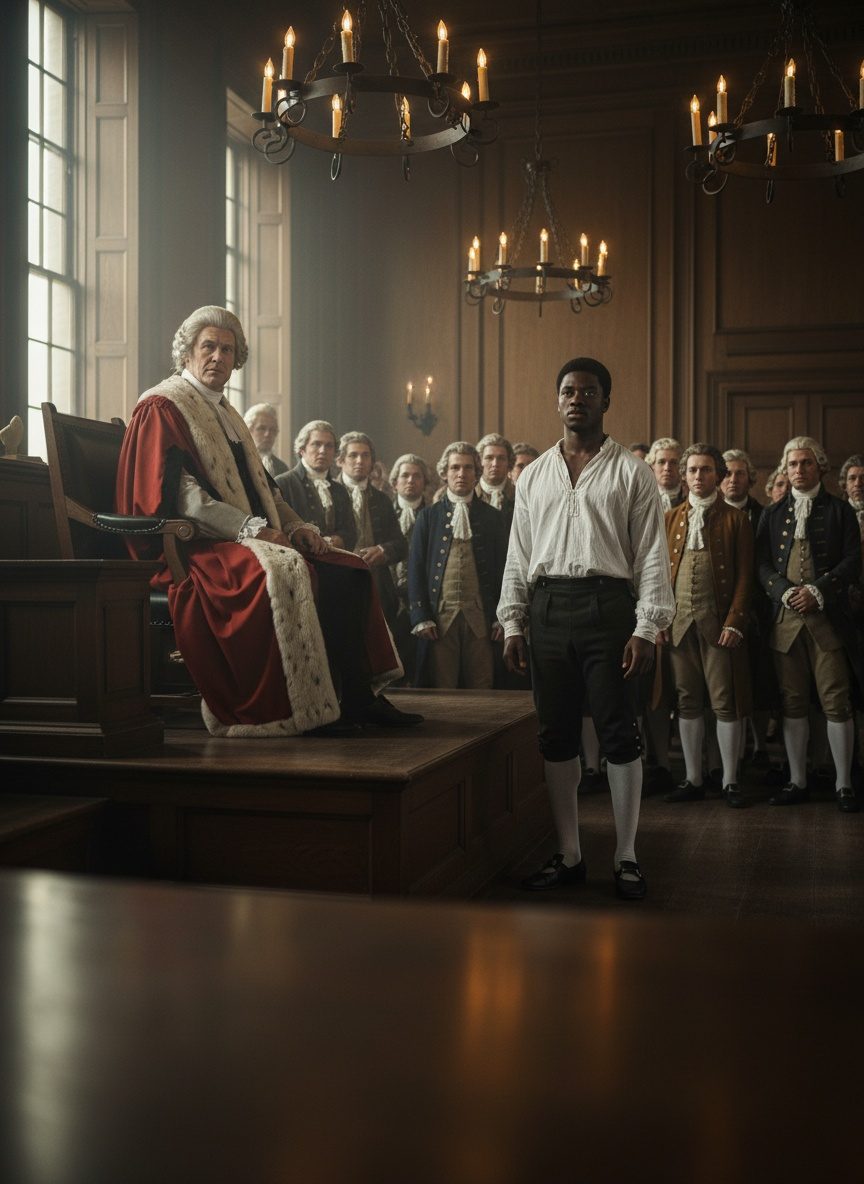
He was a man of the law, yet he was making history. Lord Mansfield had never intended to stir the very roots of British society—but here he was, changing the world with a sweeping declaration.
The Unlikely Catalyst
The case of James Somerset began much like countless others at the bustling epicenter of the British Empire—London, 1772. Somerset, an African man, had been brought to England upon escaping the shackles of his American owner, Charles Stewart. While residing on English soil, Somerset took a risk that was unthinkable for many enslaved individuals: he escaped. Captured shortly after, his fate seemed sealed, destined for a return to the notorious plantation hell. Yet, a constellation of advocates surrounded him, including Granville Sharp, a fervent abolitionist who had found his life's mission in challenging the abhorrent institution of slavery.
This conglomeration of legal minds, humanitarians, and Somerset himself converged in the courtroom of Lord Chief Justice Mansfield at Westminster Hall. The case, Somerset v. Stewart, was a legal battle poised to address not just the life of one man, but inevitably, the moral gravitas of a nation. It begged the question: Could a man, merely by stepping on English soil, be declared free from the chains that had once bound him?
The Courtroom Drama
As the proceedings unfolded, the courtroom buzzed with anticipation that many likened to the tension before a storm. Lord Mansfield, a respected yet pragmatic figure, was known for his judicious balance of law and equity. Peering over his spectacles, he listened intently as the arguments soared around him. On one side, Stewart's counsel argued for the sanctity of property—a man's rights to his assets, in this case, the human life of Somerset. Opposite them sat Somerset's defenders, wielding the powerful counter: no legal precedent existed in England for the ownership of one human by another.
Lord Mansfield understood the ramifications of his ruling. Overturning the tide of centuries-old practices could leverage Britain into unfamiliar territory—politically, socially, and economically. The courtroom itself seemed to hold its breath as he paused, considering the weight of his words. With a measured voice, Mansfield finally announced that slavery was a practice unsupported by common English law, and therefore, no enforcement of such claims would stand within British jurisdiction.
A Judgment Echoes Globally
The liberation of James Somerset was no mere personal victory; it sent reverberations across the Atlantic world. The ruling essentially implied that the very notion of slavery, while still legally upheld in Britain’s colonies, held no legitimate foundation in the mother country. Notably, this courtroom decision did not abolish slavery outright in the empire, but it planted seeds—seeds that would later grow into a mighty movement for emancipation not just within British borders, but throughout empires observing Britain’s influential stride.
International observers watched as Britain, the very architect of a sprawling empire built on commerce (much of it intertwined with the slave trade), began shifting the paradigm. Abolitionists across the world found new vigor in their cause, emboldened by the courage of a precedent that refused moral complicity. Passionate discourses erupted, both in salons and on the streets, as the implications of this ruling inspired calls for broader legal reforms in lands where the heartbeat of resistance echoed.
Why It Still Matters
Today, the legacy of the Somerset case serves as a pivotal moment in the narrative of human rights. It was not the rolling end of slavery as an institution—that battle required further struggles over decades—but it was a cornerstone, a formidable challenge to the idea that any person could remain intrinsically bound under law to servitude by virtue of geography or habit. This case urged a reconsideration of what statutory power ought to protect, rallying a cause against the stark realities of involuntary human subjugation.
The Somerset case teaches us that change is seldom abrupt. It is a culmination of enduring efforts, decisive actions, and moral clarity. It's a stark reminder that in places of entrenched injustice, a single judgment, echoing aloud in a quiet courtroom, can unshackle more than just legal bindings. It can unlock the horizons of human dignity worldwide, making history not simply an echo of battles lost or won, but a path forward—etched in the courage to disturb the unjust peace.