The Eighth Army had a simple task: cross the Po River. A task easier said than done.
The Bridge at Ferrara
April 1945, and the Italian front of World War II was reaching its chaotic crescendo. For the British Eighth Army, their immediate focus was on the mighty Po River at Ferrara, a pivotal location in Operation Grapeshot. The river, snaking its way across the northern Italian landscape, seemed more than just a geographical barrier; it was a gateway to the crumbling heart of Axis Italy. As the Eighth Army's advance units reached the riverbanks, expectations ran high. Victory felt possible, tangible even, yet crossing the Po was a logistical nightmare.
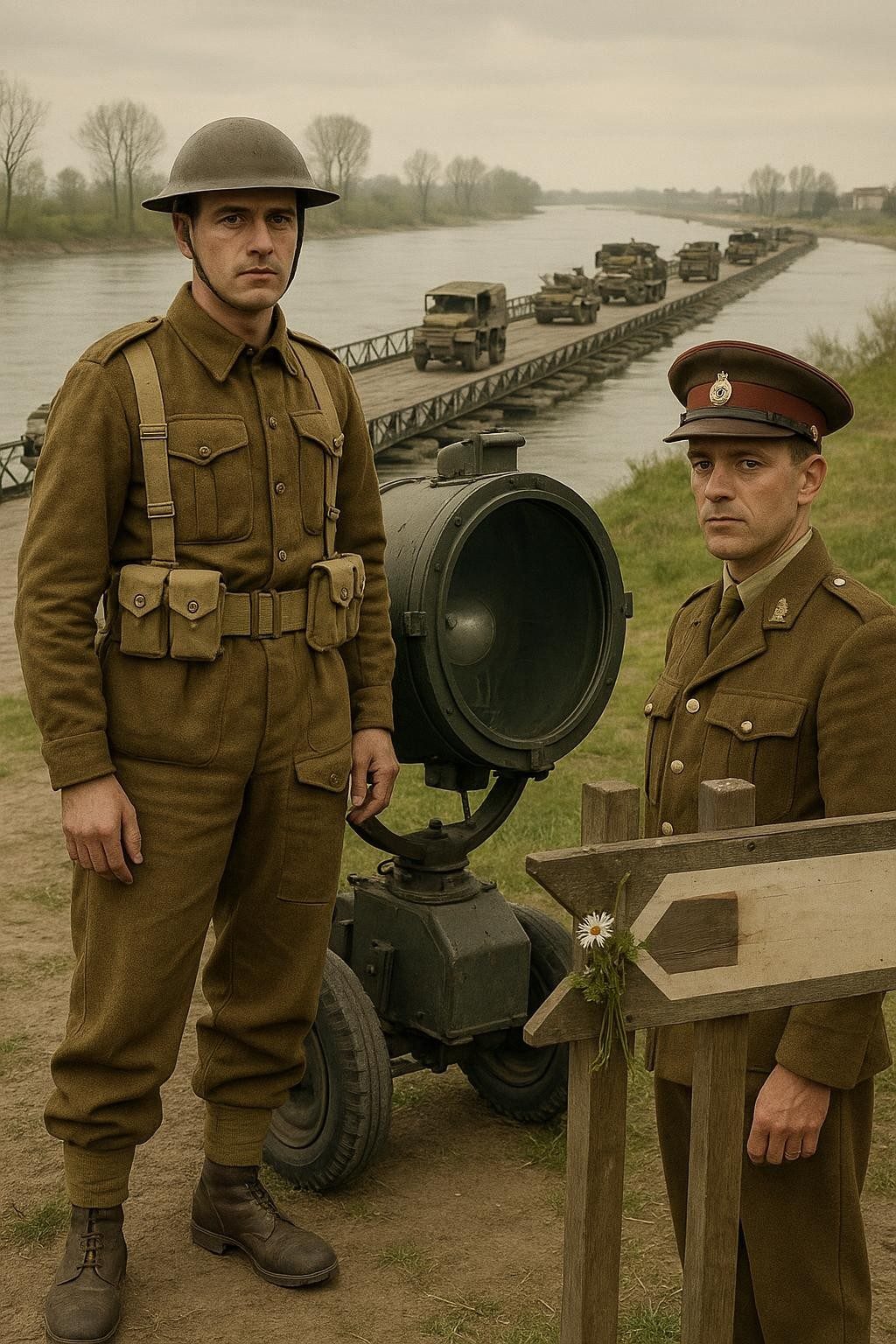
A single pontoon Bailey bridge spanned the rushing waters. Constructed hastily yet methodically by engineers under constant threat of enemy fire, it served as the crucial link in Allied plans. Here, at this narrow crossing, a lone military policeman became the gatekeeper to the north. With the backdrop of war’s thunderous symphony, his authority was signaled by a single sign — a testament to simple yet profound symbolism. Wrapped in flowers, this sign pointed in a direction that led straight into history.
The bridge crossing at Ferrara became more than just a military maneuver. It was a reflection of the rapid dissolution of German defensive lines. As the forces of the British Eighth Army began their steady flow across the pontoon, each soldier carried with him the weight of battles past and hopes for the peace that lay ahead. It was a poignant scene played against the rhythmic backdrop of marching feet and the strained hum of military vehicles inching forward into Axis territory, a visual symphony of war nearing its dissonant end.
The Relentless Advance
By late April, the impact of Operation Grapeshot was decisively felt. This final Allied offensive shattered German resolve, marking one of the conflict's last ebbs on European soil. Crossing the Po at Ferrara was more than just geographical progress — it signified a broader strategic collapse of the Axis in Italy. Soldiers of the Eighth Army, part of a coalition of British, Indian, New Zealand, and Polish units, were unified by a singular objective: to press northward with unwavering determination.
The narrative of their progress was punctuated not by large-scale battles but by relentless skirmishes against a retreating adversary. Each town and junction offered resistance stretched thinner by the hour. Yet, with every mile conquered, the Allied forces found themselves buoyed not just by military success but by the sight of liberated Italian towns and the grateful cheers of civilians long oppressed under Fascist rule.
Behind the initial units, the Royal Artillery's searchlight crews prepared to illuminate the night skies. Though designed to catch enemy aircraft in their beams, these lights now added an ethereal glow to the march northward, casting luminescent testimony to the drive and determination needed now more than ever. In this final push, speed became the currency for success, eclipsing even the power of firepower. Four tempestuous days filled the space between the crossing at Ferrara and the ultimate collapse of Mussolini's dream in Italy.
A Sign of Peace
The war in Italy would end four days after the crossing at Ferrara, but those days were suffused with tension and hope. For the men who had crossed the Po, the sight of that pontoon bridge, bedecked in floral tribute, lingered in memories like a poetic emblem of conquest against impossible odds. As Allies moved further north, the German lines faltered, unraveling in a series of surrenders, negotiation, and eventual capitulation. The human cost of these final hours was not insubstantial, as towns became unintentional fortresses and soldiers, uttering their last defiant words, succumbed to the inescapable tide of defeat.
And yet, scattered along paths trod by armored columns and infantry alike, the indelible marks of pathos painted this story's true face. The war's conclusion left questions echoing in the silence: What would recovery look like for a battered Europe? How were the chains of post-war rebuilding ready to be forged? The Eighth Army's journey was not merely a military triumph but a profound commentary on resilience, unity, and the inexorable march of history.
As those final hours counted down in Italy, history coalesced around moments like the crossing at Ferrara. Such stories persist, not just as accounts of military dates and victories, but as living reminders of courage etched into the landscapes of memory, bridging history and hope. Less about nations and more about people, these moments capture the universal yearning for peace that soldiers and civilians alike clung to amidst the fading vestiges of conflict.