He was only a lieutenant in the Frontier Constabulary, yet he was unwittingly to become an unlikely innovator on the battlefield. The man had never seen a cannon used this way before, but necessity breeds invention.
On the arid hills of the North-West Frontier in 1937, the Empire faced a unique and deadly challenge. This unforgiving landscape, now part of modern-day Pakistan, was dotted with tribesmen skilled in guerrilla warfare, who knew the territory's nooks and crannies like the backs of their weathered hands. Among these tribal warriors, the Waziri marksmen were particularly feared, their elite sharpshooters seemingly molded by the rugged terrain and haunting silence of the hills. They knew their cover well, striking from hidden positions with an accuracy that left British forces painstakingly vulnerable.
The standard-issue Lee-Enfield rifles of the British soldiers, while reliable in their own right, paled in comparison to the natural advantage held by their adversaries. Faced with such a predicament, the traditional line formations and strategies inherited from Victorian campaigns were becoming obsolete relics. In this distant corner of the British Empire, it was innovate or perish amid the dust storms and sunburnt ridges.
One officer, driven by desperation and daring, sought a solution not within the pages of military manuals, but among the litter of battle itself. The daring improvisation began with a crashed biplane, abandoned on the frontier expanse. This relic of the skies held an unlikely treasure: a “Vickers-S” cannon, typically mounted on fighter aircraft, or in this case, at the mercy of chance events strong enough to bring a warplane from its aerial domain crashing to earth.
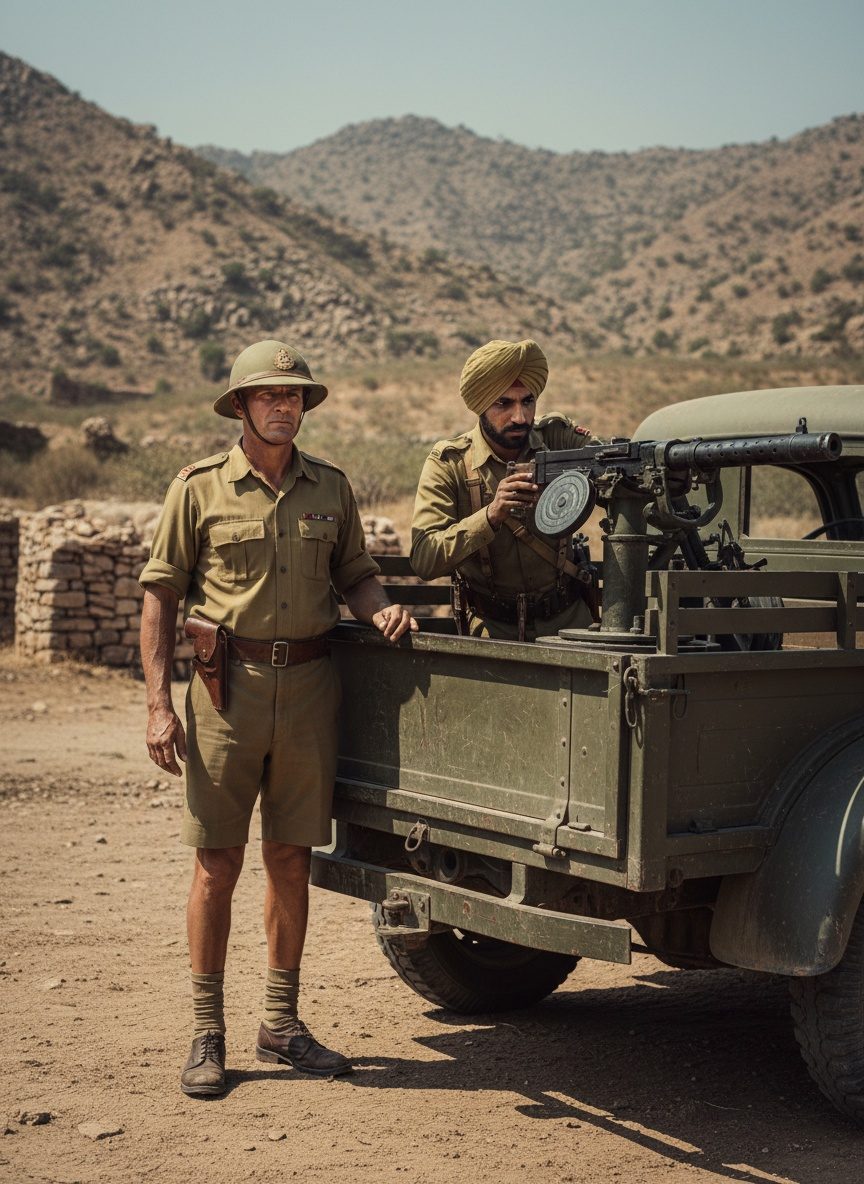
With the imaginative spark that necessity kindles, the officer envisioned a synthesis of air and land warfare. Not content to see the cannon reduced to scrap, the soldier envisioned it as the centerpiece of a transformed vehicle. Enlisting the aid of a hardworking mechanic, he meticulously unbolted the weapon from the carcass of the plane. Among clouds of welding smoke and the acrid scent of singed metal, a Ford truck was reborn as an instrument of exigency.
Seated in the open bed of this Ford gun-truck, the cannon was secured amidst laughs and skeptical murmurs from uneasy junior officers. This patchwork of innovation was an antithesis to the polished guns inherited from arsenals in faraway England. Yet within this unassuming project lay not only resourcefulness but a harbinger of the mechanized warfare that would defy conventions in years to come.
It wasn’t simply the altered vehicle that caught the imagination, but the resultant shift in tactics that redefined encounters with the Waziri. For when the gun-truck roared into action, belching smoke and the deep booms of its unorthodox armament, it did more than retaliate—it changed the tempo of warfare in the hills where the rifle was monarch. The vehicle roamed the dusty roadways with newfound reach and effectiveness, pursuing adversaries off unsuspecting ridges and precipices.
Such changes did not occur in a vacuum. Though the Frontier Constabulary faced daily struggles on the battlefield, the ramifications of these adaptations echoed in the hallways of colonial bureaucracy. News of this transformation pricked the ears of officials who saw the tactical gap between the Empire’s armed forces and the evolving methods of their far-flung adversaries. What was born of desperation in the frontier’s wildlands soon prompted serious reevaluation and discussions in the echelons of power, ultimately redefining how campaigns of supply and warfare might be conducted in difficult terrains.
The truck and cannon hybrid's success did not ensure triumph over the Waziri, nor did it alter the prevailing political undercurrents or the inevitable tensions that would reverberate through the empire. Still, for soldiers trapped in the constant see-saw of offensives and retreats, this mechanical oddity was a respite—a promise that ingenuity retained the power to turn tides, however fleetingly, in favor of hope over despair.
Today, the tale of that 1937 frontier policeman and his divergent cannon-vehicle carries a legacy of humility dressed in triumph’s colors. The persistent echoes of machine-gun fire ringing among Western lights and distant hills remind us that sometimes the pathway to victory hinges on incongruent marriages of ideology and metal, or cannons and trucks, at least. In the grand narrative that attempts to tell the saga of empires, these peculiar sagas highlight resilience hidden in the annals often left untold.
To revisit this story is not only to explore a uniquely inventive moment but to extend a hand backwards in history, towards countless individuals who, when faced with the specter of helplessness, dared to weld together hope and necessity. Their stories, rarely penned in textbooks, are whispers reverberating from dusty trails and forgotten hills, inviting curiosity, daring the conventional, and reminding us of the improvised battles fought at civilization's margins.